

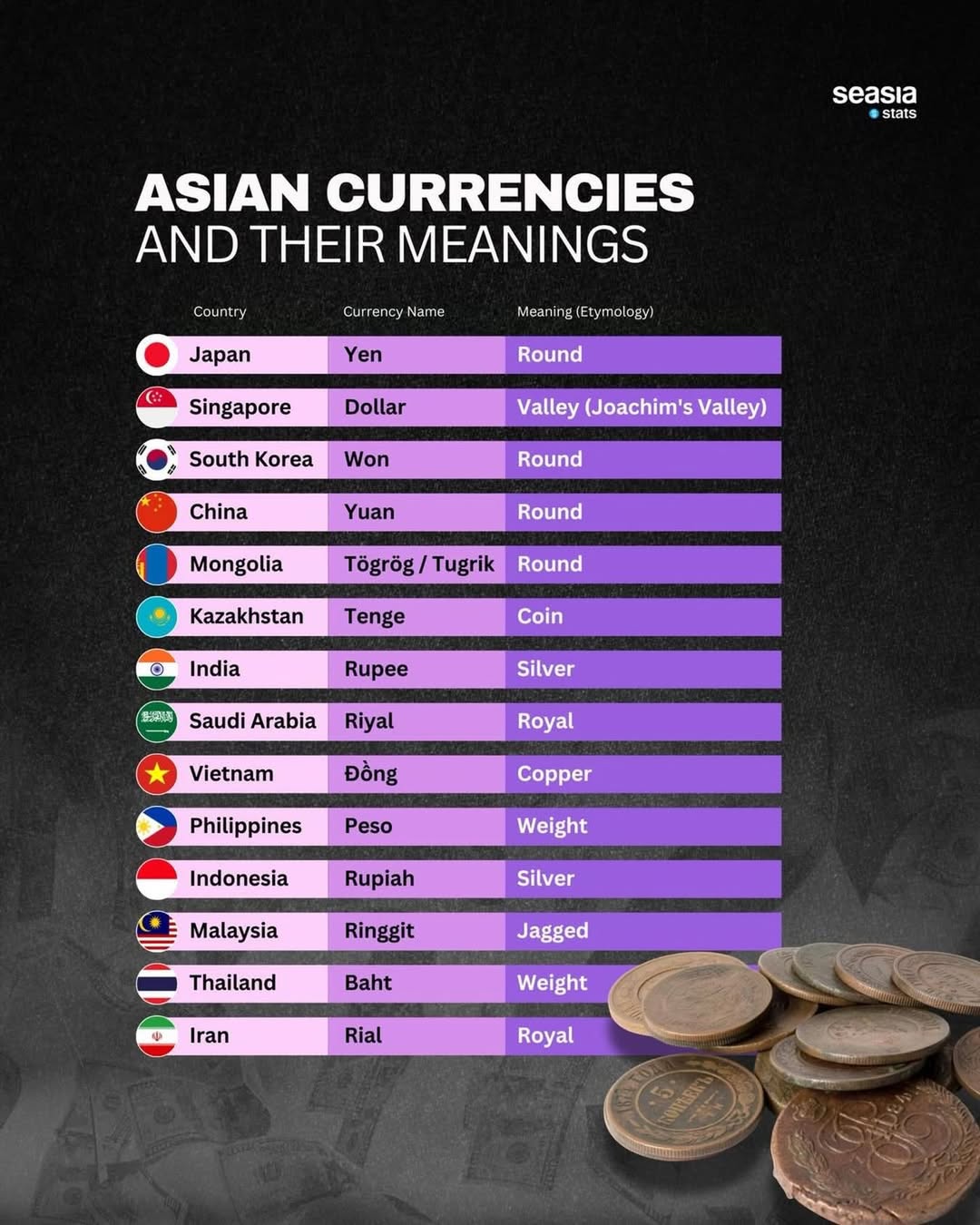
Asian currency names carry rich historical and linguistic traces of the region’s past economic systems. Across East Asia, a notable similarity emerges: several major currencies originate from a word meaning “round,” a reference to the shape of early metal coins. This common origin can be seen in the Japanese Yen, Chinese Yuan, South Korean Won, and Mongolian Tögrög, reflecting a shared monetary tradition.
Beyond coin shape, many currency names are closely linked to the physical value of metals or standardized measurements. The Indian Rupee and Indonesian Rupiah both mean “silver,” highlighting the importance of silver in early trade and minting practices. Vietnam’s Đồng, which translates to “copper,” also reflects the material basis of its historical currency. Meanwhile, the Philippine Peso and Thai Baht derive from terms meaning “weight,” emphasizing their origins as units of measurement rather than abstract value.
Other currencies in Asia stand out for their distinct or symbolic meanings. Malaysia’s Ringgit, meaning “jagged,” refers to the serrated edges of old Spanish coins used in the region. Singapore’s Dollar has an unexpected origin linked to the word “valley,” while in the Middle East, the Saudi Riyal and Iranian Rial both stem from a term meaning “royal,” underscoring the connection between currency and sovereignty.


