

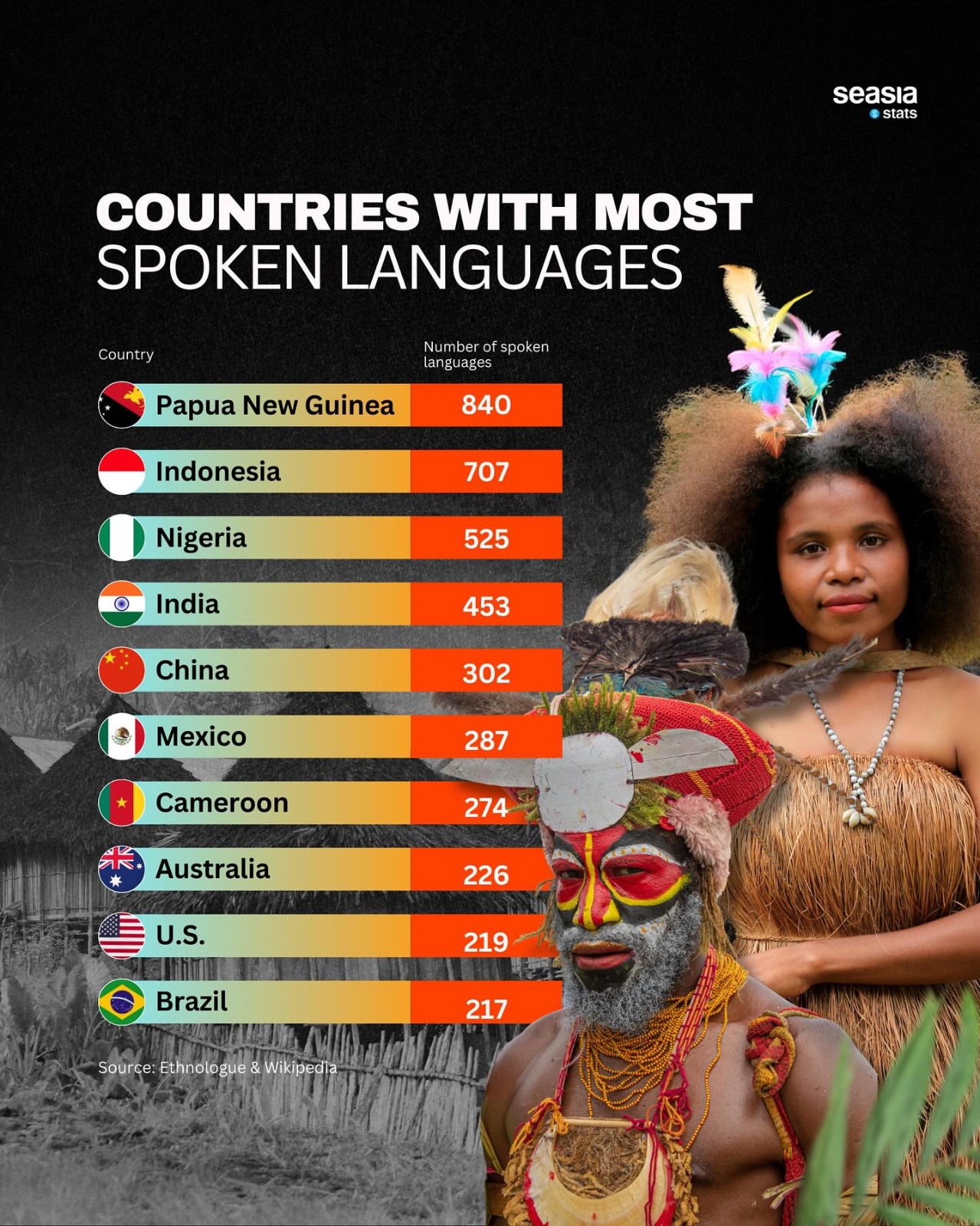
Language is one of humanity’s richest cultural treasures—and nowhere is that more visible than in the world’s most linguistically diverse nations. From the dense highlands of Papua New Guinea to the vast archipelagos of Southeast Asia, language diversity reflects centuries of migration, isolation, trade, and cultural exchange. New data from Ethnologue and Wikipedia in early 2026 reveals just how varied the global linguistic landscape truly is.
A World of 7,000 Voices
Globally, there are around 7,000 living languages, but they are not evenly distributed. A handful of countries hold the majority of these languages, often due to geographic complexity or deep-rooted cultural diversity. Papua New Guinea stands at the top with about 840 languages—more than any other nation in the world. Its mountainous terrain and isolated communities allowed languages to evolve independently over millennia, creating a mosaic of distinct linguistic identities.
Close behind is Indonesia, the most linguistically diverse country in Southeast Asia, with roughly 707 languages spoken across thousands of islands. Nigeria ranks third globally with 525 languages, while India follows with 453—each reflecting their status as major multicultural societies shaped by long histories of trade, migration, and empire.
Southeast Asia: A Linguistic Treasure Trove
Southeast Asia is one of the most linguistically rich regions on Earth, with Indonesia leading the way. The country’s national language, Bahasa Indonesia, serves as a unifying medium, yet hundreds of local languages—from Javanese to Sundanese and Papuan languages—remain widely spoken and culturally significant.
Beyond Indonesia, the region hosts remarkable linguistic diversity. The Philippines is home to more than 180 languages, including Cebuano, Ilocano, and Waray, alongside Filipino and English as official languages. Malaysia features a multilingual society where Malay, Chinese dialects, Tamil, and indigenous languages coexist. In Myanmar, over 100 languages are spoken among various ethnic groups such as the Shan, Karen, and Chin peoples.
Vietnam and Thailand also contribute to the region’s linguistic richness, with dozens of minority languages spoken in mountainous regions, even as Vietnamese and Thai dominate nationally. Smaller nations like Laos and Cambodia similarly maintain numerous ethnic languages tied to indigenous traditions. This diversity highlights how Southeast Asia’s geography—ranging from islands to highlands—has shaped linguistic evolution for centuries.
The Global Top Ten
Outside Southeast Asia, linguistic diversity is spread across continents. China has around 302 languages, Mexico 287, and Cameroon 274, each reflecting deep indigenous heritage. Australia, with 226 languages, and the United States with 219, demonstrate how migration and indigenous cultures contribute to linguistic variety even in highly globalized societies. Brazil rounds out the top ten with 217 languages, many rooted in Amazonian indigenous communities.
Despite dominant national languages such as English, Mandarin, or Spanish, these countries preserve hundreds of regional and indigenous tongues, often tied to unique cultural identities and knowledge systems.
Preserving Languages in a Globalized World
While linguistic diversity is a source of cultural richness, many languages today face the threat of extinction. Globalization, urbanization, and the dominance of major world languages have caused younger generations to shift away from traditional tongues. UNESCO estimates that nearly half of the world’s languages could disappear within this century without preservation efforts.
In Southeast Asia, initiatives to teach local languages in schools and document oral traditions are helping protect this heritage. Indonesia, for example, promotes regional language education alongside its national language, while the Philippines supports multilingual education in early schooling.
More Than Words
Languages are more than tools for communication—they carry history, identity, and worldview. From Papua New Guinea’s unparalleled diversity to Southeast Asia’s rich linguistic tapestry, the global map of languages tells a story of humanity itself. Preserving this diversity is not just about saving words, but about safeguarding the cultures and communities that give them life.


