

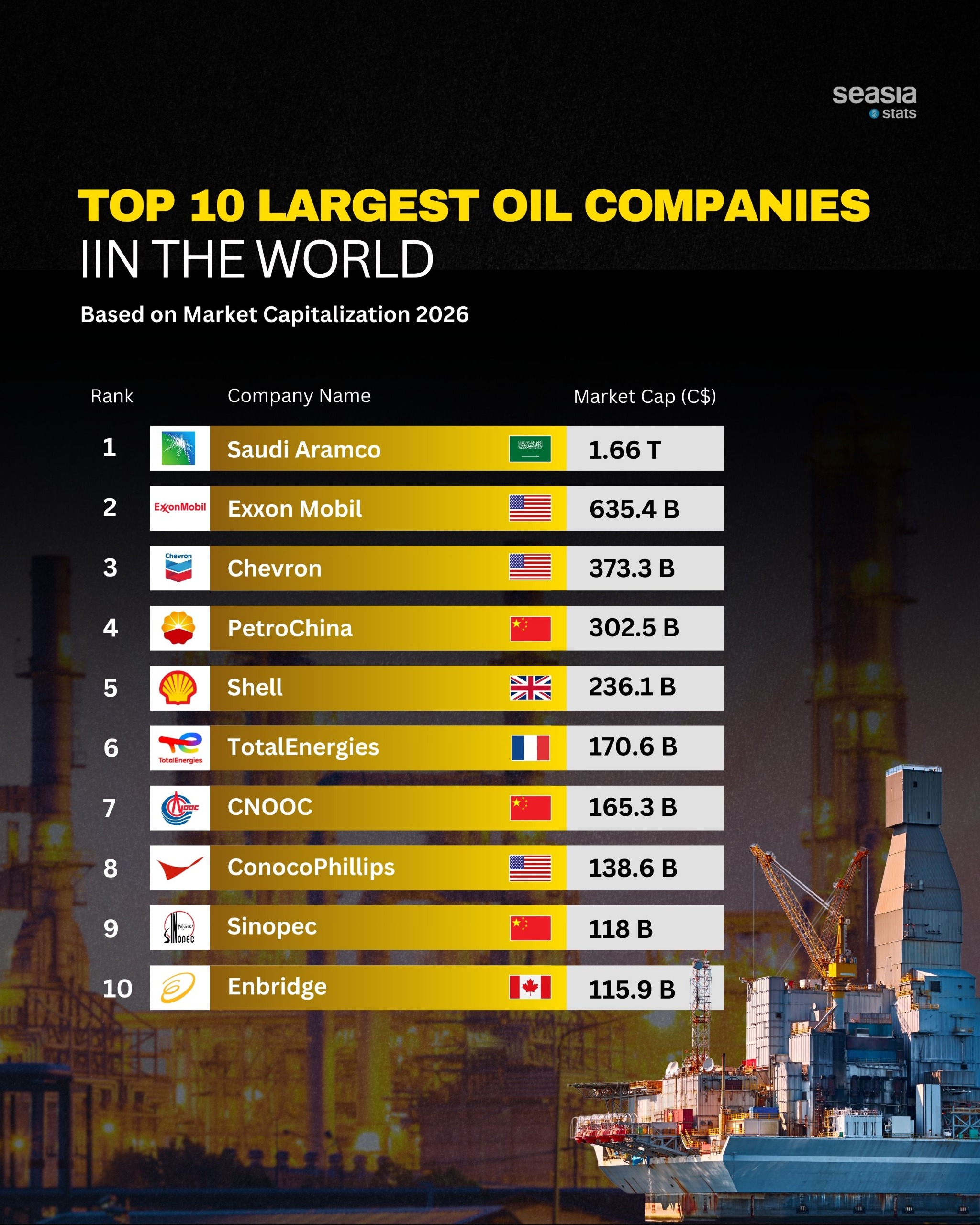
Global energy markets continue to be shaped by a handful of powerful corporations whose operations span continents and influence everything from fuel prices to geopolitical dynamics. Despite the growing global push toward renewable energy, oil and gas companies remain among the most valuable enterprises in the world. Market capitalization rankings in 2026 highlight the immense financial scale and strategic importance of these companies, which dominate the global fossil fuel industry and maintain deep influence over international energy supply chains.
Saudi Aramco’s Unmatched Dominance
At the very top of the global oil industry stands Saudi Aramco, the state-owned energy giant of Saudi Arabia. With a market capitalization of approximately $1.66 trillion CAD, Aramco remains by far the most valuable oil company in the world. Its valuation exceeds that of its closest competitor by more than double, demonstrating the extraordinary scale of its operations.
Saudi Aramco’s dominance is rooted in Saudi Arabia’s vast petroleum reserves, some of the largest and most cost-efficient to extract anywhere on Earth. The company controls massive production capacity, global refining operations, and extensive export infrastructure. As a result, it plays a central role in global energy markets and remains one of the most influential corporate actors in the world economy.
American Energy Giants Maintain Strong Presence
Following Aramco, the United States maintains a strong foothold in the upper ranks of the global oil industry. Exxon Mobil holds the second position with a market capitalization of $635.4 billion CAD, reflecting its continued role as one of the world’s most powerful multinational energy corporations.
Exxon Mobil’s global operations include oil exploration, production, refining, petrochemicals, and distribution across numerous regions. Its technological capabilities and global reach have long positioned it as a leader among international oil majors.
Another American heavyweight, Chevron, ranks third with a valuation of $373.3 billion CAD. Chevron’s portfolio spans upstream oil extraction, liquefied natural gas projects, and downstream fuel distribution networks across multiple continents.
Together, these American companies form a major pillar of the global energy system, supplying fuel and petrochemical products to markets worldwide.
European and Chinese Energy Powerhouses
Beyond the American supermajors, the middle tier of the global rankings reflects a mix of European and Chinese energy companies that command substantial market value and operational scale.
China’s PetroChina ranks fourth globally with a market capitalization of $302.5 billion CAD, reflecting China’s enormous domestic energy demand and the company’s vast upstream and downstream operations.
European energy leaders also hold significant positions. Shell, headquartered in the United Kingdom, ranks fifth with a valuation of $236.1 billion CAD. The company has long been one of the most internationally diversified energy firms, operating in oil, natural gas, petrochemicals, and increasingly renewable energy sectors.
France’s TotalEnergies follows closely in sixth place at $170.6 billion CAD. In recent years, TotalEnergies has pursued an aggressive strategy of expanding into renewable energy, positioning itself as a major participant in the global energy transition while maintaining strong oil and gas production.
The Remaining Global Energy Heavyweights
The lower half of the top ten continues to illustrate the influence of both Chinese and North American companies in shaping the global oil industry.
China’s CNOOC ranks seventh with a market capitalization of $165.3 billion CAD, reflecting its importance as a major offshore oil producer. In eighth place is ConocoPhillips, another American energy company valued at $138.6 billion CAD, known for its extensive exploration and production activities.
China’s Sinopec occupies the ninth spot with a market value of $118 billion CAD, playing a crucial role in refining and petrochemical production within the Chinese economy.
Finally, Enbridge of Canada rounds out the top ten with a market capitalization of $115.9 billion CAD. Unlike many companies on the list, Enbridge focuses primarily on energy transportation infrastructure, operating one of the largest pipeline networks in North America.
Southeast Asia’s Role in the Global Energy Network
While none of Southeast Asia’s oil companies appear among the global top ten by market capitalization, the region remains deeply integrated into the global energy landscape. Countries such as Indonesia, Malaysia, Thailand, and Vietnam are important producers, refiners, and consumers of petroleum products.
Indonesia’s Pertamina and Malaysia’s Petronas are particularly influential state-owned energy companies that play key roles in regional energy supply. Petronas, for instance, operates internationally across liquefied natural gas markets and offshore exploration projects.
As Southeast Asia’s economies continue to grow, energy demand across the region is expected to rise significantly. This will ensure that global oil companies—alongside regional energy firms—remain closely tied to Southeast Asia’s economic development and infrastructure expansion in the years ahead.


