

Energy security has become one of the most critical strategic priorities for nations around the world. As global demand for fuel continues to grow and geopolitical tensions periodically disrupt supply chains, countries are increasingly focused on building strategic petroleum reserves (SPR) that can cushion their economies during supply shocks. These reserves are essentially emergency stockpiles designed to keep economies running if imports are disrupted.
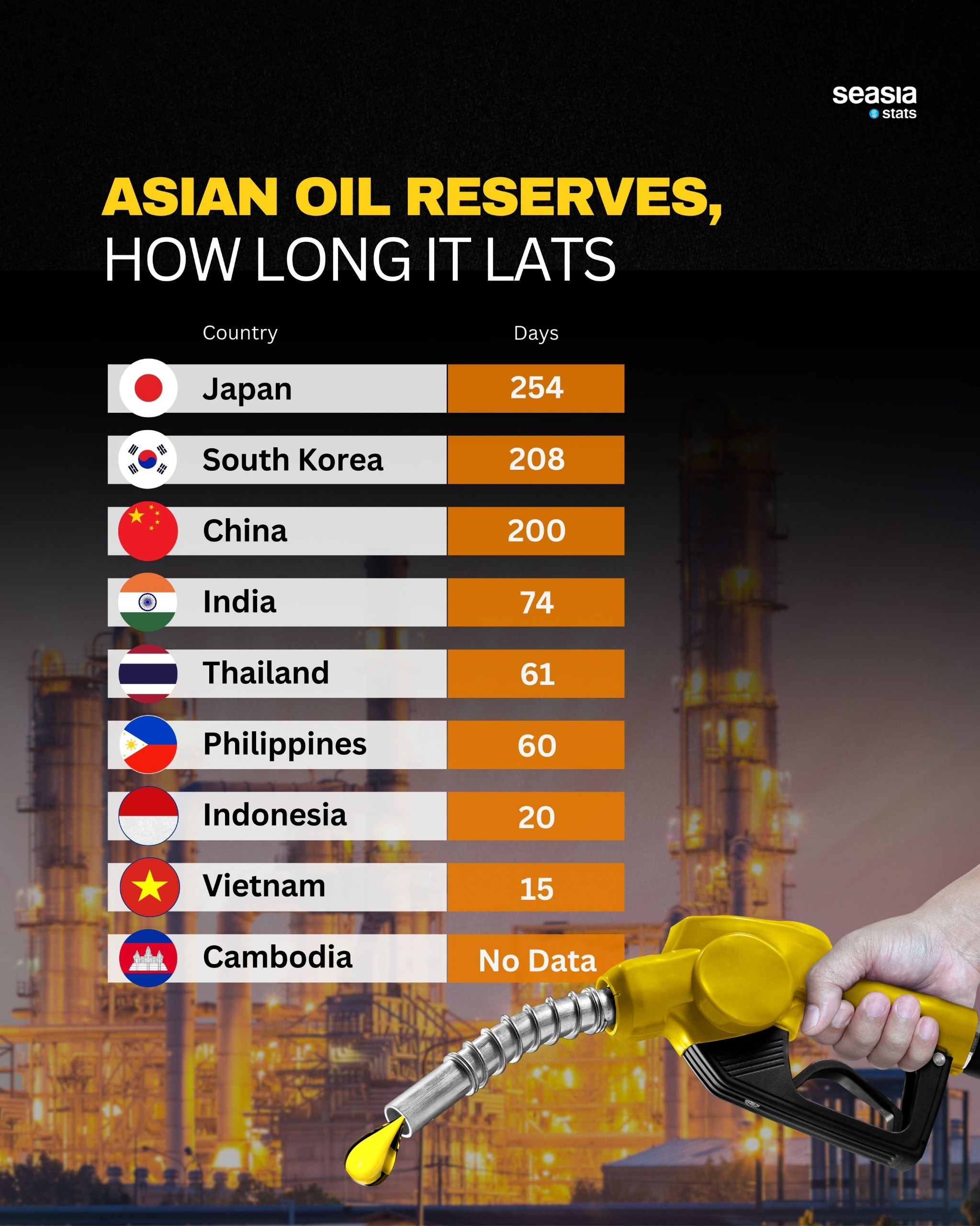
An infographic highlighted by Seasia Stats illustrates how long oil reserves could last in several Asian countries if supply lines were suddenly cut off. The data reveals significant differences across the region, particularly between highly industrialized East Asian economies and many developing Southeast Asian nations.
East Asia Leads in Strategic Oil Stockpiles
At the top of the list is Japan, which maintains the largest oil reserve buffer relative to its consumption. According to the data, Japan’s reserves could last approximately 254 days without new imports. This impressive stockpile reflects decades of strategic planning following the oil crises of the 1970s, which exposed Japan’s vulnerability to energy disruptions.
Japan’s approach has been to build extensive strategic petroleum reserves managed by both government and private companies. These reserves are stored in underground facilities, coastal storage tanks, and offshore sites across the country.
Following Japan is South Korea, whose oil reserves could sustain the country for about 208 days. South Korea, like Japan, relies heavily on imported energy, making strategic reserves essential to national economic stability.
China ranks third, with reserves estimated to last around 200 days. As the world’s largest energy consumer and one of the largest oil importers, China has been steadily expanding its strategic petroleum reserves over the past two decades as part of its broader energy security strategy.
A Sharp Drop in the Middle Tier
After the top three nations, the number of days that reserves can sustain national consumption drops significantly.
India, one of the fastest-growing economies in the world, has reserves that would last about 74 days. While India has been investing in expanding its strategic petroleum storage infrastructure, its massive population and rapidly growing energy demand place constant pressure on its reserves.
In Southeast Asia, Thailand and the Philippines hold similar levels of energy security, with reserves estimated to last 61 days and 60 days, respectively. Both countries are major energy importers and have been exploring ways to strengthen their strategic reserves while also investing in renewable energy and domestic resource development.
Southeast Asia’s Energy Vulnerability
The data also highlights the relatively limited oil buffers in some Southeast Asian nations.
Indonesia, Southeast Asia’s largest economy, is estimated to have reserves that would last only around 20 days under current consumption levels. This relatively small buffer reflects the country’s transition from being a historical oil exporter to becoming a net importer in recent decades.
Vietnam faces an even tighter margin, with oil reserves estimated to last approximately 15 days. However, Vietnam has been actively exploring offshore oil and gas resources in the South China Sea while also increasing investments in renewable energy and LNG infrastructure.
Meanwhile, Cambodia appears in the ranking without available data on reserve duration, reflecting the limited transparency and development of strategic petroleum storage within the country.
The Growing Importance of Energy Security
These differences highlight the broader energy resilience gap across Asia. Wealthier and highly industrialized economies like Japan, South Korea, and China have invested heavily in strategic reserves to protect themselves from supply disruptions.
In contrast, many Southeast Asian countries remain more vulnerable to fluctuations in global energy markets. However, governments across the region are increasingly prioritizing energy diversification—investing in renewable energy, natural gas infrastructure, and regional energy cooperation.
As Asia continues to power global economic growth, energy security will remain a key strategic challenge. Building stronger reserves and diversifying energy sources will be essential for ensuring long-term stability in the region’s rapidly expanding economies.


