

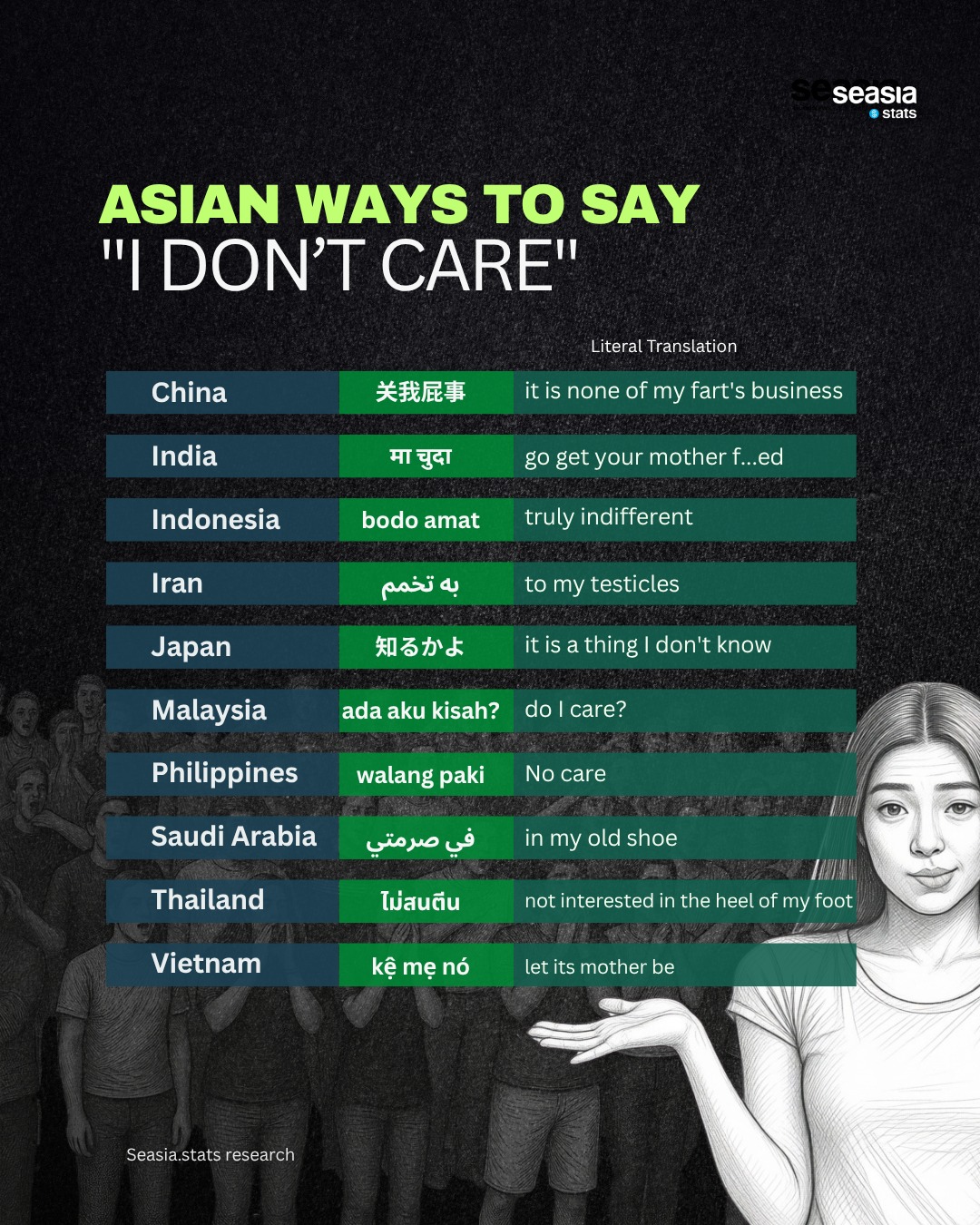
Across Asia, saying “I don’t care” is rarely just about indifference. More often, it becomes a miniature cultural performance—sarcastic, funny, sharp, and deeply local. A simple dismissal in one language can turn into a shoe, a body part, a family reference, or a rhetorical shrug in another. And in that variety lies something fascinating: the way everyday frustration gets transformed into metaphor.
When indifference gets colorful
The Seasia Stats compilation reveals just how inventive Asian languages can be when expressing apathy. In some places, indifference is blunt and earthy. In China, one colloquial expression is rendered as “it is none of my fart’s business,” a phrase that turns bodily humor into a clear message of total disinterest. Iran’s expression is even more direct, while Thailand’s version uses the heel of the foot to communicate that something is beneath concern—literally and symbolically.
These phrases may sound shocking when translated word for word, but that is exactly the point. Literal translations often strip away tone and context while exposing the vivid imagery beneath ordinary speech. What sounds extreme in English may function as casual slang, comic exaggeration, or a social signal among friends in its original language.
Southeast Asia’s wonderfully expressive shrug
Southeast Asia is especially rich in these kinds of expressions. In Indonesia, “bodo amat” has become one of the most recognizable modern slang phrases for not caring. It is short, punchy, and deeply embedded in youth culture, often used online, in conversation, and even in memes. In Malaysia, “ada aku kisah?” takes a more rhetorical route—“do I care?”—with the answer already implied in the tone.
The Philippines offers perhaps the most straightforward version with “walang paki,” which simply means “no care.” Yet even in its simplicity, it carries emotional texture depending on how it is said: dismissive, playful, irritated, or detached. Vietnam, meanwhile, turns indifference into a family-inflected expression—“let its mother be”—a phrase that sounds almost absurd in literal English but feels naturally emphatic in colloquial use.
This is where Southeast Asian language culture becomes especially interesting. Across Indonesia, Malaysia, the Philippines, Thailand, and Vietnam, slang often works through humor, compression, and social familiarity. People do not just reject a topic—they do it with style.
What language says about attitude
These expressions also reveal something deeper than vocabulary. They show how cultures manage emotional distance. Some societies prefer direct confrontation; others prefer coded detachment. Japan’s phrase, translated roughly as “it is a thing I don’t know,” is less explosive than its regional counterparts, but no less effective. It reflects a more indirect mode of disengagement—one that distances the speaker without escalating conflict.
That difference matters. Linguists have long noted that colloquial expressions often tell us more about a society’s emotional habits than formal language ever could. As BBC Language has observed in broader discussions on idioms and translation, literal meanings often “miss the social temperature” of a phrase. In other words, what matters is not just what is said, but how a culture permits people to say it.
More than slang, more than sarcasm
At first glance, these phrases are just funny translations. But they are also windows into how ordinary people navigate annoyance, boredom, and social boundaries. They remind us that indifference is never expressed neutrally; it is shaped by culture, humor, and habit.
From Indonesia’s “bodo amat” to Malaysia’s “ada aku kisah?”, from Thailand’s heel-of-the-foot dismissal to Vietnam’s unforgettable “let its mother be,” Asia proves that even not caring can be said with remarkable creativity. In the end, these expressions are not just about apathy. They are about personality—and every language seems to have its own way of rolling its eyes.


