

Economic rankings always attract attention, but few are as seductive—or as misleading at first glance—as the list of the world’s richest countries. On paper, the 2026 leaderboard looks dazzling: tiny states, financial hubs, energy exporters, and ultra-efficient trade economies dominating the top. Yet behind the headline numbers lies a deeper story about scale, specialization, and why Southeast Asia’s place on this list says more than it might seem.
Why the richest countries are often the smallest
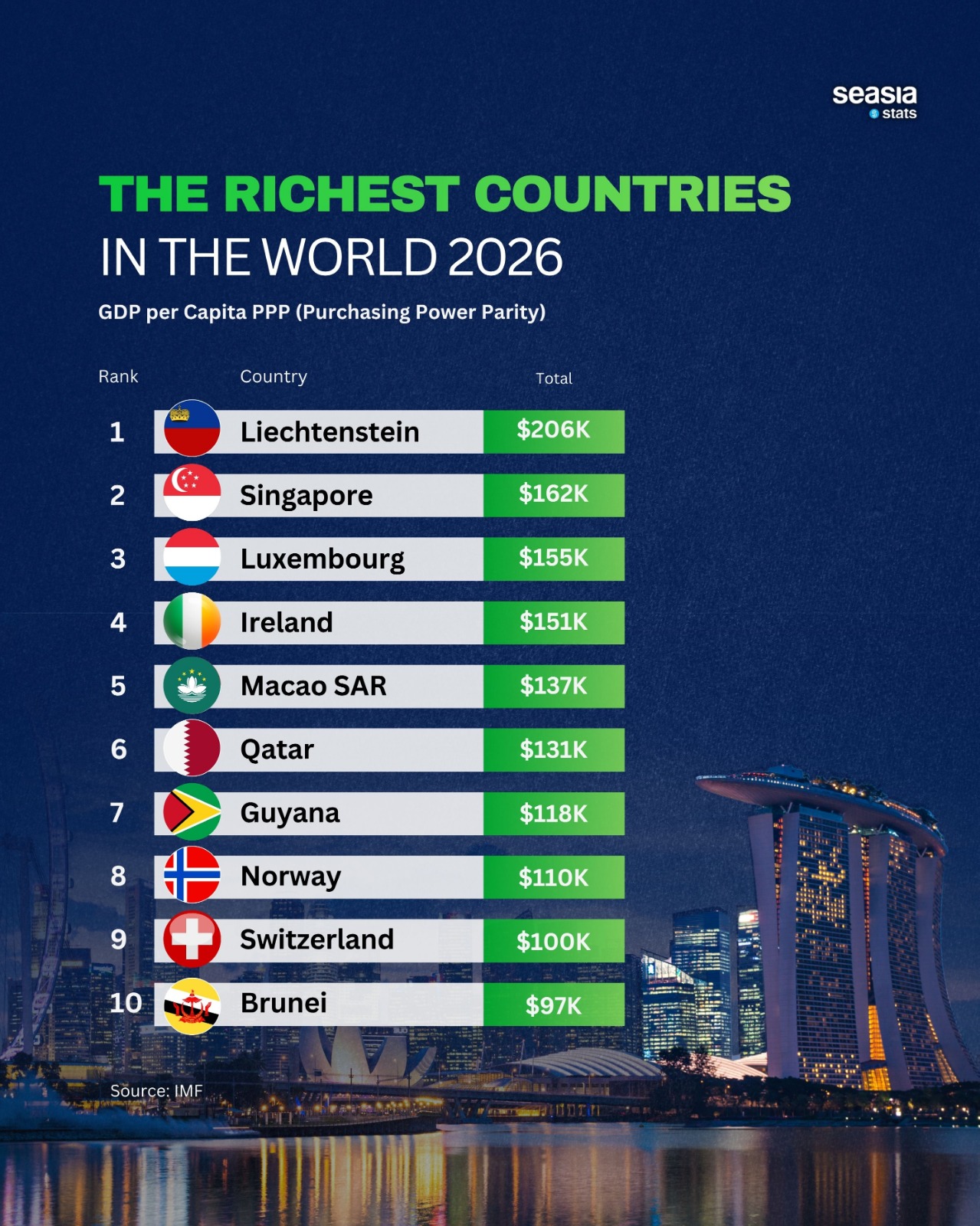
According to IMF-based 2026 GDP per capita (PPP) projections, Liechtenstein leads the world at roughly $206,000, followed by Singapore at about $161,500 and Luxembourg at around $155,300. Ireland and Macao SAR complete the top five, while Qatar, Guyana, Norway, Switzerland, and Brunei also make the global top tier. Brunei sits just outside the top ten in many IMF-based compilations at roughly $97,400, even though it is often rounded into the top ten in infographic summaries.
These are not countries that became rich simply by being “better” at everything. Most are highly specialized. Liechtenstein and Luxembourg punch above their weight through finance, advanced industry, and niche services. Singapore thrives as a trade, logistics, finance, and technology hub. Qatar and Brunei benefit from hydrocarbon wealth. Macao SAR’s economy has long been shaped by tourism and gaming.
That is the first lesson of this ranking: per-capita wealth is often less about national size and more about economic concentration.
Singapore’s success is Southeast Asia’s clearest benchmark
For Southeast Asia, the standout story is obvious. Singapore, ranked second in the world, remains the region’s undisputed outlier. It is not just wealthy by ASEAN standards; it is wealthy by any standard on Earth. That success has come from an extraordinary combination of strategic geography, state capacity, global capital, and relentless upgrading into higher-value sectors.
But Singapore’s place on the list also highlights a broader truth about Southeast Asia: the region is increasingly important to the global economy, yet only a handful of its economies have converted that importance into very high per-capita prosperity.
Brunei is the other Southeast Asian economy in the global elite. Its inclusion reflects the enduring power of natural-resource wealth, though it also raises familiar questions about diversification and long-term resilience in a world gradually shifting away from fossil fuel dependence.
ASEAN’s real story is not only about riches—but catch-up
Beyond Singapore and Brunei, the rest of Southeast Asia sits much lower in PPP-per-capita rankings, but that does not necessarily mean failure. In fact, countries like Malaysia, Thailand, Vietnam, Indonesia, and the Philippines are often more interesting from a development perspective precisely because they are still climbing.
Malaysia, for example, remains one of Asia’s stronger upper-middle-income performers, with IMF-based PPP per capita above $45,000 in 2026—well ahead of much of the developing world. Thailand continues to benefit from a more mature industrial base, while Vietnam and Indonesia are increasingly seen as the region’s major long-term growth stories. IMF-based Asia rankings place Malaysia, Thailand, Vietnam, and Indonesia well below Singapore and Brunei, but still within a rapidly expanding middle tier of Asian economies.
This is where GDP per capita (PPP) becomes useful—but only if read carefully. It measures average output adjusted for cost of living, not the lived experience of every citizen. A country can post a strong PPP figure while still grappling with inequality, housing pressure, wage gaps, or regional disparities. Rich on paper does not always mean comfortable in practice.
PPP explains more than nominal GDP ever could
That is why economists often prefer purchasing power parity for cross-country comparisons. The World Bank’s International Comparison Program explains that PPP is designed to account for price-level differences between economies, making comparisons more meaningful than raw exchange-rate-based GDP alone. In other words, a dollar-equivalent in one country does not buy the same life as a dollar-equivalent in another.
This matters especially in Southeast Asia, where cost structures vary dramatically. A middle-income household in Kuala Lumpur, Bangkok, or Ho Chi Minh City may enjoy a materially better lifestyle than a simple nominal GDP figure would suggest. That is precisely why PPP-based rankings remain influential: they tell us more about economic capacity inside an economy, not just how rich it looks from abroad.
The bigger question is who rises next
The most interesting part of these rankings may not be who is already rich, but who is moving toward the next tier. Guyana’s rapid rise, powered by energy, shows how quickly a country can leap in per-capita terms under the right conditions. Southeast Asia has its own versions of that question.
Can Vietnam move from factory-floor success to higher-income innovation? Can Indonesia translate scale into prosperity per person? Can Malaysia break decisively into advanced-economy territory? Can the Philippines convert demographics and services into stronger productivity gains?
Singapore and Brunei may already be in the club. But the future story of wealth in Southeast Asia will be written by the countries still trying to get there.
And that may be the more important race.


