

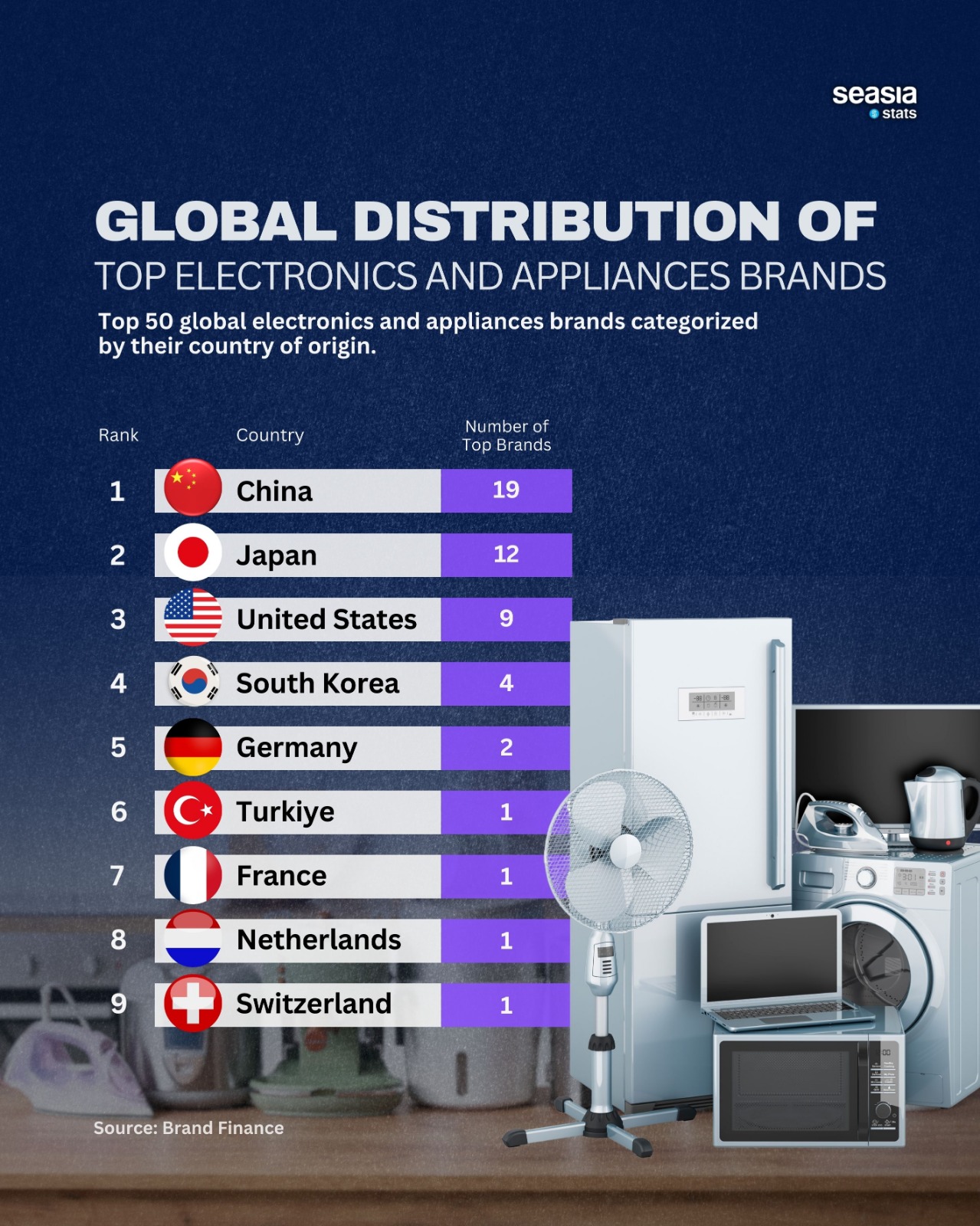
The map of global electronics and appliance brands is no longer just a story about who manufactures the world’s gadgets. It is increasingly about who owns the names, the ecosystems, and the consumer loyalty behind them. The latest Seasia Stats graphic, based on Brand Finance data, shows a striking concentration of power in East Asia—with China far ahead, Japan firmly entrenched, and South Korea still punching above its weight.
China’s leap from factory floor to brand powerhouse
China leads the ranking with 19 of the world’s top 50 electronics and appliances brands, far ahead of every other country. That dominance says something important about how the global consumer tech industry has changed. China is no longer simply where the world’s electronics are assembled. It is now where many of the world’s most recognizable consumer brands are designed, scaled, and exported.
That shift has been building for years. Chinese firms have moved from cost-based competition into premium product categories, smart-home ecosystems, connected devices, and electric mobility. Brand Finance noted in 2025 that Chinese technology brands collectively represented a major share of global brand value, with several Chinese names now among the strongest tech brands in the world. As one Brand Finance release put it, “Four of the world’s top 10 strongest technology brands” now come from China.
In practical terms, that means the average household appliance or electronics purchase is no longer just a hardware choice. It is a bet on software, cloud integration, after-sales service, and long-term brand trust. China has become increasingly competitive in all four.
Japan and the enduring power of reliability
Japan, with 12 brands in the global top 50, remains one of the most respected names in the industry. While China has gained scale and speed, Japan still commands a particular kind of authority: durability, engineering precision, and consumer confidence built over decades.
That matters in categories like televisions, audio equipment, cameras, kitchen appliances, and home comfort systems, where reputation is often earned slowly and lost quickly. Japanese brands continue to benefit from a global perception that they are dependable, refined, and built to last.
The United States, ranked third with nine brands, remains influential through software-linked consumer ecosystems, premium electronics, and household appliance giants. But the center of gravity in this industry is unmistakably Asian.
Southeast Asia: not yet a brand giant, but impossible to ignore
What makes this ranking especially interesting for Southeast Asia is not who appears on it, but who mostly does not. No Southeast Asian country makes the top country list by brand count. And yet the region is deeply embedded in the industry’s supply chains, labor systems, and export machinery.
That gap tells an important story. Southeast Asia has become essential to how electronics are made, tested, packaged, and shipped—but not yet central to who owns the biggest consumer-facing brands.
Still, that may be changing. The Philippines remains one of the region’s strongest electronics export hubs, especially in semiconductors and components. Industry projections reported this year suggest Philippine semiconductor and electronics exports could reach a record US$50 billion in 2026, underlining the sector’s growing strategic importance.
Malaysia also continues to strengthen its position in higher-value electronics and chip packaging. Reuters reported that Intel announced an additional investment in Malaysia, reinforcing the country’s role in assembly and testing operations. That kind of investment matters because branding power often follows manufacturing sophistication.
Thailand and Vietnam, meanwhile, are becoming increasingly important as companies diversify supply chains beyond China. That does not automatically create homegrown global brands—but it does build the industrial base, talent pool, and supplier ecosystem from which future brands can emerge.
The next battle is not just production, but identity
This is the deeper takeaway from the ranking: in electronics and appliances, manufacturing strength alone is no longer enough. Countries that want to move up the value chain must eventually build not just factories, but names people trust.
For Southeast Asia, that is the next frontier. The region already has the labor, logistics, and strategic geography. What it needs now is more indigenous brand ambition—companies that do not just produce for the world, but sell to it under their own banner.
In the coming decade, the real competition may not be over who makes the most devices, but over who becomes the brand sitting in the world’s kitchens, living rooms, and pockets.


