

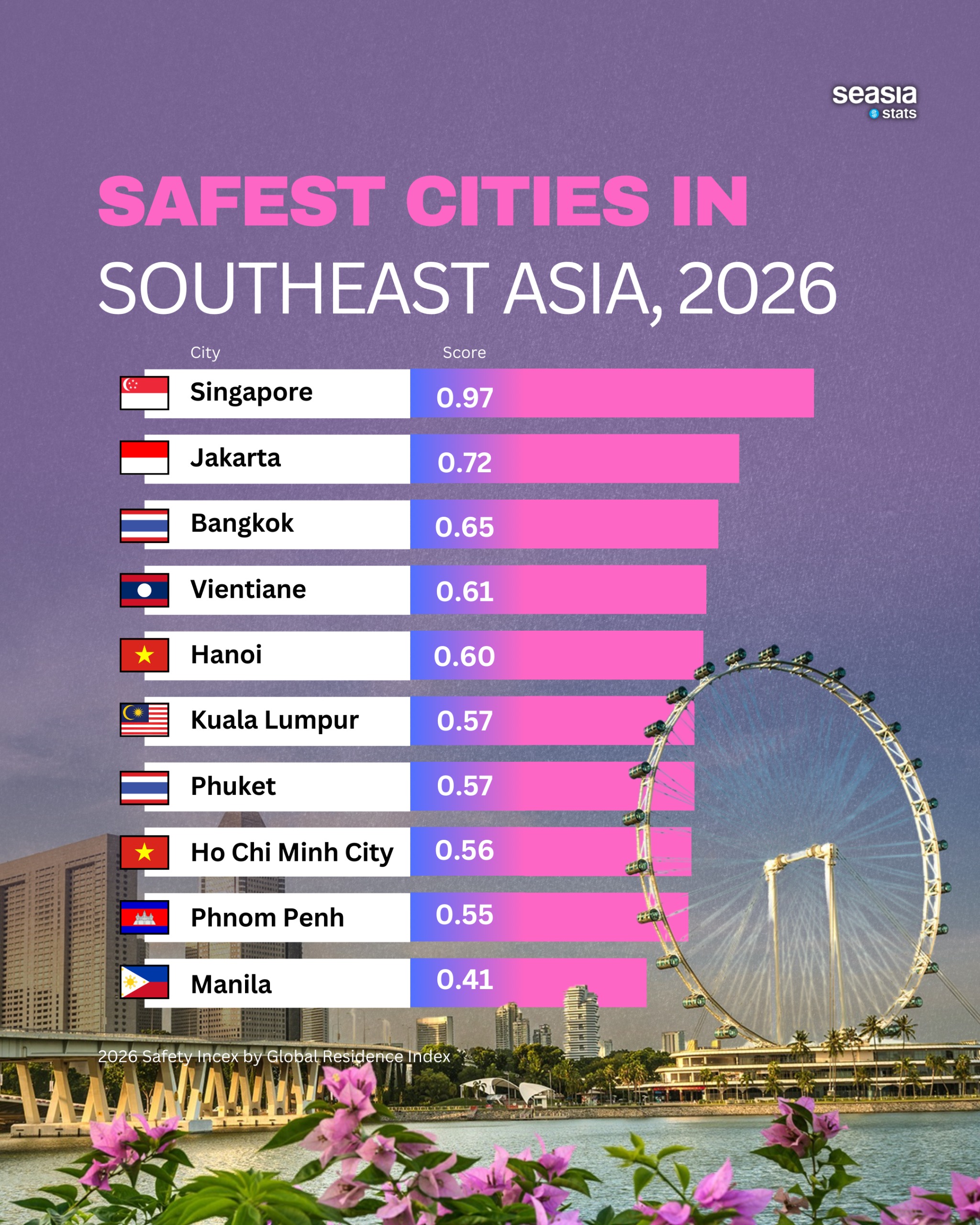
Safety is one of the most powerful forces in modern travel and city life—not because it is glamorous, but because it shapes everything else. It determines whether people stay out late, whether families feel comfortable on public transport, whether investors feel confident, and whether a city feels welcoming rather than stressful. The 2026 Safety Index from Global Residence Index, as highlighted by Seasia Stats, offers a revealing snapshot of how Southeast Asia’s major cities are being perceived today. And once again, Singapore sits comfortably at the top.
Singapore’s Lead Is No Surprise
With a standout score of 0.97, Singapore remains in a category of its own. That number reflects more than low crime; it reflects a system. In Singapore, safety is built into daily life through urban design, strong enforcement, efficient transport, and a culture of public order that visitors notice almost immediately.
That reputation has become one of the city-state’s most valuable assets. It is not just a place people visit—it is a place people trust. As CNBC once observed in a broader feature on global urban competitiveness, safety in Singapore is “part of the city’s economic infrastructure,” not merely a social outcome. That distinction matters. It helps explain why the city continues to rank highly not only for livability, but also for tourism, business, and family relocation.
Jakarta’s Rise Tells a Bigger Story
Perhaps the most interesting result on the list is Jakarta’s position at number two with a score of 0.72. For years, the Indonesian capital has battled a reputation for congestion, unpredictability, and urban overload. Yet perceptions are shifting.
That change is not necessarily because Jakarta has become simple or polished—it has not. But it has become more navigable, more organized in key districts, and increasingly confident as a major Southeast Asian metropolis. Better transport infrastructure, expanded public spaces, and growing private-sector urban redevelopment have all contributed to a city that feels more manageable than it once did.
Jakarta’s ranking also reflects a broader Indonesian trend: large cities in the country are becoming more competitive not only economically, but in quality-of-life metrics that used to be dominated by Singapore or Kuala Lumpur alone.
Thailand and Vietnam Stay Strong
Bangkok’s third-place finish feels fitting. It is one of Asia’s busiest tourism capitals, yet for many travelers it still feels remarkably workable. That is no small achievement for a city that receives millions of visitors while remaining deeply local in character. Safety in Bangkok is not about perfection; it is about functionality. The city’s public-facing hospitality, dense commercial life, and visible street activity create an environment that often feels active rather than threatening.
Thailand’s presence is strengthened further by Phuket, which ties with Kuala Lumpur at 0.57. That matters because resort destinations are increasingly judged not just by beauty, but by whether visitors feel secure moving around them independently.
Vietnam also performs well with both Hanoi and Ho Chi Minh City making the top ten. Hanoi, with a score of 0.60, often feels calmer and more community-oriented, while Ho Chi Minh City’s slightly lower 0.56 reflects its faster, more intense urban rhythm. Still, both cities continue to benefit from the kind of street-level vitality that can often enhance perceived safety: people out late, active food culture, and neighborhoods that remain socially alive after dark.
A Region Defined by Contrast
One of the clearest lessons from this ranking is that Southeast Asia does not have one urban model—it has many. Vientiane’s quietness is very different from Bangkok’s density. Kuala Lumpur’s modern order differs from Phnom Penh’s transitional energy. Manila, which ranks tenth, remains a city of extraordinary warmth and vitality, even if its lower score reflects persistent concerns around congestion, inequality, and urban security.
That diversity is precisely what makes regional comparisons so interesting. Safety in Southeast Asia is not simply about police numbers or crime statistics. It is also about lighting, transport, trust, affordability, and whether public space feels shared rather than fragmented.
More Than a Security Ranking
Ultimately, the safest cities are often the ones that feel most usable. They allow people to move, work, eat, socialize, and return home without carrying unnecessary stress. That is why rankings like this resonate so strongly.
And in 2026, Southeast Asia’s safest cities are not just competing on security—they are competing on confidence.


