

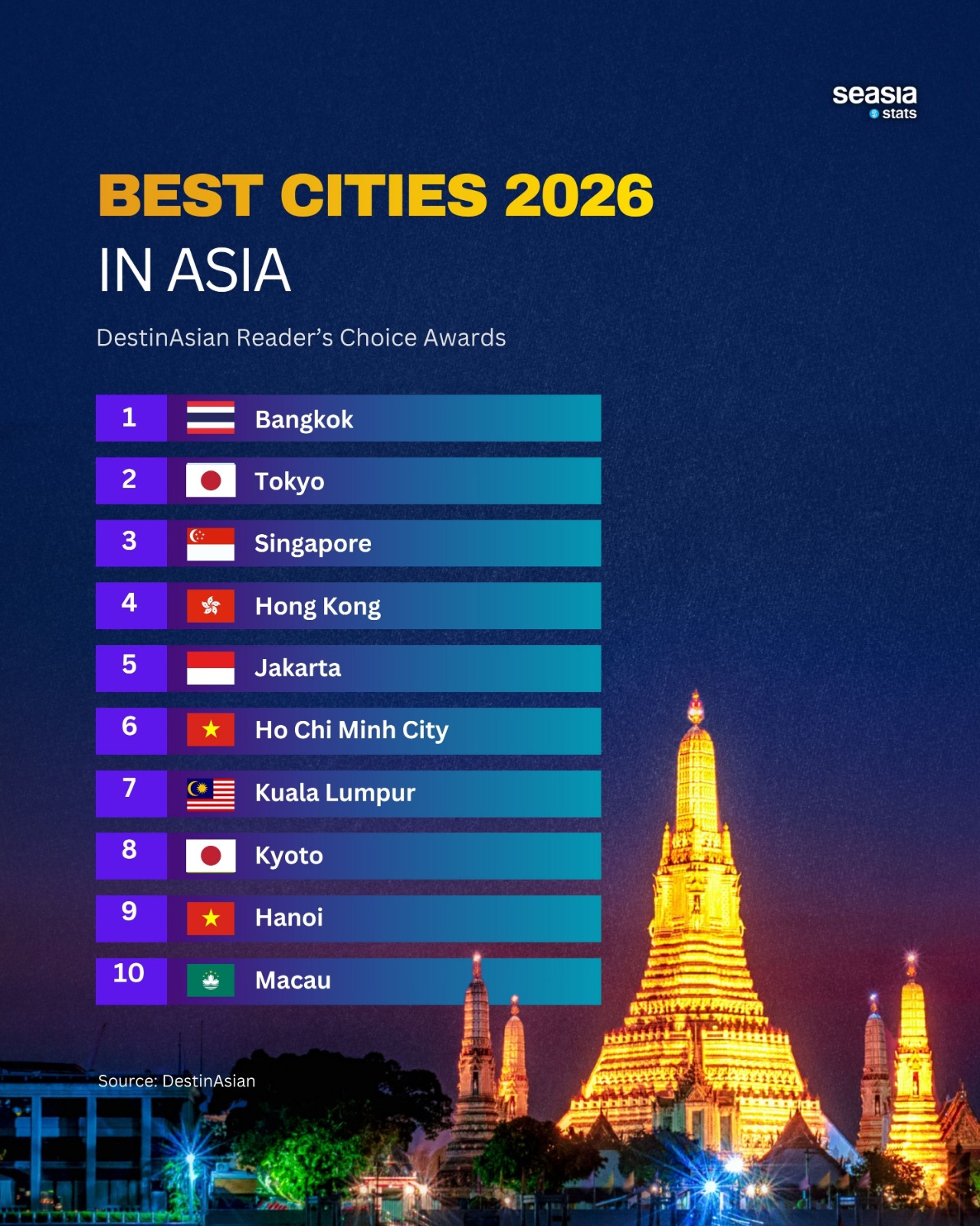
Some cities are built to be visited. Others are built to be felt. The best cities in Asia in 2026, according to the DestinAsian Readers’ Choice Awards as presented by Seasia Stats, are not simply destinations on a map—they are atmospheres, habits, flavors, and rhythms. This year’s ranking places Bangkok at number one, followed by Tokyo and Singapore, a trio that says a great deal about what travelers now value most: energy, ease, and unforgettable character.
Bangkok’s Winning Formula
Bangkok’s rise to the top feels almost inevitable. It is one of those rare capitals that can be overwhelming and deeply lovable at the same time. One hour you are standing before the glittering spires of Wat Arun, and the next you are eating noodles on a plastic stool under a tangle of electric wires. The city is grand and intimate all at once.
What makes Bangkok so compelling is that it refuses to become one thing. It is a city of luxury malls and canal-side neighborhoods, rooftop bars and temple courtyards, Michelin-starred tasting menus and 60-baht street food. Travel + Leisure once described Bangkok as “a city where old and new are constantly in conversation,” and that remains one of the best ways to understand its pull.
Southeast Asia’s Urban Powerhouse Moment
What stands out most in this year’s top ten is how strongly Southeast Asia performs. Beyond Bangkok, the region places Singapore at number three, Jakarta at five, Ho Chi Minh City at six, Kuala Lumpur at seven, and Hanoi at nine. That is six Southeast Asian cities in the top ten—an extraordinary showing that reflects how central the region has become to global travel.
Singapore’s appeal is easy to understand. It offers one of the most efficient, polished, and traveler-friendly city experiences anywhere in the world. But what makes it more than just convenient is its cultural layering: hawker centers, heritage districts, lush urban design, and a food scene that punches far above its size.
Jakarta’s presence is perhaps one of the most interesting. For years, the Indonesian capital was often framed as a business city rather than a leisure destination. But that perception is changing. Today, Jakarta is increasingly appreciated for its culinary diversity, creative scene, luxury hospitality, and role as the restless heartbeat of modern Indonesia.
Vietnam and Malaysia Keep Rising
Two of the list’s most important entries are Ho Chi Minh City and Hanoi, which together underline Vietnam’s growing influence in Asian tourism. Ho Chi Minh City offers speed, ambition, and youthful energy. Hanoi, by contrast, moves with more nostalgia and texture, where lakes, colonial façades, and old alleyways create a slower but equally magnetic charm.
Kuala Lumpur, meanwhile, remains one of Asia’s most underrated capitals. It has long offered tremendous value, but in recent years it has also sharpened its identity as a city where Malay, Chinese, Indian, and global influences coexist in remarkably visible ways. It is a city that rewards curiosity.
Why Travelers Are Choosing Cities Like These
The success of these cities reflects a broader shift in travel itself. Increasingly, people are not only looking for famous landmarks. They are looking for cities that feel alive after dark, taste distinct at every meal, and reveal something new with every neighborhood.
That is exactly where Asia—and especially Southeast Asia—has the advantage. These cities are not polished into sameness. They still surprise. They still challenge. They still feel human.
More Than Just a Ranking
In the end, this list is not only about which city is “best.” It is about which cities stay with you. And in 2026, the answer is clear: Asia’s most memorable urban experiences are being led, with real confidence, by Southeast Asia.


