

Beneath Southeast Asia’s volcanoes, fault lines, and steaming hot springs lies one of the region’s most underrated strategic assets: heat. Not the kind that comes from the sun or imported fuel, but the kind stored deep underground for millennia. In a world racing toward cleaner energy, geothermal power is giving several Southeast Asian countries an advantage that many others simply do not have.
A Global Energy Map Written by Volcanoes
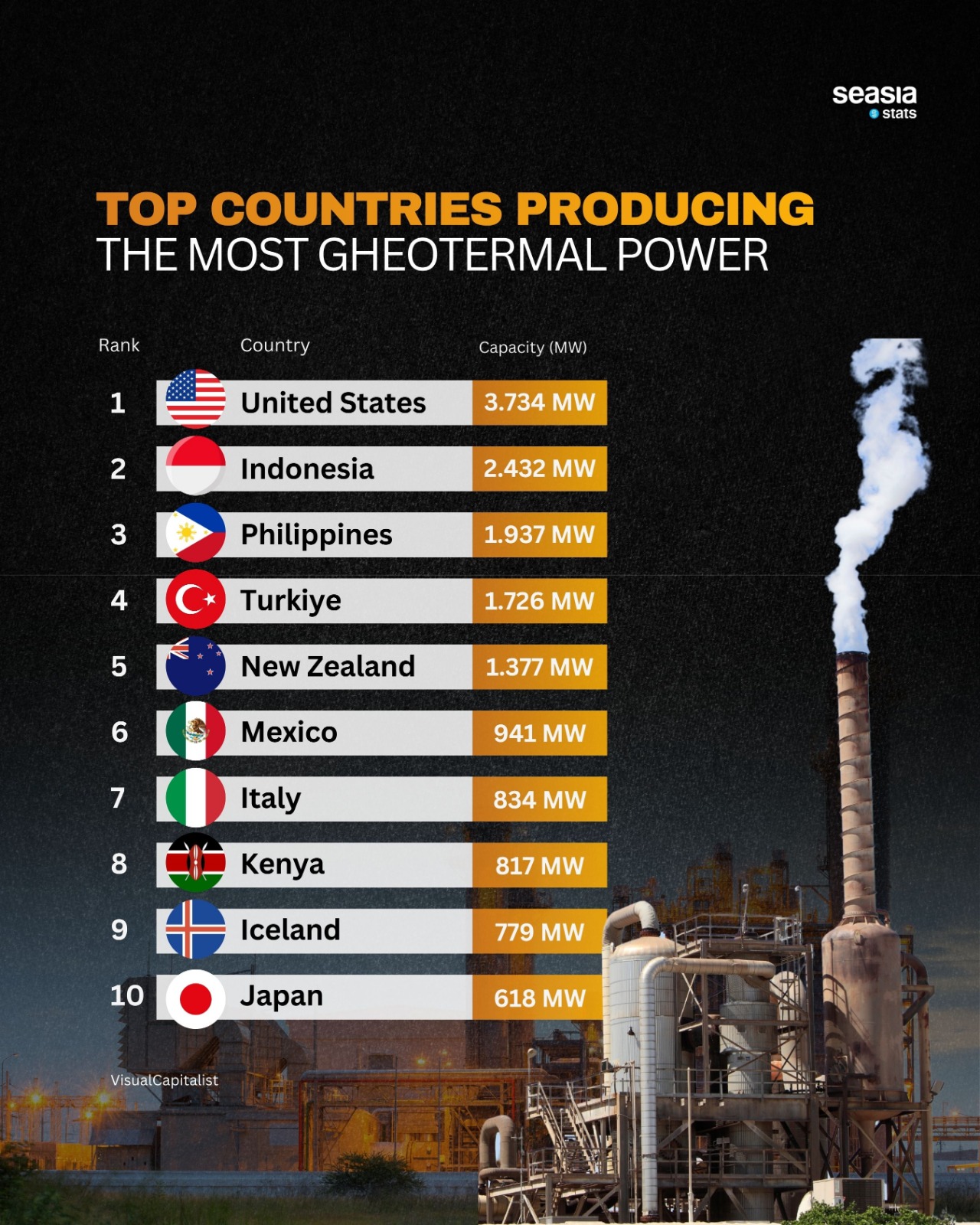
According to the infographic from Seasia Stats and Visual Capitalist, the United States remains the world’s largest geothermal power producer with 3,734 MW of installed capacity. But the most striking story is what comes next: Indonesia in second place with 2,432 MW, and the Philippines in third with 1,937 MW.
That means two Southeast Asian countries sit firmly in the global top three—a remarkable position for a region often discussed more for coal dependence, palm oil, or hydropower than for underground renewable energy.
This is not a coincidence. Geothermal power follows geology, and Southeast Asia sits on some of the most active tectonic zones on Earth. The same restless plates that created the region’s volcanoes, earthquakes, and dramatic landscapes also created the ideal conditions for tapping the Earth’s internal heat. Reuters noted in late 2025 that most of the world’s geothermal leaders are concentrated in tectonically active zones, where heat is accessible enough to turn steam into electricity at scale.
Indonesia’s Sleeping Giant
If any country symbolizes geothermal’s unrealized promise, it is Indonesia. With more than 17,000 islands and over a hundred active volcanoes, the country has long been described as sitting atop a vast natural battery. Yet for years, that promise moved more slowly than expected.
The challenge was never the resource itself. It was the difficulty—and cost—of developing it. Drilling geothermal wells is expensive, risky, and technically demanding. A project can take years before producing a single watt of electricity. That is one reason geothermal has often struggled to compete with cheaper, faster fossil fuel projects in developing economies.
Still, Indonesia remains one of the most important geothermal frontiers in the world. The World Bank once described the country’s installed geothermal capacity as already “the second largest in the world,” while emphasizing that exploration risk remains the key barrier to faster expansion.
For Southeast Asia, that matters enormously. Indonesia is not just producing geothermal power for itself—it is effectively testing whether volcanic developing nations can scale a cleaner alternative to coal without sacrificing energy security.
The Philippines: The Quiet Veteran
While Indonesia is often described as the giant of future geothermal growth, the Philippines is in many ways the region’s veteran. Long before climate targets and energy transition plans became fashionable, the Philippines was already turning volcanic heat into electricity.
This history matters because geothermal is not just “green”—it is also firm power. Unlike solar and wind, which depend on weather and daylight, geothermal can run around the clock. The International Energy Agency notes that geothermal plants often achieve utilization rates above 75%, making them especially valuable for grids that need dependable baseload electricity.
That is why geothermal matters so much in Southeast Asia. The region’s electricity demand is rising fast, driven by industrialization, air-conditioning demand, urbanization, and data infrastructure. Countries here do not only need clean energy—they need stable clean energy.
Why Southeast Asia Could Matter Even More
The biggest story may still be ahead. The IEA’s 2024 geothermal report estimates that ASEAN countries together represent about 15% of global technical potential for advanced geothermal systems, with Indonesia and the Philippines leading the way.
That is a profound figure. It suggests Southeast Asia is not just a participant in geothermal energy—it could become one of its defining regions in the decades ahead.
And that is what makes this ranking more than a list. It is a glimpse of a future in which some of the world’s most important clean-energy breakthroughs may not come from wind farms or solar deserts, but from volcanic islands and mountain belts in Southeast Asia—places where the Earth has been storing power all along.


