

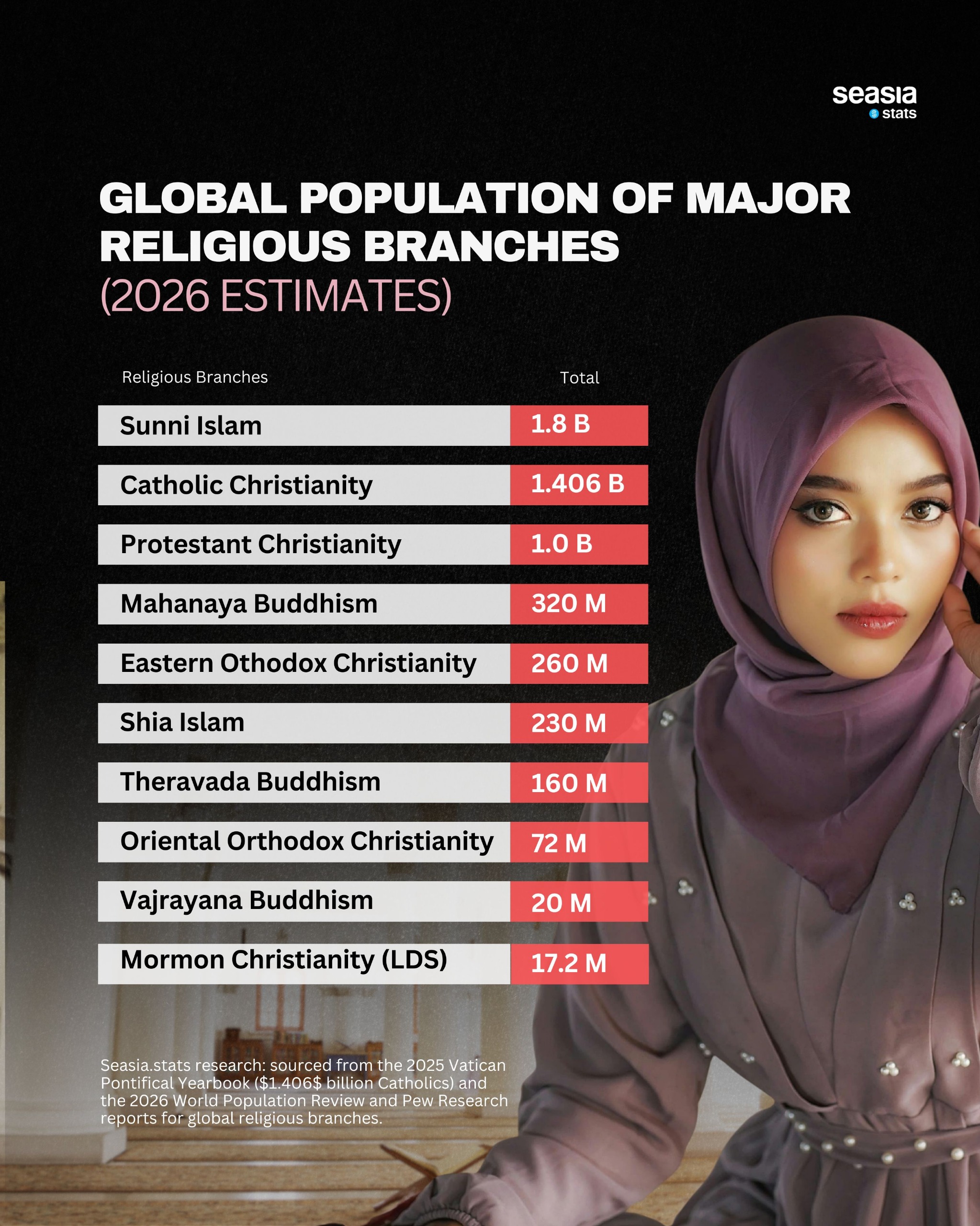
Religion is often discussed in sweeping terms—Islam, Christianity, Buddhism—but the real global picture is far more layered. Within every major faith tradition are branches, schools, and historical communities that have shaped civilizations for centuries. The latest estimates highlighted by Seasia Stats offer a useful reminder that the world’s spiritual map is not only vast, but internally diverse.
The World’s Biggest Religious Branches
At the top of the list is Sunni Islam, with an estimated 1.8 billion followers worldwide, making it the largest religious branch on Earth. It is followed by Catholic Christianity at 1.406 billion, a figure aligned with the Vatican’s 2025 Pontifical Yearbook, and Protestant Christianity, estimated at 1 billion globally. The Vatican said the global Catholic population rose from about 1.39 billion to 1.406 billion between 2022 and 2023, underscoring how large and geographically widespread the Catholic world remains.
These numbers matter not just because they are large, but because they reveal where religious influence still strongly shapes education, politics, family life, and identity. Christianity and Islam continue to dominate the global religious landscape in sheer scale, while Buddhism remains one of the world’s most culturally influential traditions even with smaller branch totals. Pew Research also notes that Christians and Muslims remain the two largest global religious populations overall.
Islam and Christianity: Global, Diverse, Deeply Rooted
The infographic also highlights the internal diversity within Islam and Christianity. While Sunnis make up the overwhelming majority of Muslims, Shia Islam, at around 230 million, remains one of the world’s most historically significant religious communities, with especially strong presence in Iran, Iraq, parts of Lebanon, Pakistan, and India. Pew has long estimated that roughly 87–90% of Muslims are Sunni and 10–13% are Shia.
Christianity, meanwhile, is not a single bloc. Alongside Catholics and Protestants, Eastern Orthodox Christianity is estimated at 260 million, while Oriental Orthodox Christianity accounts for another 72 million. These traditions remain central in countries such as Russia, Greece, Ethiopia, Armenia, and parts of the Middle East. Even Mormon Christianity (LDS), at 17.2 million, demonstrates how newer movements have carved out a global presence far beyond their American origins.
Buddhism’s Quiet Reach Across Asia
Among Buddhist traditions, Mahayana Buddhism leads with an estimated 320 million followers, followed by Theravada Buddhism at 160 million and Vajrayana Buddhism at 20 million. Pew notes that the three major branches of Buddhism in the modern world are Mahayana, Theravada, and Vajrayana—a reminder that “Buddhism” itself encompasses very different spiritual worlds.
This matters especially in Asia, where these traditions are not evenly distributed. Mahayana has historically shaped China, Japan, Korea, and Vietnam. Theravada remains central to mainland Southeast Asia, while Vajrayana is most associated with the Himalayan world and Tibetan traditions.
Why Southeast Asia Matters So Much
Few regions illustrate global religious diversity as vividly as Southeast Asia. It is one of the only places in the world where major branches of Islam, Christianity, and Buddhism coexist at national scale.
Indonesia, the world’s largest Muslim-majority country, is overwhelmingly Sunni and gives Southeast Asia enormous weight in the global Muslim story. Malaysia and Brunei also reinforce Islam’s strong presence in the region. At the same time, the Philippines and Timor-Leste anchor Southeast Asia’s Christian identity, with Catholicism deeply embedded in public life and culture.
On the Buddhist side, Thailand, Cambodia, Myanmar, and Laos are key centers of Theravada Buddhism, while Vietnam reflects a more mixed religious tapestry influenced by Mahayana Buddhism, folk religion, and smaller Christian communities. Singapore, perhaps more than any other ASEAN country, stands out as a religious crossroads, with significant Buddhist, Muslim, Christian, Hindu, and nonreligious populations. Pew describes Singapore as having no majority religion and being among the world’s most religiously diverse societies.
More Than Numbers
In the end, these estimates are not just about counting believers. They are about understanding how people make meaning, build communities, and inherit identity.
From Sunni mosques in Java, to Catholic churches in Manila, to Theravada temples in Bangkok, Southeast Asia alone shows that religion is not a relic of the past. It remains one of the most powerful ways human beings still understand the world—and their place in it.


