

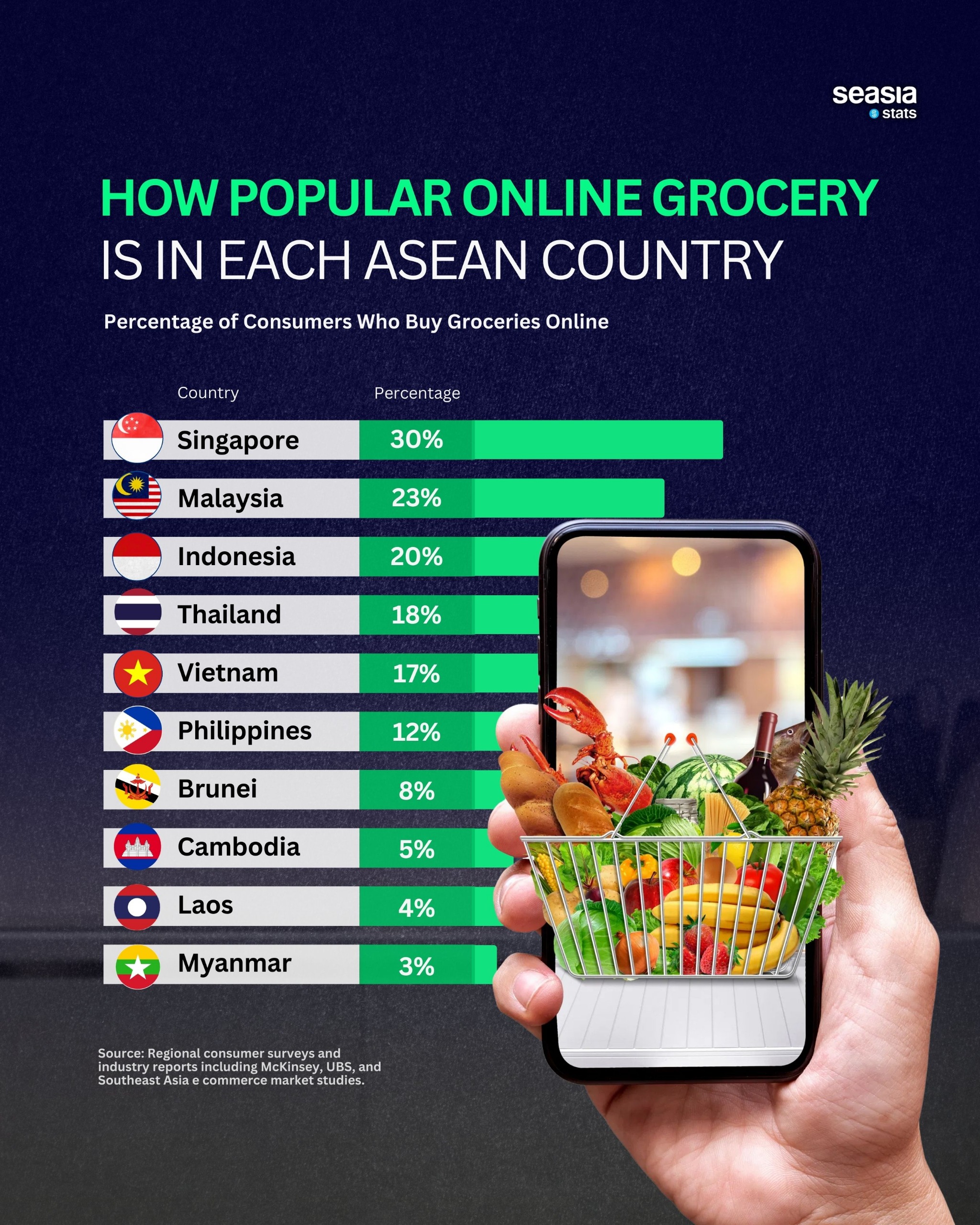
The way Southeast Asians buy their daily vegetables, rice, milk, and instant noodles is quietly changing. Grocery shopping, once defined by wet markets, neighborhood minimarts, and supermarket aisles, is increasingly moving onto smartphones. The Seasia Stats compilation shows that online grocery adoption is still uneven across ASEAN, but the direction is unmistakable: convenience is becoming a new staple.
Singapore Sets the Pace
At the top of the regional ranking is Singapore, where 30% of consumers already buy groceries online. That lead is not especially surprising. Singapore combines high internet penetration, dense urban living, reliable delivery infrastructure, and consumers who are deeply accustomed to app-based services. In a place where time is expensive and efficiency is part of daily life, online grocery shopping fits naturally into the rhythm of the city.
The country also reflects a broader regional pattern: the more urbanized and digitally connected the market, the faster grocery e-commerce grows. Across Asia, shoppers are increasingly blending digital and physical retail, with value, convenience, and product range shaping where they spend. NielsenIQ notes that e-commerce has become one of the most important FMCG channels in Asia Pacific, as households grow more comfortable buying even routine essentials online.
Malaysia and Indonesia Are Building Scale
Right behind Singapore is Malaysia at 23%, followed by Indonesia at 20%. These two countries are especially important because they represent scale, not just digital maturity.
Malaysia’s relatively strong showing reflects its urban concentration, high smartphone use, and a retail environment where modern trade and digital payments have become increasingly normalized. Consumers there are not just shopping online for electronics or fashion anymore; groceries are becoming part of everyday digital behavior.
Indonesia is perhaps the most fascinating case in the region. With its vast geography and island-to-island logistical complexity, online grocery in Indonesia faces obvious challenges. Yet it is still among ASEAN’s leaders. That suggests demand is real, especially in major urban centers such as Jakarta, Surabaya, Bandung, and Medan, where time-saving delivery services are now part of middle-class life. McKinsey has also pointed to Indonesia as a major engine of Southeast Asia’s e-grocery growth, arguing that a significant share of the region’s future expansion could come from the Indonesian market alone.
The Middle Tier Is Full of Opportunity
Thailand (18%) and Vietnam (17%) are close behind, forming a strong middle tier alongside the top three. These are markets where online grocery has clearly moved beyond novelty, but has not yet become fully mainstream.
Thailand’s strength lies in its well-developed retail culture and highly active digital consumer base. Vietnam, meanwhile, continues to benefit from one of the region’s most dynamic e-commerce ecosystems, powered by rapid smartphone adoption and increasingly app-driven urban consumption. Both countries show that online grocery does not need to dominate to matter—it only needs to become habitual for enough households to reshape retail strategy.
The Philippines, at 12%, presents a different kind of story. Adoption is lower than some of its regional peers, but the upside is significant. The archipelago’s fragmented geography has historically complicated grocery logistics, yet it also makes delivery platforms potentially transformative. If infrastructure, fulfillment, and cold-chain systems improve, the Philippines could become one of ASEAN’s more interesting late accelerators.
The Digital Divide Still Shapes the Region
At the lower end of the ranking are Brunei (8%), Cambodia (5%), Laos (4%), and Myanmar (3%). These figures do not necessarily indicate a lack of consumer interest; they more likely reflect structural limitations.
Online grocery depends on more than just apps. It requires reliable delivery networks, digital payment adoption, warehousing, merchant digitization, and consumer trust in ordering perishables remotely. In markets where traditional trade still dominates and logistics remain fragmented, adoption naturally stays lower.
That matters because Southeast Asia’s grocery market is still, in many places, overwhelmingly offline. McKinsey has noted that traditional trade continues to account for a major share of grocery spending in the region, meaning the digital transition is still in its early chapters rather than its mature phase.
The Future Is Omnichannel, Not Fully Online
The bigger story is not that Southeast Asia is abandoning physical grocery shopping. It is that the region is becoming omnichannel. Consumers may browse prices on an app, reorder household staples online, and still visit a fresh market for produce or fish the next day.
That is why online grocery matters. It is not replacing the region’s food culture; it is layering convenience onto it. And in Southeast Asia, where daily life is increasingly shaped by super apps, digital payments, and delivery ecosystems, that layer is only going to get thicker.


