

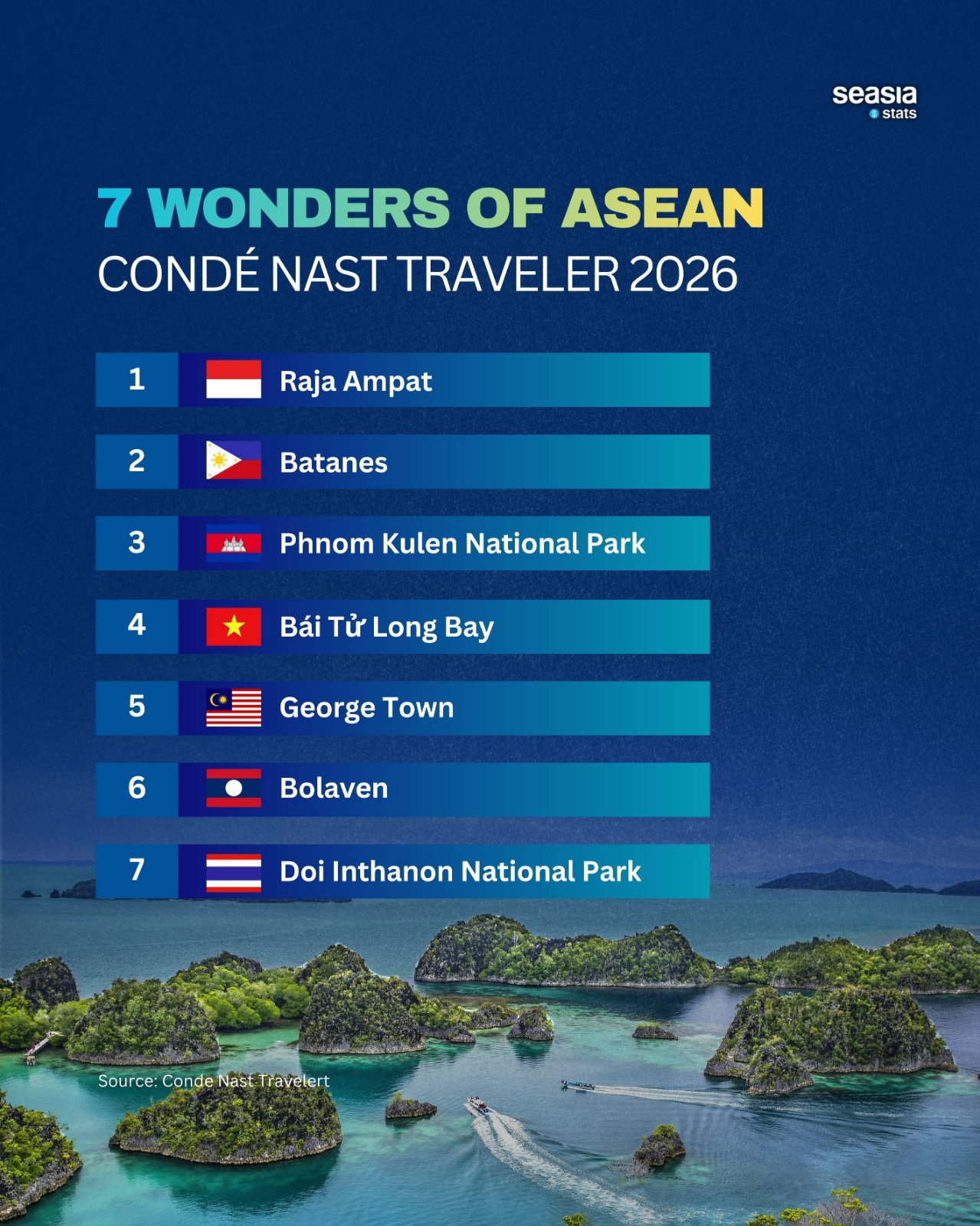
Southeast Asia has never lacked postcard beauty. What is changing now is where travelers are looking. The new mood in travel is moving away from overcrowded icons and toward places that still feel textured, intimate, and alive. That is what makes Condé Nast Traveler’s 2026 selection of the “7 Wonders of Southeast Asia” so interesting: it is not just a list of beautiful destinations, but a portrait of a region whose greatest treasures often lie just beyond the obvious.
Raja Ampat Leads a New Kind of Bucket List
At the top of the 2026 ranking is Raja Ampat, an Indonesian archipelago that has become shorthand for paradise among divers, conservationists, and serious travelers. Condé Nast Traveler described it as “one of the last unspoiled paradises left on earth,” citing its remote geography, conservation efforts, and extraordinary marine life.
That first-place finish is no surprise. Located off the northwest tip of New Guinea, Raja Ampat is globally celebrated for its coral reefs, karst islands, and unmatched underwater biodiversity. It also reflects a larger truth about Indonesia: the country’s travel appeal is becoming less centered on Bali alone and more on its wider ecological and cultural map—from Komodo and Sumba to Labuan Bajo and Papua.
For Indonesia, Raja Ampat’s inclusion is both a tourism triumph and a warning. Its beauty is now globally recognized, but that visibility must be balanced with strict ecological protection.
The Philippines and Cambodia Make a Powerful Statement
In second place is Batanes in the Philippines, a destination Condé Nast Traveler praised for its “rugged coastal cliffs and rolling green hills” and the enduring culture of the Ivatan people. Rather than tropical excess, Batanes offers something quieter and rarer: atmosphere, memory, and resilience.
That matters for the Philippines, which is often marketed internationally through beaches and island-hopping alone. Batanes broadens that image. It shows that Philippine tourism can also be about heritage landscapes, Indigenous identity, and slow travel.
In third place, Phnom Kulen National Park gives Cambodia one of the most compelling entries on the list. Often overshadowed by Angkor Wat, Phnom Kulen is both a natural sanctuary and a sacred historical landscape. Cambodia’s tourism authorities describe it as an isolated mountain massif near Siem Reap, while officials have also highlighted its biodiversity significance and conservation value.
For Cambodia, its inclusion signals something important: the country’s tourism story is no longer just about temple tourism. Nature, sacred geography, and ecological travel are becoming part of its global image too.
Vietnam, Malaysia, Laos, and Thailand Show Their Range
The middle and lower half of the list is where Southeast Asia’s diversity becomes especially vivid.
Vietnam’s Bái Tử Long Bay, ranked fourth, is presented as the quieter sibling of Ha Long Bay. Condé Nast Traveler called it “a more tranquil, less crowded, but just-as-beautiful alternative,” a description that captures the new premium in travel: serenity. Vietnam’s own tourism promotion also emphasizes the wider Gulf of Tonkin as a place for slower, more varied exploration beyond mass cruise routes.
Malaysia’s George Town, ranked fifth, remains one of the region’s finest examples of urban heritage done right. The city’s layered Malay, Chinese, Indian, and colonial influences continue to make it one of Southeast Asia’s richest cultural destinations. UNESCO materials have long pointed to the need to preserve George Town’s living traditions, not just its buildings—a reminder that heritage cities succeed when they remain inhabited, not fossilized.
Then comes Bolaven Plateau in Laos, ranked sixth. It is one of the most underrated landscapes in mainland Southeast Asia, known for waterfalls, volcanic soil, and increasingly, specialty coffee. Laos tourism authorities describe the area as famous for its plantations, cool climate, and dramatic scenery, while more recent tourism coverage has highlighted the rising profile of Bolaven coffee.
Finally, Thailand’s Doi Inthanon National Park rounds out the list at number seven. Home to the country’s highest peak, it reflects a side of Thailand that often gets less attention than beaches and nightlife: mountains, forests, birdlife, and highland culture. Thai tourism sources continue to market it as one of the country’s signature cool-season and trekking destinations.
A Different Vision of Southeast Asia
What makes this ranking compelling is not just which places made the list, but what kind of places they are. Most are not mega-cities. Most are not overbuilt. Most still require effort to reach. That is the point.
This is Southeast Asia not as a cheap checklist, but as a region of ecological wonder, sacred memory, Indigenous culture, and layered local identity. And perhaps that is the deeper message of the 2026 list: the future of travel in ASEAN may belong not to the loudest destinations, but to the ones that still feel discovered rather than consumed.


