

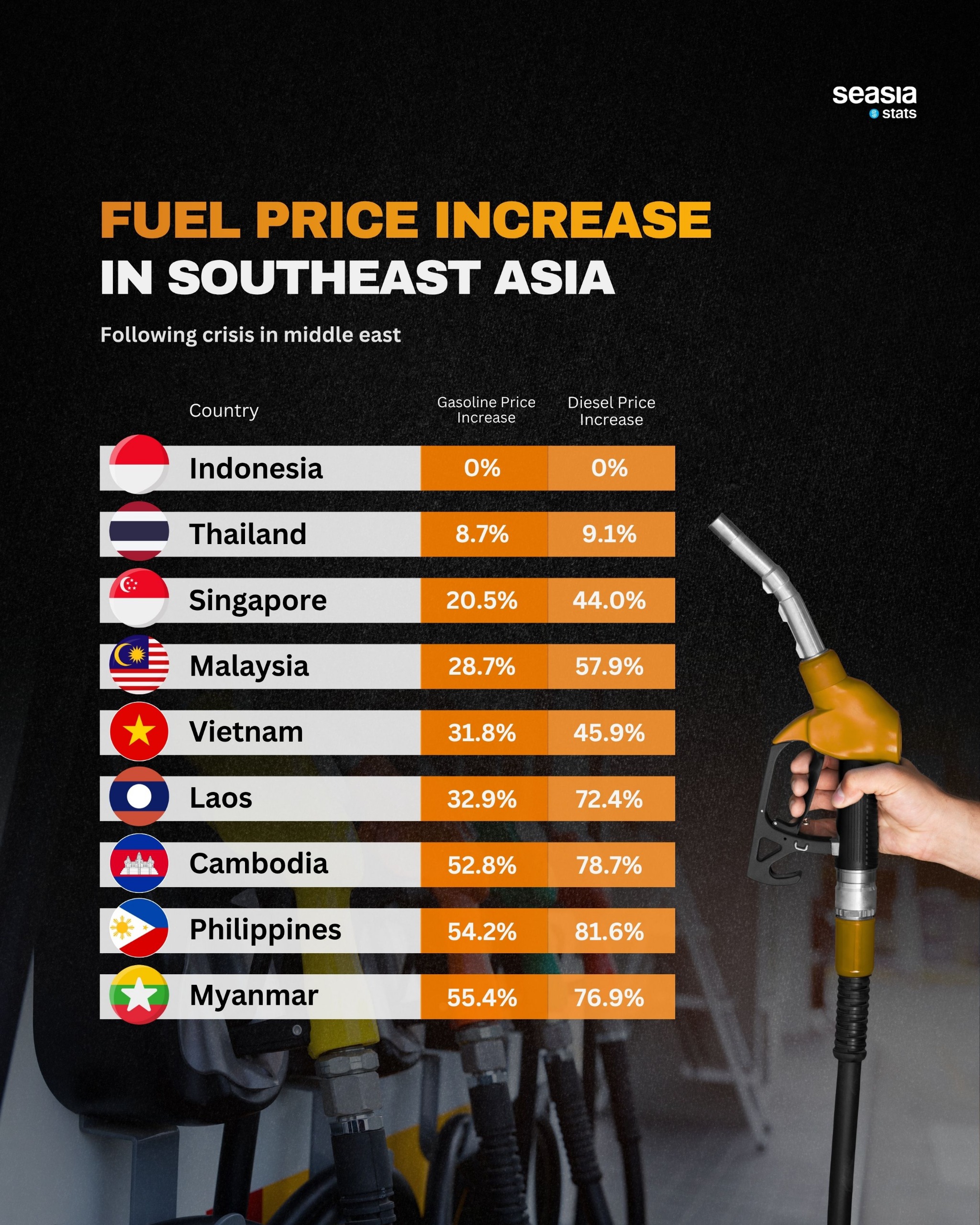
The fuel pump has become one of the clearest places where geopolitics turns into daily life. A conflict thousands of kilometers away can suddenly reshape commuting costs, food prices, shipping fees, and even household budgets across Southeast Asia. The latest Seasia Stats infographic captures that reality starkly: after the Middle East crisis, fuel prices across ASEAN did not move uniformly at all. Some countries absorbed the shock. Others passed it directly to consumers.
A Region Split by Fuel Vulnerability
According to the infographic, Myanmar recorded the region’s sharpest gasoline increase at 55.4%, followed closely by the Philippines at 54.2% and Cambodia at 52.8%. On the diesel side, the pain was even more severe: the Philippines saw an 81.6% increase, Cambodia 78.7%, and Myanmar 76.9%.
Those are not just transport numbers. In Southeast Asia, diesel is deeply tied to the movement of food, construction materials, buses, farm equipment, and small business logistics. When diesel jumps, the cost of living often follows.
The broader backdrop is easy to understand. Oil markets were hit hard by the Middle East crisis, with Brent crude rising nearly 60% and Asian refined products such as gasoil and jet fuel surging even more sharply. Reuters reported that the Strait of Hormuz, one of the world’s most important oil chokepoints, remained heavily disrupted, putting intense pressure on Asian energy buyers.
Why Southeast Asia Was Hit So Differently
The ranking is a reminder that fuel prices are not determined by global oil alone. They are shaped just as much by domestic policy.
At one end is Indonesia, which stands out dramatically with 0% increase in both gasoline and diesel. That does not mean Indonesia escaped the shock; it means the government chose to absorb more of it through pricing controls, state intervention, and energy policy. Reuters also reported that Jakarta is pushing ahead with a B50 biodiesel blend this year, partly to reduce vulnerability to imported oil disruptions.
Thailand also appears relatively protected, with only 8.7% gasoline and 9.1% diesel increases. That reflects a more managed pricing environment, including temporary efforts to cushion diesel costs for consumers and businesses.
By contrast, more import-dependent and less heavily subsidized markets saw the shock hit faster. Singapore, for example, recorded a 20.5% rise in gasoline and 44.0% in diesel, reflecting how quickly international market movements can pass through in a highly open economy. Local reports noted that pump prices there rose as retailers priced in higher freight, insurance, and crude costs.
The Southeast Asian Stories Behind the Numbers
The most revealing part of this story may be how differently each Southeast Asian country is positioned.
In the Philippines, the situation became serious enough for the government to declare a national energy emergency and activate emergency funding to stabilize fuel supply. Reuters reported that Manila also moved to secure extra barrels and protect consumers from broader inflation risks.
In Cambodia, the pressure was visible at the street level. Reports said authorities were investigating around 2,000 petrol stations that had temporarily shut, amid concerns over supply disruptions and alleged stock withholding.
In Myanmar, the disruption went even further, with authorities introducing fuel rationing for private vehicles as supply stress intensified.
These are not just energy stories—they are governance stories. They reveal which states can buffer shocks, which pass them on, and which struggle to keep markets functioning under pressure.
More Than a Fuel Story
As ASEAN ministers warned earlier this month, prolonged instability in the Middle East risks becoming not just an oil problem, but a regional inflation problem. Economists cited by The Straits Times warned that Southeast Asia could face a broader “stagflationary shock” if high fuel prices begin feeding into transport, food, fertilizer, and household costs.
That may be the real takeaway from this chart. Fuel prices are not only about what motorists pay at the pump. They are often the first visible sign that a distant geopolitical crisis has already arrived at home.


