

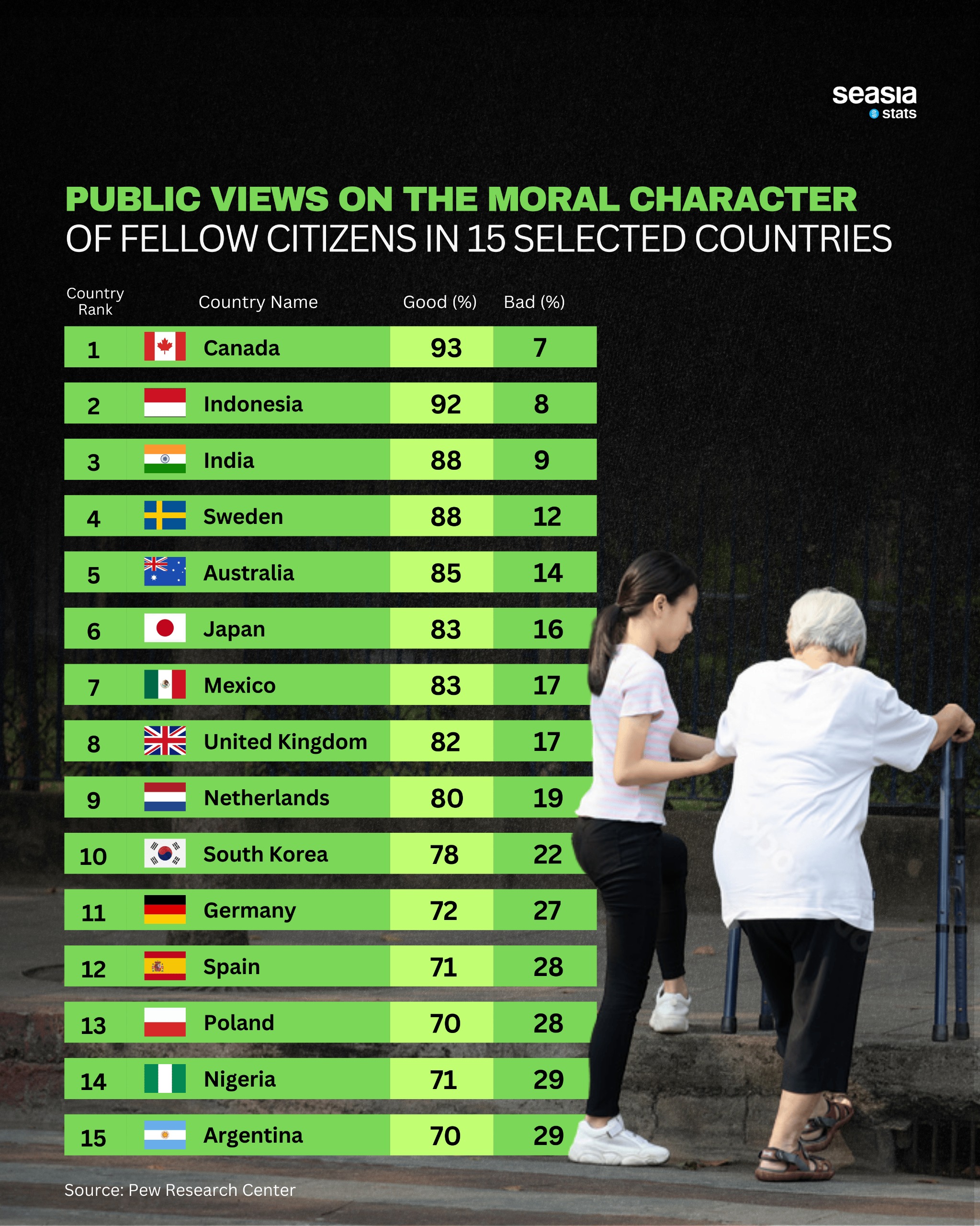
Trust and social cohesion are often invisible forces that shape the strength of a society. When citizens believe that the people around them act with integrity and good intentions, communities tend to experience higher levels of cooperation, civic engagement, and social stability. A recent global survey conducted by the Pew Research Center provides an interesting snapshot of how people around the world perceive the moral character of their fellow citizens. The findings reveal significant differences between countries, highlighting how culture, social trust, and national experiences influence public perception.
Canada Leads in Social Trust
According to the Pew Research Center study, Canada ranks first among the 15 surveyed nations when it comes to positive perceptions of fellow citizens’ moral character. An overwhelming 93% of Canadians believe that the people around them generally possess “good” moral character, while only 7% hold negative views.
This high level of social trust reflects Canada’s long-standing reputation for strong civic institutions, relatively low levels of social polarization, and a culture that emphasizes cooperation and community responsibility. Trust between citizens often translates into stronger public engagement and greater willingness to participate in collective efforts, from volunteering to public policy discussions.
Indonesia Emerges as a Regional Leader
In second place globally is Indonesia, where 92% of respondents view their fellow citizens as morally good, with only 8% expressing negative perceptions. This strong showing places Indonesia ahead of many advanced economies and highlights the country’s high levels of interpersonal trust.
Indonesia’s diverse society—spanning thousands of islands, hundreds of ethnic groups, and multiple religions—has historically relied on cultural values such as gotong royong, a concept emphasizing communal cooperation and mutual assistance. These traditions continue to play a role in shaping positive perceptions among Indonesians.
Within Southeast Asia, Indonesia’s ranking is particularly notable. While many countries in the region emphasize strong community ties, large-scale survey data measuring public perceptions of moral character are relatively rare. Indonesia’s high score suggests a robust sense of social cohesion despite its vast geographic and cultural diversity.
Strong Middle Rankings Across Asia and the West
Several other countries also show high levels of trust in the moral character of fellow citizens. India and Sweden share the next positions, each with 88% of respondents expressing positive views.
India’s high rating reflects strong social networks and community ties, particularly in family and neighborhood structures that remain central to everyday life. Sweden’s result, meanwhile, reflects the Nordic country’s longstanding culture of institutional trust, equality, and social responsibility.
Further down the ranking are Australia, where 85% of respondents view fellow citizens positively, followed by Japan and Mexico, both tied at 83%. These countries maintain relatively high levels of public confidence in societal norms and collective responsibility.
The United Kingdom and the Netherlands also perform well, with 82% and 80% positive perceptions respectively. In both countries, public trust remains an important component of social stability, though debates over political and economic issues have influenced perceptions in recent years.
South Korea and the Transition Point
South Korea completes the top ten with 78% of respondents expressing positive views of fellow citizens’ moral character. While still relatively high, the figure also reflects a larger share—22%—who perceive negative moral traits among their peers.
South Korea’s result highlights the complex relationship between rapid economic development, social pressure, and public perceptions of trust. As societies modernize and become more competitive, perceptions of social cohesion can shift in subtle ways.
More Divided Perceptions in Other Nations
The remaining countries in the survey display more mixed views. Germany records 72% positive perceptions, while Spain and Poland follow closely with around 70–71%.
In these countries, roughly one-quarter to nearly one-third of respondents believe their fellow citizens lack strong moral character. Such divisions may reflect political polarization, economic challenges, or broader social tensions.
Further down the list are Nigeria and Argentina, where positive perceptions hover around 70–71%, but negative views reach nearly 30%. Argentina sits at the bottom of the surveyed group, with 29% of respondents expressing unfavorable perceptions of their fellow citizens.
Social Trust in Southeast Asia
Indonesia’s high ranking also invites broader reflection on social trust within Southeast Asia. Many societies in the region place strong emphasis on communal values, respect for elders, and collective responsibility.
Countries such as Thailand, Vietnam, Malaysia, and the Philippines have long traditions of community-centered social structures that reinforce cooperation at the neighborhood and family levels. Concepts similar to Indonesia’s gotong royong exist across the region, often expressed through village cooperation, religious institutions, and extended family networks.
While economic modernization and urbanization continue to reshape Southeast Asian societies, cultural traditions of mutual support remain deeply embedded in everyday life.
Why Perceptions of Moral Character Matter
Public perceptions of moral character go beyond simple opinions—they influence how people interact with one another, how societies function, and how communities solve shared problems. When citizens trust the intentions and behavior of others, cooperation becomes easier and collective progress more achievable.
The Pew Research Center findings highlight an important truth: social trust varies widely across cultures and nations, but where it exists strongly—as in Canada and Indonesia—it becomes a powerful foundation for social stability and community resilience.


