

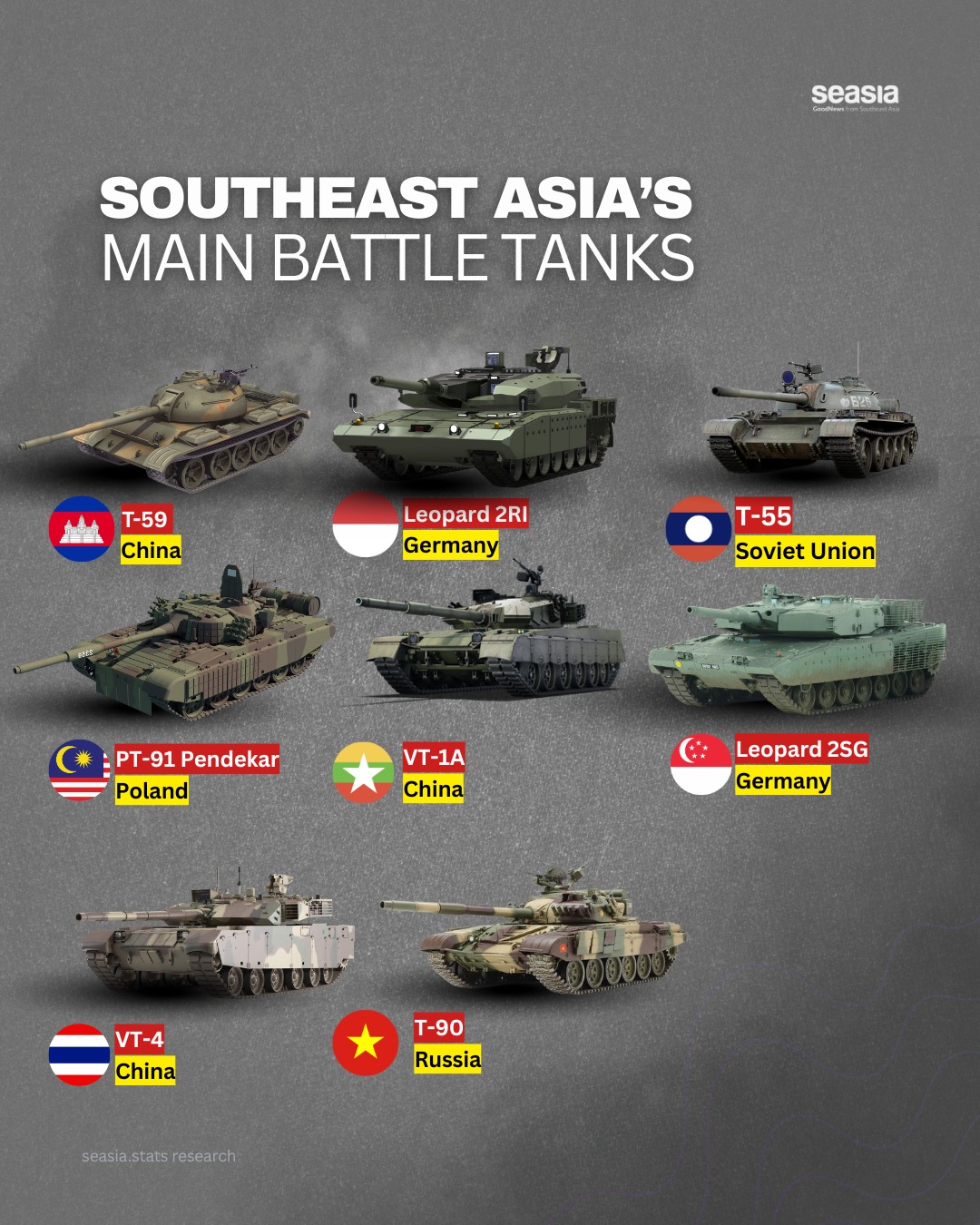
Across Southeast Asia, military modernization is accelerating as nations strengthen their defense capabilities amid evolving regional security dynamics. While naval and air power often dominate headlines, armored forces remain a crucial component of national defense strategies. Main Battle Tanks (MBTs) serve as the backbone of ground combat power, providing mobility, firepower, and protection on the battlefield.
Data highlighted by Seasia Stats shows that Southeast Asian armies rely on a remarkably diverse range of tank platforms sourced from Europe, China, and Russia, reflecting the region’s varied defense partnerships and procurement strategies. From advanced German-designed tanks to Soviet-era armor still in service, the region’s armored fleets reveal a complex blend of modernization and legacy equipment.
Western Technology in Indonesia and Singapore
Among Southeast Asian nations, Indonesia and Singapore operate some of the most advanced Western-designed tanks in the region.
Indonesia fields the Leopard 2RI, a modernized variant of the German-made Leopard 2 series. These tanks were upgraded specifically for Indonesian operational requirements, including improved armor protection and enhanced battlefield electronics. As Southeast Asia’s largest military force, Indonesia’s adoption of Leopard tanks reflects its broader modernization program aimed at strengthening territorial defense across its vast archipelago.
Similarly, Singapore operates the Leopard 2SG, another variant of Germany’s renowned Leopard 2 platform. Singapore’s highly professional armed forces emphasize technological superiority, and the Leopard 2SG represents one of the most advanced armored vehicles currently deployed in Southeast Asia.
The Leopard series, widely used by NATO countries, is known for its powerful 120mm smoothbore cannon, advanced targeting systems, and heavy armor, making it a cornerstone of Western armored warfare.
China Expands Its Defense Influence
Chinese-made tanks have become increasingly prominent in Southeast Asia as Beijing expands its defense partnerships throughout the region.
Thailand operates the VT-4, a modern Chinese main battle tank designed for export. The VT-4 features advanced fire-control systems, composite armor, and modern battlefield electronics, offering strong capabilities at a relatively competitive price.
Meanwhile, Myanmar fields the VT-1A, another Chinese-built platform that has become a key component of the country’s armored forces. China’s growing role as a defense supplier reflects both geopolitical partnerships and the affordability of its military equipment.
In Cambodia, the armored fleet is built around the T-59, a Chinese-developed version of the Soviet T-54 tank. Although older than many modern tanks, the T-59 remains operational in several countries due to its durability and simplicity.
Russian and Soviet Legacy Platforms
Russia and the former Soviet Union also remain major influences on Southeast Asia’s armored capabilities.
Vietnam, for example, operates the T-90, one of Russia’s most advanced main battle tanks. Known for its strong armor protection and powerful weapon systems, the T-90 continues the long-standing defense relationship between Moscow and Hanoi that dates back to the Cold War.
Meanwhile, Laos still operates the T-55, a Soviet-designed tank introduced in the late 1950s. Despite its age, the T-55 remains widely used around the world due to its reliability and ease of maintenance.
Eastern European Engineering in Malaysia
Another unique case in Southeast Asia is Malaysia, which operates the PT-91 Pendekar. This tank is a Polish modernization of the Soviet-designed T-72 platform, featuring upgraded armor, fire-control systems, and improved battlefield survivability.
The PT-91 represents Malaysia’s effort to balance cost-effective procurement with modern combat capability, ensuring the country maintains a capable armored force within its defense strategy.
A Diverse Armored Landscape
The diversity of tanks across Southeast Asia reflects the region’s complex geopolitical relationships and defense priorities. Unlike regions dominated by a single supplier, ASEAN countries procure equipment from a wide variety of sources, including Germany, China, Russia, and Eastern Europe.
As military modernization continues across the region, Southeast Asian nations are likely to further upgrade their armored capabilities. Whether through advanced Western platforms or increasingly sophisticated Chinese designs, the region’s armored forces remain an essential pillar of national defense.


