

In today’s rapidly evolving geopolitical landscape, Southeast Asia sits at the heart of one of the world’s most consequential strategic rivalries. The region, home to nearly 700 million people and some of the fastest-growing economies, has become a focal point of competition between global powers—most notably China and the United States.
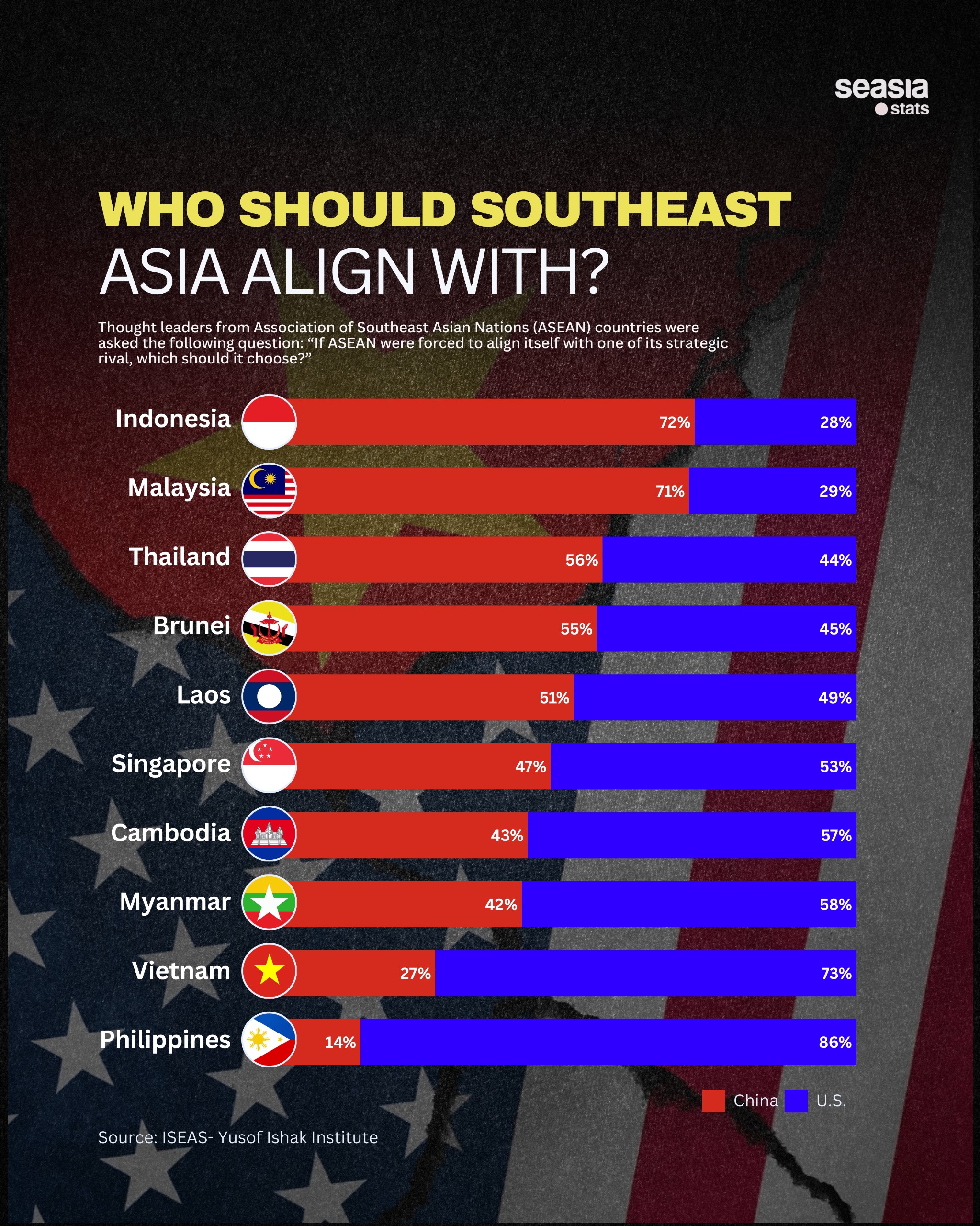
A recent analysis highlighted by Seasia Stats, drawing on research from the ISEAS–Yusof Ishak Institute, offers a revealing snapshot of how thought leaders across Southeast Asia view this rivalry. When asked a hypothetical but important question—if ASEAN were forced to align with one strategic rival, which should it choose?—responses showed a region divided between the two global giants.
A Strong Lean Toward China in Several ASEAN Nations
The survey results reveal that several Southeast Asian countries show a clear preference for closer alignment with China. Indonesia leads this group, with 72% of respondents favoring China over the United States. Malaysia follows closely at 71%, indicating strong confidence in China’s role as a regional economic partner.
Thailand and Brunei also show majority support for China, with 56% and 55% respectively favoring Beijing. Meanwhile, Laos registers a narrow majority at 51%, reflecting the country’s deep economic ties with China, particularly through infrastructure initiatives linked to the Belt and Road Initiative (BRI).
These preferences are not entirely surprising. Over the past two decades, China has become the largest trading partner for nearly every ASEAN country. Massive investments in railways, ports, industrial parks, and digital infrastructure have strengthened Beijing’s economic influence across the region.
For countries like Indonesia, Malaysia, and Thailand, the pragmatic benefits of economic cooperation with China—ranging from manufacturing investment to trade integration—play a major role in shaping strategic perceptions.
Strong Support for the United States in Key Countries
While several ASEAN nations lean toward China, others strongly favor alignment with the United States.
The Philippines shows the most decisive preference in the survey, with 86% of respondents supporting alignment with Washington. This overwhelming support reflects the country’s long-standing defense alliance with the U.S., as well as ongoing security concerns related to the South China Sea disputes.
Vietnam also demonstrates strong support for the United States, with 73% of respondents favoring closer alignment. Vietnam’s complex relationship with China—marked by both economic cooperation and territorial tensions—has driven Hanoi to deepen strategic ties with Washington and other partners.
Interestingly, Myanmar and Cambodia also lean toward the United States in the survey results, with 58% and 57% respectively expressing preference for Washington over Beijing. These results illustrate that strategic perceptions in the region are often more nuanced than commonly assumed.
Singapore: The Region’s Strategic Balancer
Among all ASEAN countries surveyed, Singapore represents the most evenly divided viewpoint.
The city-state shows a slight preference for the United States at 53%, compared to 47% for China. This narrow margin reflects Singapore’s long-standing foreign policy approach: maintaining strong relationships with both superpowers while avoiding exclusive alignment with either.
Singapore’s economy is deeply interconnected with China through trade and finance, yet it also maintains robust defense and strategic ties with the United States. As one of Asia’s leading financial hubs, the country often acts as a bridge between East and West.
ASEAN’s Delicate Balancing Act
Taken together, the survey results reveal a region split almost down the middle. Roughly half of the surveyed ASEAN nations lean toward China, while the other half favor the United States.
This divide underscores the delicate balancing act that defines Southeast Asian diplomacy. Rather than choosing sides outright, most ASEAN countries prefer to pursue a strategy of strategic autonomy—engaging with both powers while protecting their own national interests.
For Southeast Asia, the ultimate goal remains clear: maintaining stability, economic growth, and regional cooperation in a world increasingly shaped by great-power competition.


