

Southeast Asia’s economic rise over the past two decades has been powered not only by growing populations and expanding trade but also by the emergence of powerful regional corporations. From global banks to technology firms and telecommunications giants, companies across the ASEAN region are increasingly competing on the world stage. Market capitalization—often seen as a key indicator of a company’s financial strength and investor confidence—offers a clear snapshot of which corporations currently dominate the region’s economic landscape.
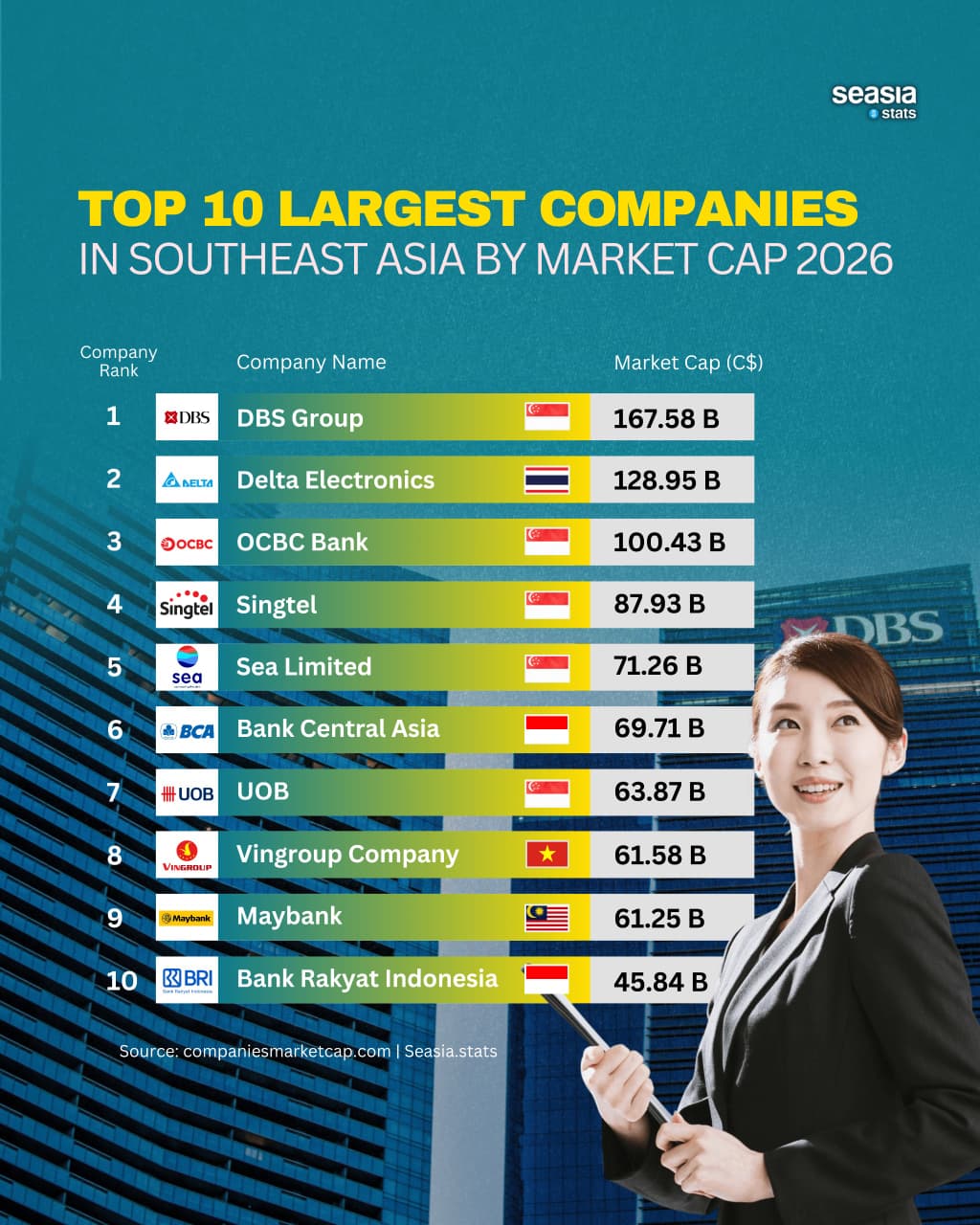
According to data compiled by companiesmarketcap.com and highlighted by Seasia Stats, the list of the largest companies in Southeast Asia by market capitalization in 2026 reflects the strong influence of Singapore’s financial sector, as well as the rising prominence of firms from Indonesia, Thailand, Vietnam, and Malaysia.
Singapore’s Financial Giants Lead the Region
Singapore stands out as the clear regional leader, with five companies occupying the top ten positions. The largest of them all is DBS Group, which holds the top spot with a market capitalization of $167.58 billion. As Southeast Asia’s largest bank, DBS has expanded its influence across Asia through digital banking innovations and regional investments.
In third place is OCBC Bank, valued at $100.43 billion, reinforcing Singapore’s reputation as a global financial hub. The country’s strong regulatory environment and reputation for stability have allowed its banking sector to flourish.
Other Singapore-based companies in the top rankings include Singtel, one of Asia’s largest telecommunications companies, and Sea Limited, the tech powerhouse behind the popular e-commerce platform Shopee and gaming division Garena. United Overseas Bank (UOB) also appears in the top ten, further demonstrating the city-state’s dominance in regional banking.
Singapore’s strong presence in the list highlights its strategic role as ASEAN’s financial center, connecting global capital with the fast-growing markets of Southeast Asia.
Thailand’s Technology Champion
Breaking Singapore’s dominance at the top is Delta Electronics Thailand, which ranks second with a market capitalization of $128.95 billion. Delta Electronics has become a global leader in power electronics, energy-efficient solutions, and industrial automation.
The company’s rise reflects Thailand’s growing importance in the global manufacturing supply chain, particularly in advanced electronics and green technologies.
Indonesia’s Banking Powerhouses
Indonesia, Southeast Asia’s largest economy, is represented by two major banks in the top ten.
Bank Central Asia (BCA) ranks sixth with a market capitalization of $69.71 billion. Known for its strong digital banking services and loyal customer base, BCA has consistently been one of Indonesia’s most valuable companies.
Another Indonesian giant, Bank Rakyat Indonesia (BRI), appears in tenth place with a market cap of $45.84 billion. BRI is widely recognized for its extensive microfinance network, serving millions of small businesses and rural communities across Indonesia.
The presence of these banks highlights the crucial role of financial services in supporting Indonesia’s rapidly expanding economy.
Regional Champions from Vietnam and Malaysia
Beyond Singapore, Thailand, and Indonesia, the ranking also includes leading corporations from other Southeast Asian nations.
Vietnam’s Vingroup ranks eighth with a market capitalization of $61.58 billion. The conglomerate has expanded into industries ranging from real estate and retail to electric vehicles and technology, making it one of Vietnam’s most influential corporate groups.
Malaysia’s Maybank follows closely behind in ninth place with a market cap of $61.25 billion. As Malaysia’s largest bank, Maybank plays a significant role in regional finance, with operations across multiple ASEAN countries.
ASEAN’s Growing Corporate Power
The companies on this list represent more than just financial success—they reflect the broader transformation of Southeast Asia into one of the world’s most dynamic economic regions.
Countries such as Vietnam, Indonesia, Thailand, and Malaysia continue to nurture national corporate champions that are expanding beyond domestic markets. Meanwhile, Singapore remains a financial powerhouse that connects global investment with Southeast Asia’s rapidly growing economies.
As ASEAN’s combined economy continues to expand, these corporate giants are likely to play an increasingly important role in shaping the region’s future—driving innovation, creating jobs, and strengthening Southeast Asia’s position in the global economic landscape.


