

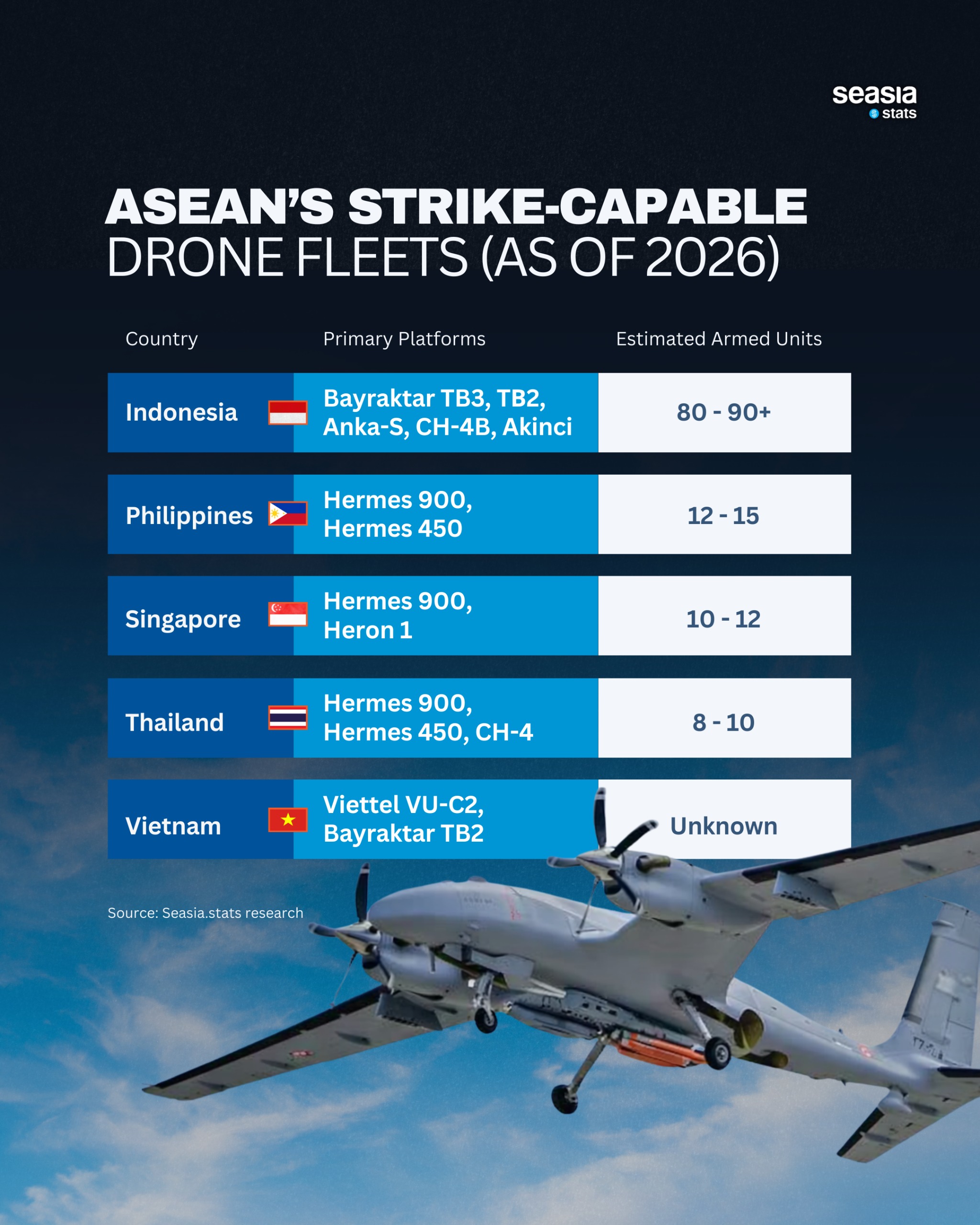
Across Southeast Asia, military modernization is entering a new phase as countries invest heavily in unmanned aerial vehicles (UAVs). These drones—capable of surveillance, reconnaissance, and precision strike missions—are becoming essential tools for modern defense strategies. As maritime disputes, border security challenges, and counterterrorism operations evolve, many ASEAN nations are integrating strike-capable drones into their armed forces. According to research highlighted by Seasia Stats, several Southeast Asian countries now operate armed UAV fleets, reflecting a growing shift toward unmanned warfare across the region.
Indonesia Leads ASEAN’s Armed Drone Fleet
Indonesia currently possesses the largest strike-capable drone fleet in Southeast Asia, with an estimated 80 to more than 90 armed UAV units. This substantial inventory demonstrates Jakarta’s commitment to strengthening its surveillance and combat capabilities across its vast archipelagic territory.
Indonesia’s drone arsenal includes a diverse set of platforms such as the Bayraktar TB3, Bayraktar TB2, Anka-S, CH-4B, and the advanced Akinci combat drone. These UAVs provide long-range reconnaissance and precision strike capabilities that are particularly useful for monitoring Indonesia’s extensive maritime borders.
Given Indonesia’s geography—spanning more than 17,000 islands and thousands of kilometers of coastline—drones play a crucial role in maritime patrol, anti-smuggling operations, and national defense. The country has also shown interest in developing domestic drone technologies through cooperation with international partners and local defense industries.
The Philippines Strengthens Its Surveillance Capabilities
In second place within ASEAN is the Philippines, which operates an estimated 12 to 15 strike-capable drones. The Philippine military primarily relies on Israeli-made platforms such as the Hermes 900 and Hermes 450, both widely used for intelligence, surveillance, and reconnaissance missions.
These drones have become essential for the Philippines’ defense strategy, particularly in monitoring its vast maritime zones and responding to security challenges. The country has been steadily upgrading its defense capabilities as part of its long-term military modernization program.
Drones allow the Philippine armed forces to conduct real-time monitoring of territorial waters and remote areas, significantly improving situational awareness without requiring large numbers of personnel.
Singapore’s High-Tech Drone Force
Despite its relatively small size, Singapore ranks third in the region with an estimated 10 to 12 armed drones. The country’s UAV fleet focuses on technologically advanced systems such as the Hermes 900 and the Heron 1.
Singapore’s defense strategy emphasizes precision, technology, and efficiency, and unmanned systems play an important role in this approach. The Singapore Armed Forces have long invested in cutting-edge defense technologies, including artificial intelligence, cyber capabilities, and autonomous systems.
Drones enable Singapore to conduct surveillance missions, border monitoring, and intelligence gathering with high levels of precision while minimizing risk to personnel.
Thailand and Vietnam Expand Their Capabilities
Thailand ranks next with an estimated 8 to 10 strike-capable drones, including systems like the Hermes 900, Hermes 450, and the Chinese-made CH-4. These UAVs support Thailand’s military operations by providing reconnaissance and strike capabilities across land and maritime environments.
Meanwhile, Vietnam is also developing its drone capabilities, although the exact number of its armed UAVs remains unclear. The country operates the Viettel VU-C2, a domestically developed drone, alongside the Turkish-made Bayraktar TB2.
Vietnam’s approach highlights a growing emphasis on domestic defense technology, as local companies increasingly contribute to the development of advanced military systems.
A Growing Trend Across Southeast Asia
While the infographic highlights five countries with known strike-capable fleets, other Southeast Asian nations are also exploring UAV technologies. Countries such as Malaysia, Cambodia, and Myanmar have begun integrating drones into surveillance and border security operations.
Across the region, drones are proving valuable not only for military use but also for disaster response, maritime monitoring, and environmental protection. As technology continues to advance, unmanned systems are expected to become even more central to national security strategies.
Ultimately, the expansion of strike-capable drone fleets reflects a broader transformation in Southeast Asia’s defense landscape. With increasing investments in technology and modernization, ASEAN countries are steadily adapting to the evolving realities of modern warfare.


