

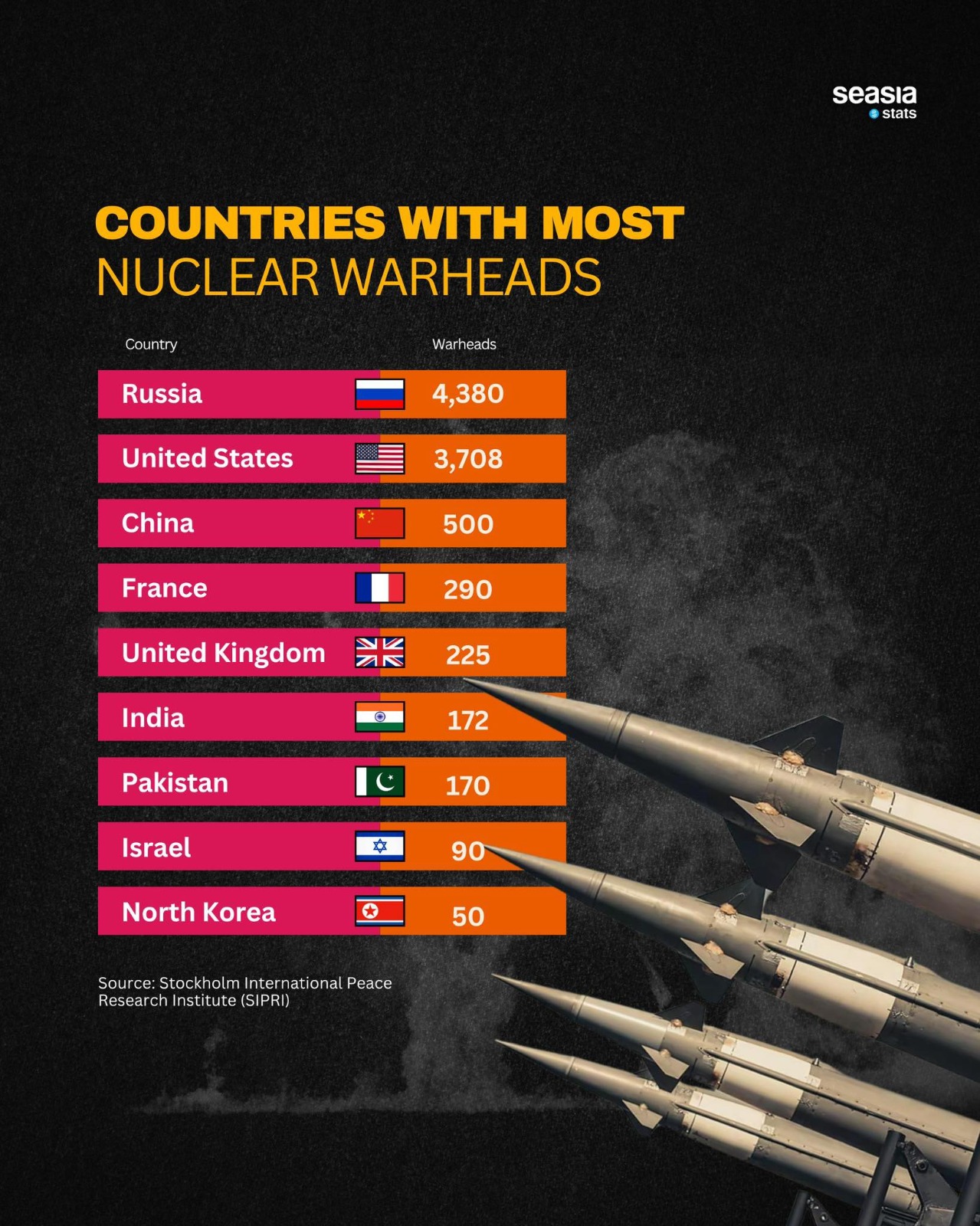
In the modern geopolitical landscape, nuclear weapons remain one of the most powerful—and controversial—symbols of military strength. More than seven decades after the first atomic bombs were used in warfare, nuclear arsenals still shape global security strategies and diplomatic relations. According to data from the Stockholm International Peace Research Institute (SIPRI) and the Federation of American Scientists, the world’s nuclear landscape in 2026 is dominated by a handful of countries whose stockpiles define the balance of power.
Russia and the United States: The Two Nuclear Superpowers
At the top of the global ranking stands Russia, possessing approximately 4,380 nuclear warheads in its military stockpile. When including reserve and retired warheads, Russia’s total nuclear inventory is estimated at around 5,459 warheads.
Close behind is the United States, with roughly 3,708 warheads in its active military stockpile and an overall inventory estimated between 5,044 and 5,177. Together, Russia and the United States control roughly 87% of the world’s total nuclear arsenal, making them by far the most influential players in global nuclear deterrence.
Historically, both countries limited their arsenals through arms control agreements such as the New START treaty. However, with the treaty’s expiration in February 2026, there are currently no major bilateral agreements in place to cap or verify their nuclear inventories, raising concerns among international security experts.
China’s Rapid Nuclear Expansion
China holds the third-largest nuclear arsenal, currently estimated at around 500 warheads in the ranking presented by Seasia Stats. However, several international research organizations estimate that the country’s stockpile has grown to approximately 600 warheads as of 2025.
China is currently undergoing the fastest nuclear expansion in its history. Analysts predict that Beijing could possess at least 1,000 warheads by 2030 and potentially as many as 1,500 by 2035 if current trends continue.
This rapid buildup reflects China’s evolving military strategy and its desire to maintain a credible deterrent alongside the United States and Russia.
Europe’s Nuclear Powers
Two European countries also maintain nuclear arsenals: France and the United Kingdom. France holds approximately 290 nuclear warheads, while the United Kingdom maintains around 225.
Both countries rely primarily on submarine-launched ballistic missiles as the backbone of their nuclear deterrence strategies. In 2026, French President Emmanuel Macron announced plans to expand France’s nuclear capabilities as part of a broader “advanced deterrence” framework aimed at strengthening Europe’s strategic autonomy.
Although smaller than those of the United States or Russia, the nuclear forces of France and the United Kingdom remain technologically sophisticated and highly operational.
South Asia’s Strategic Rivalry
In South Asia, nuclear weapons play a central role in the strategic rivalry between India and Pakistan. India currently possesses approximately 172 warheads, slightly ahead of Pakistan’s estimated 170.
Both countries have steadily modernized their nuclear capabilities over the past two decades, developing a variety of missile systems capable of delivering nuclear payloads. Their arsenals serve primarily as deterrents in the context of longstanding geopolitical tensions.
Israel and North Korea
Two additional countries round out the list of nuclear-armed states featured in the ranking. Israel is widely believed to possess about 90 nuclear warheads, though it maintains a long-standing policy of “strategic ambiguity” and has never officially confirmed its nuclear arsenal.
North Korea is estimated to have around 50 assembled warheads. However, analysts believe the country possesses enough fissile material to potentially double that number in the coming years as it continues to advance its missile technology.
Southeast Asia’s Nuclear-Free Zone
While nuclear weapons dominate discussions of global security, Southeast Asia has taken a different approach. The region is covered by the Southeast Asian Nuclear-Weapon-Free Zone (SEANWFZ) Treaty, signed in 1995 by ASEAN member states.
Countries such as Indonesia, Malaysia, Thailand, Vietnam, and the Philippines have committed to prohibiting nuclear weapons within their territories. This agreement reflects a regional consensus prioritizing diplomacy, stability, and non-proliferation.
As nuclear powers continue to modernize and expand their arsenals, Southeast Asia’s commitment to remaining a nuclear-free region stands as a reminder that not all security strategies rely on atomic deterrence.


