

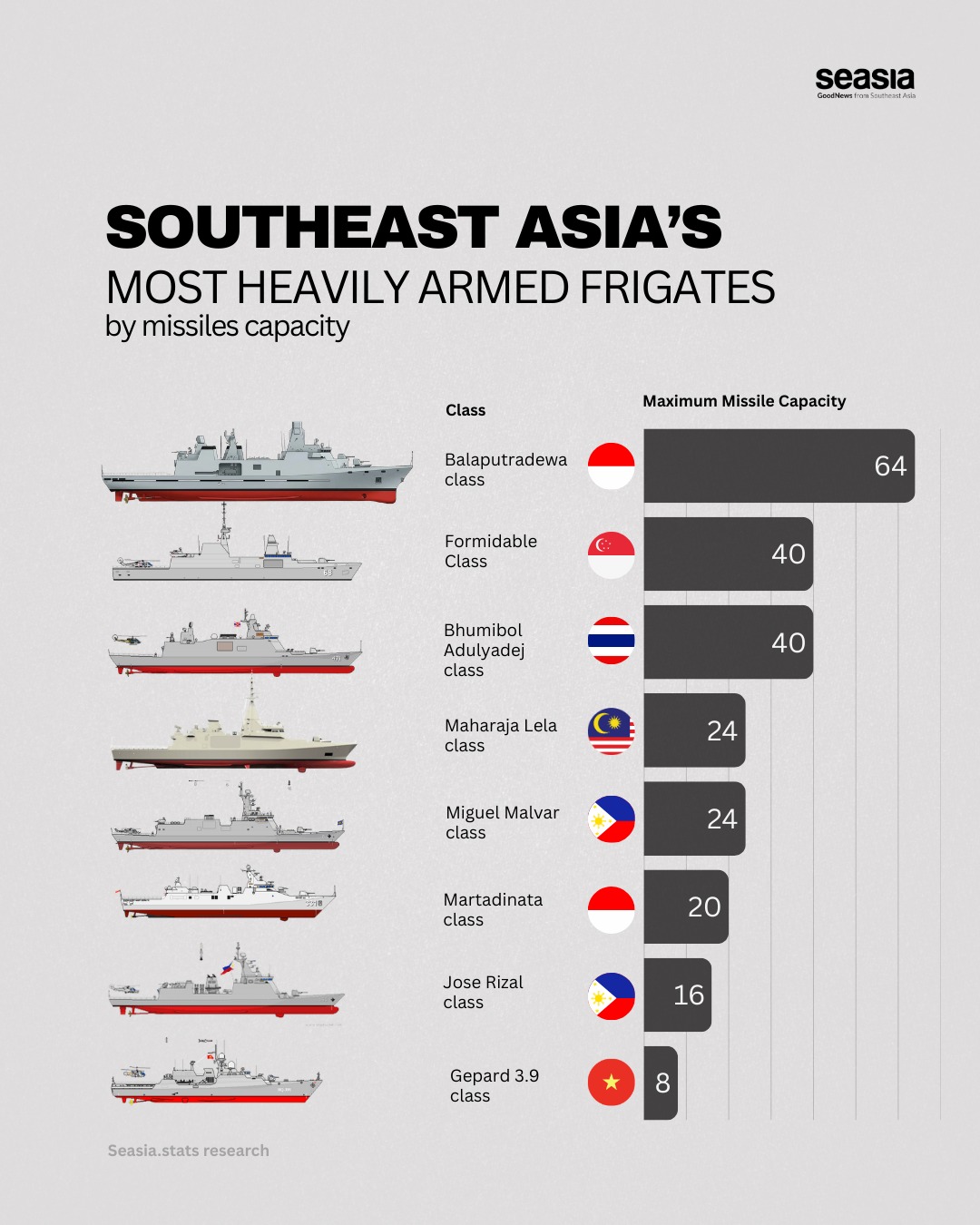
In recent years, Southeast Asia has witnessed a steady modernization of its naval forces. As maritime trade routes, territorial waters, and strategic sea lanes become increasingly important, regional countries are investing heavily in advanced warships capable of defending national interests. Among these vessels, frigates play a central role. Designed to balance firepower, mobility, and versatility, modern frigates serve as the backbone of many Southeast Asian navies. According to research compiled by Seasia Stats, several frigate classes in the region stand out for their missile capacity—one of the key indicators of a warship’s offensive and defensive capabilities.
Indonesia’s Balaputradewa Class Leads the Region
At the top of the regional ranking stands Indonesia’s Balaputradewa class frigate, which boasts a maximum missile capacity of 64 missiles, making it the most heavily armed frigate in Southeast Asia. This significant firepower highlights Indonesia’s ambition to strengthen its naval deterrence capabilities and protect its vast maritime territory.
Indonesia’s strategic geography—spanning more than 17,000 islands and sitting along some of the world’s busiest shipping lanes—requires a capable naval force. Frigates like the Balaputradewa class are designed to perform multiple roles, including anti-air warfare, anti-ship combat, and maritime patrol operations. Their large missile capacity allows them to respond to a variety of threats while supporting broader fleet operations.
The Indonesian Navy has also been expanding its shipbuilding capabilities through domestic defense industries, reflecting a long-term strategy to increase naval independence and technological capability.
Singapore and Thailand’s High-Tech Frigates
The second tier of Southeast Asia’s missile-heavy frigates is shared by Singapore’s Formidable class and Thailand’s Bhumibol Adulyadej class, each capable of carrying up to 40 missiles.
Singapore’s Formidable-class frigates are widely regarded as some of the most technologically advanced warships in the region. Equipped with sophisticated radar systems, stealth design features, and modern combat management systems, these ships serve as the core of the Republic of Singapore Navy’s fleet.
Thailand’s Bhumibol Adulyadej-class frigates also represent a new generation of advanced naval vessels. These ships combine modern sensor technology with powerful missile systems, enabling the Royal Thai Navy to conduct complex maritime operations while maintaining strong defensive capabilities.
Both Singapore and Thailand emphasize technological superiority and strategic efficiency, allowing their navies to maintain significant operational strength despite smaller fleet sizes.
Malaysia and the Philippines Strengthen Their Fleets
In the mid-range of the ranking are Malaysia’s Maharaja Lela class and the Philippines’ Miguel Malvar class, each capable of carrying 24 missiles. These ships represent important milestones in the modernization of their respective navies.
Malaysia’s Maharaja Lela-class frigates form part of the Royal Malaysian Navy’s long-term naval transformation program. Designed with stealth features and modern combat systems, these vessels are intended to enhance Malaysia’s maritime surveillance and defense capabilities.
The Philippines has also invested heavily in naval modernization in recent years. The Miguel Malvar class reflects Manila’s growing emphasis on maritime security, particularly as the country seeks to strengthen its ability to monitor and protect its territorial waters.
Additional Frigates Across the Region
Other notable vessels in Southeast Asia include Indonesia’s Martadinata-class frigates, which carry up to 20 missiles, and the Philippines’ Jose Rizal class, with a capacity of 16 missiles. These ships contribute significantly to their nations’ ability to patrol large maritime areas and respond to emerging security challenges.
Vietnam’s Gepard 3.9-class frigates, with a missile capacity of 8, complete the regional ranking. While smaller in missile capacity compared to some of their counterparts, these ships remain important assets within Vietnam’s naval strategy.
A Region Increasing Its Maritime Capabilities
Across Southeast Asia, naval modernization reflects a broader recognition of the importance of maritime security. The region sits at the crossroads of global trade routes, with critical waterways such as the Malacca Strait, the South China Sea, and the Lombok Strait playing vital roles in international shipping.
As economic growth continues and maritime interests expand, Southeast Asian nations are increasingly investing in advanced warships, surveillance systems, and naval infrastructure. Frigates—versatile, powerful, and adaptable—will remain central to these efforts, shaping the future of naval power in the region.


