

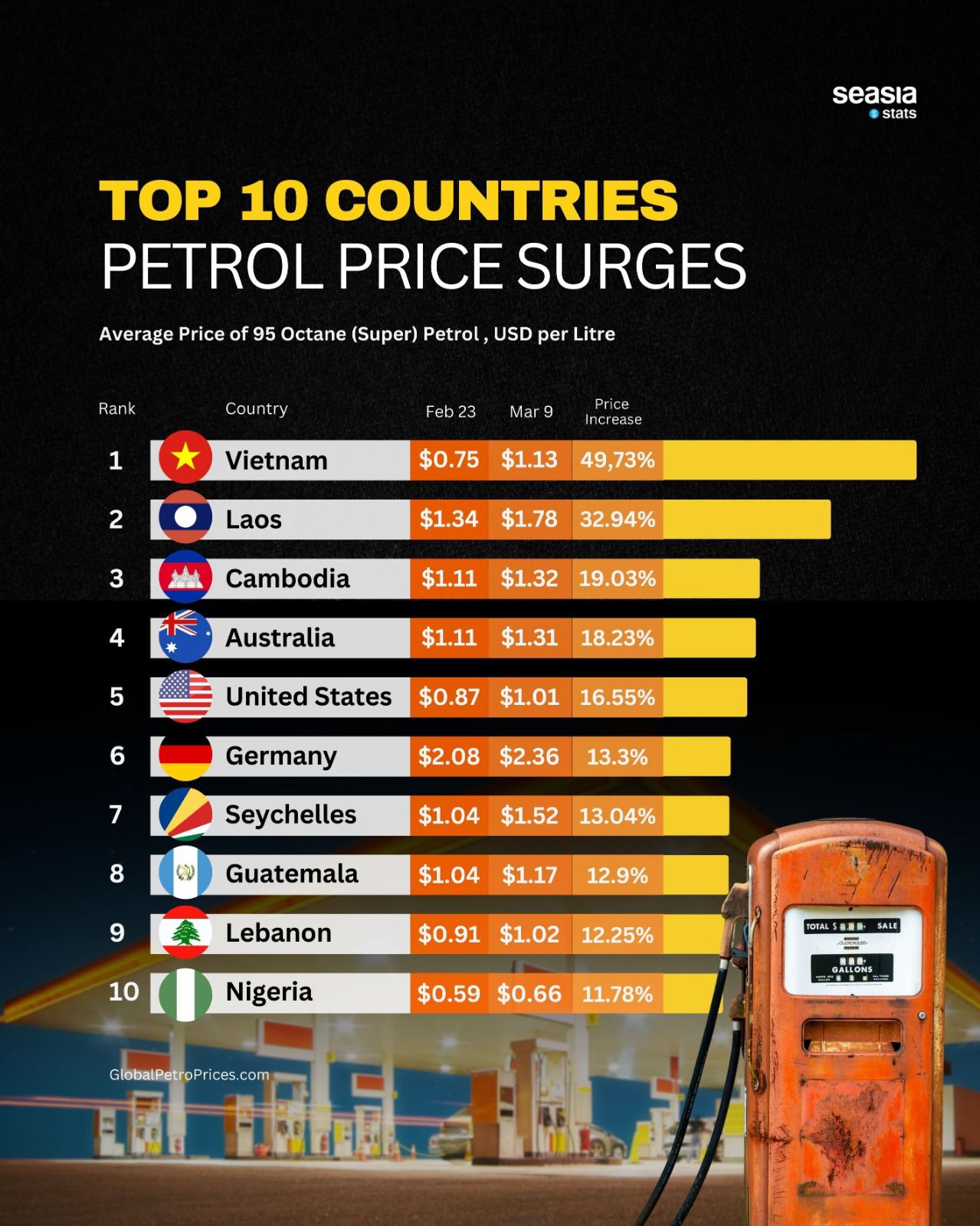
Fuel prices rarely stay a matter of economics alone. Once petrol jumps sharply, it quickly becomes a story about commuting, food inflation, delivery costs, tourism, and public anger. The latest Seasia Stats graphic, based on data from GlobalPetrolPrices.com, captures that pressure in real time: in just over two weeks, several countries saw noticeable spikes in the average price of 95-octane petrol, with Vietnam, Laos, and Cambodia emerging as the most heavily hit in Southeast Asia.
Southeast Asia Takes the Hardest Hit
The most dramatic jump came in Vietnam, where the average price of petrol reportedly climbed from US$0.75 to US$1.13 per litre between February 23 and March 9, a surge of 49.73%. Laos followed with a 32.94% increase, while Cambodia ranked third with a 19.03% rise. That means three Southeast Asian countries occupied the top three positions in the global list—an indication of just how vulnerable the region remains to external energy shocks.
The broader backdrop is global. The International Energy Agency said in its March oil market report that prices had become highly volatile amid supply disruption fears and geopolitical instability, with oil markets “gyrating wildly” during the month.
In Vietnam, the government was forced into action as fuel prices rose repeatedly in March. Reuters reported that authorities tapped the country’s fuel price stabilization fund and later suspended some fuel taxes to cushion consumers and businesses from the shock. One Reuters report noted that “gasoline prices jumped 7.66%” in one official adjustment, while another said Hanoi moved to suspend taxes on fuels “to stabilise the domestic market.”
Why Southeast Asia Is So Exposed
Southeast Asia’s problem is not simply high oil prices—it is dependence. Many economies in the region are highly exposed to imported fuel, and even those with domestic refining or production still depend on global supply chains, shipping routes, and regional trade flows.
That fragility became especially clear in Cambodia, where Reuters reported that the country had to turn to Singapore and Malaysia for more fuel after supply from Vietnam and China tightened. At one point, roughly a third of Cambodia’s petrol stations temporarily shut amid uncertainty, before supplies gradually stabilized.
Laos, meanwhile, has long faced structural fuel vulnerabilities because of its landlocked geography, limited refining capacity, and dependence on cross-border supply. That makes it especially sensitive not only to global oil prices, but also to regional transport bottlenecks and currency pressure.
The contrast inside ASEAN is telling. While Vietnam, Laos, and Cambodia experienced the sharpest price jumps, countries such as Indonesia, Malaysia, and Thailand were more focused on shielding consumers through subsidies, controls, or budget support. Reuters reported that Indonesia said it would absorb part of the oil shock through the state budget, while Malaysia increased spending to maintain fixed fuel prices. Thailand, for its part, sought to cap diesel prices and explore alternative energy sources while promoting subsidised biodiesel.
Beyond the Pump: A Wider Economic Ripple
The impact of fuel inflation does not stop at gas stations. It feeds directly into transport fares, airline operating costs, logistics, manufacturing, and household spending. In Southeast Asia, where motorcycles, delivery fleets, intercity buses, and fuel-intensive food distribution are essential to daily life, petrol price spikes hit especially hard.
Reuters has already reported that higher energy prices have begun to ripple across Asian supply chains, affecting industries from packaging to food production. In Vietnam, the pressure became so serious that officials even warned sectors such as aviation to prepare for potential supply disruptions if the crisis dragged on.
That is why this ranking matters beyond its numbers. It is not just about who paid more for petrol in early March. It is about which economies are most exposed when global energy markets seize up—and, in this round, Southeast Asia was clearly on the front line.
For ASEAN governments, the lesson is becoming harder to ignore: fuel volatility is no longer a temporary inconvenience. It is now a structural risk to growth, inflation, and political stability.


