

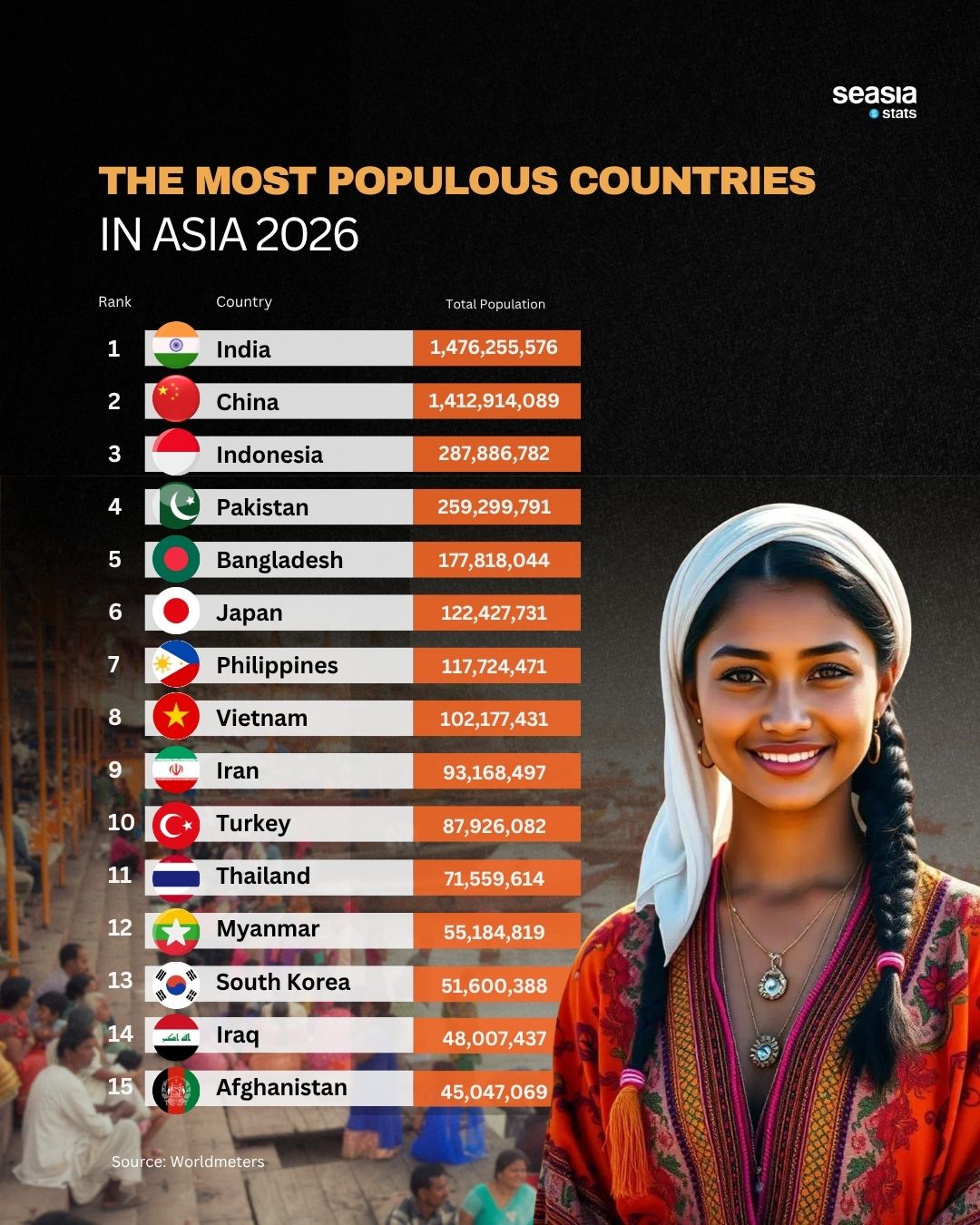
Asia’s population map in 2026 is not just a story of size. It is a story of momentum, youth, urbanization, migration, and the enormous pressure placed on governments trying to build enough jobs, housing, schools, hospitals, and transport systems for hundreds of millions of people. The continent remains the demographic center of the world—and nowhere is that more visible than in the gap between its giant population powers and the rest of the field.
The billion-person giants still define the continent
India remains Asia’s most populous country in 2026, with an estimated 1.476 billion people, followed by China at 1.412 billion. Together, they still dominate the demographic landscape of the continent in a way that no other pair of countries on Earth can match.
But the contrast between the two is becoming increasingly important. India’s population story is still driven by youth, labor force expansion, and long-term domestic demand. China’s, by contrast, is increasingly shaped by aging, slower population growth, and the economic implications of a shrinking working-age base. The headline numbers may look close, but the demographic trajectories are moving in very different directions.
That divergence will matter not only for economic competition, but also for manufacturing, migration, education, and even military planning across Asia over the next two decades.
Southeast Asia’s population weight is impossible to ignore
If India and China dominate the top, Southeast Asia provides some of the most strategically important population clusters in the entire ranking. Indonesia, with nearly 288 million people, remains the third most populous country in Asia and by far the largest in Southeast Asia. It is followed by the Philippines at 117.7 million, Vietnam at 102.1 million, Thailand at 71.5 million, and Myanmar at 55.1 million.
That means Southeast Asia is not just a regional bloc of mid-sized economies—it is home to some of the most significant consumer and labor markets in the world.
Indonesia’s scale gives it extraordinary long-term importance. It is not just ASEAN’s largest economy; it is one of the few countries in the world with the population size to support truly massive domestic consumption while still serving as a manufacturing and investment destination. The Philippines, meanwhile, continues to stand out for its youthful population, a factor that shapes everything from labor exports to digital consumption and long-term growth potential.
Vietnam’s crossing of the 100 million mark is particularly symbolic. It confirms the country’s transformation from a rising frontier economy into one of Asia’s central industrial and demographic players. Thailand, by contrast, reflects a more mature population profile, with aging now becoming a more serious national concern.
Population is power—but also pressure
Large populations can be an advantage, but only if states can convert demographic weight into human capital. That is where the challenge becomes much harder.
Across Asia, fast-growing populations bring opportunities for labor supply, urban markets, and industrial expansion. But they also place intense pressure on infrastructure, healthcare systems, public education, food security, and employment generation. A country can be demographically rich and still economically strained if institutions fail to keep pace.
That is especially true in Southeast Asia, where rapid urban growth has transformed cities like Jakarta, Manila, Ho Chi Minh City, and Bangkok into some of the most dynamic—but also most congested and unequal—urban centers in the region.
The real story is what comes next
The most important question is no longer simply which countries are the biggest. It is which countries are best prepared for what their population size means.
For India and much of Southeast Asia, the challenge is creating enough productive opportunity for a still-expanding population. For China, Japan, and South Korea, it is how to sustain prosperity amid aging and demographic slowdown.
In that sense, Asia’s population rankings are not just a snapshot of how many people live where. They are a preview of where the next great struggles—and opportunities—of the 21st century will unfold.


