

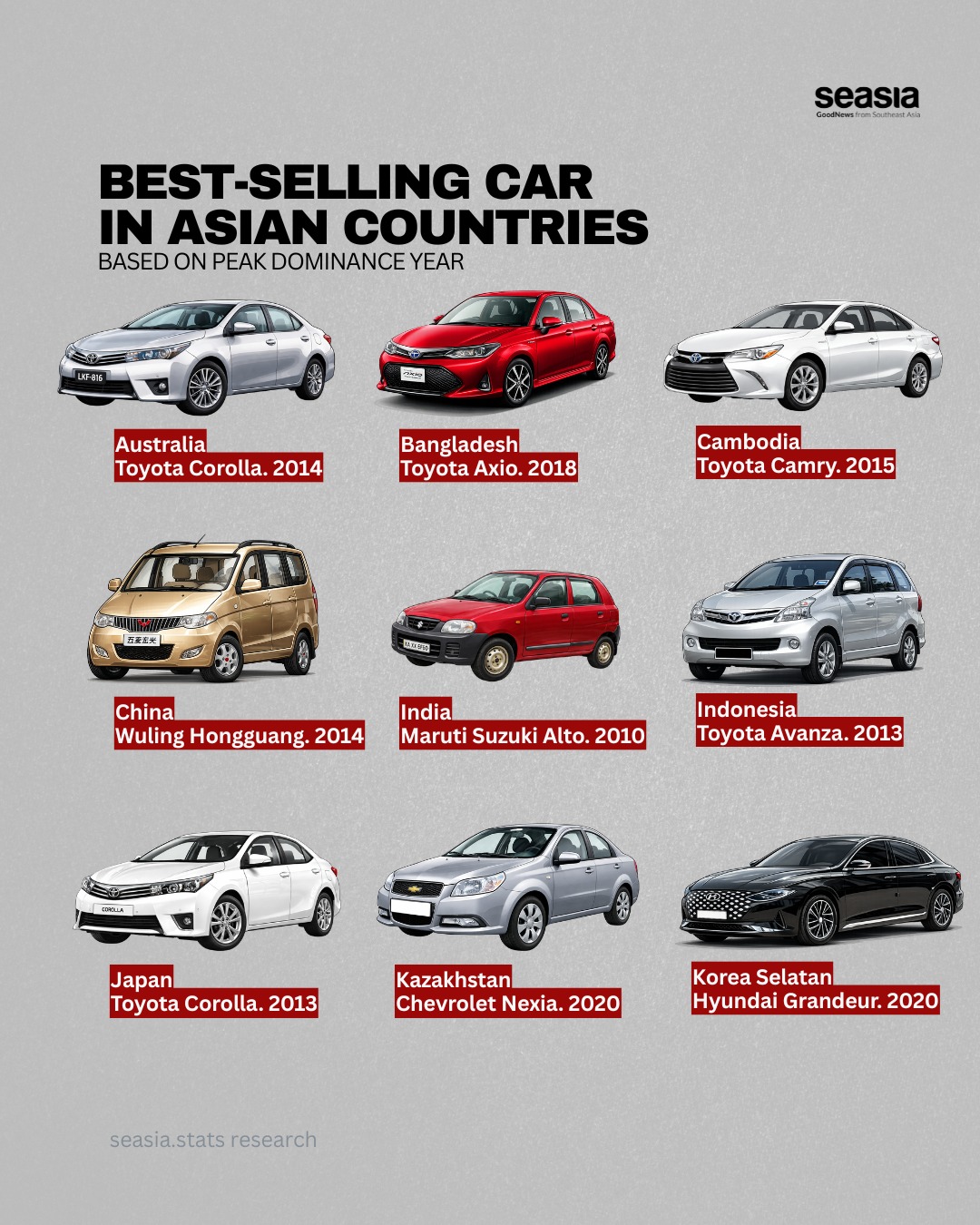
Cars can tell you a lot about a country. Not just what people drive, but how they live, what they can afford, what roads they use, what families need, and what brands they trust. That is what makes this Seasia Stats infographic so interesting: it is less about horsepower than about national character. Across Asia, the “best-selling car” in its peak-dominance year often reflects a very specific local reality.
Toyota’s Quiet Empire Across Asia
The most obvious story is Toyota’s reach. Across the infographic, the Japanese giant appears again and again: Corolla in Australia and Japan, Axio in Bangladesh, Camry in Cambodia and Saudi Arabia, Avanza in Indonesia, Vios in the Philippines and Vietnam, Corolla Altis in Singapore, and Hilux in Thailand.
That kind of spread is not accidental. Toyota has long built its Asian success around durability, resale value, easy servicing, and a model lineup that can adapt to wildly different markets—from dense city-states to pickup-heavy economies. Even recent reporting still notes Toyota’s unusually strong regional hold, with one Philippine feature describing the company as responsible for “roughly two out of every five brand-new cars sold” in the country.
In other words, Toyota does not just sell cars in Asia. In many places, it sells familiarity.
Southeast Asia’s Best-Sellers Reveal How People Actually Move
If there is one region where this pattern becomes most vivid, it is Southeast Asia.
Take Indonesia, where the Toyota Avanza dominated in 2013. That makes perfect sense for a country where the car is often expected to do the work of both family sedan and informal people carrier. The Avanza is not glamorous, but it is practical, roomy, and mechanically simple—qualities that matter far more in a sprawling archipelago than flashy branding.
In Thailand, the best-seller was the Toyota Hilux in 2018, which says a lot about Thailand’s automotive identity. Thailand is not just a passenger-car market; it is one of Asia’s pickup strongholds, where one-ton trucks are central to small business, farming, logistics, and provincial mobility. Toyota’s long-term investment in Thailand’s production ecosystem helped reinforce that dominance.
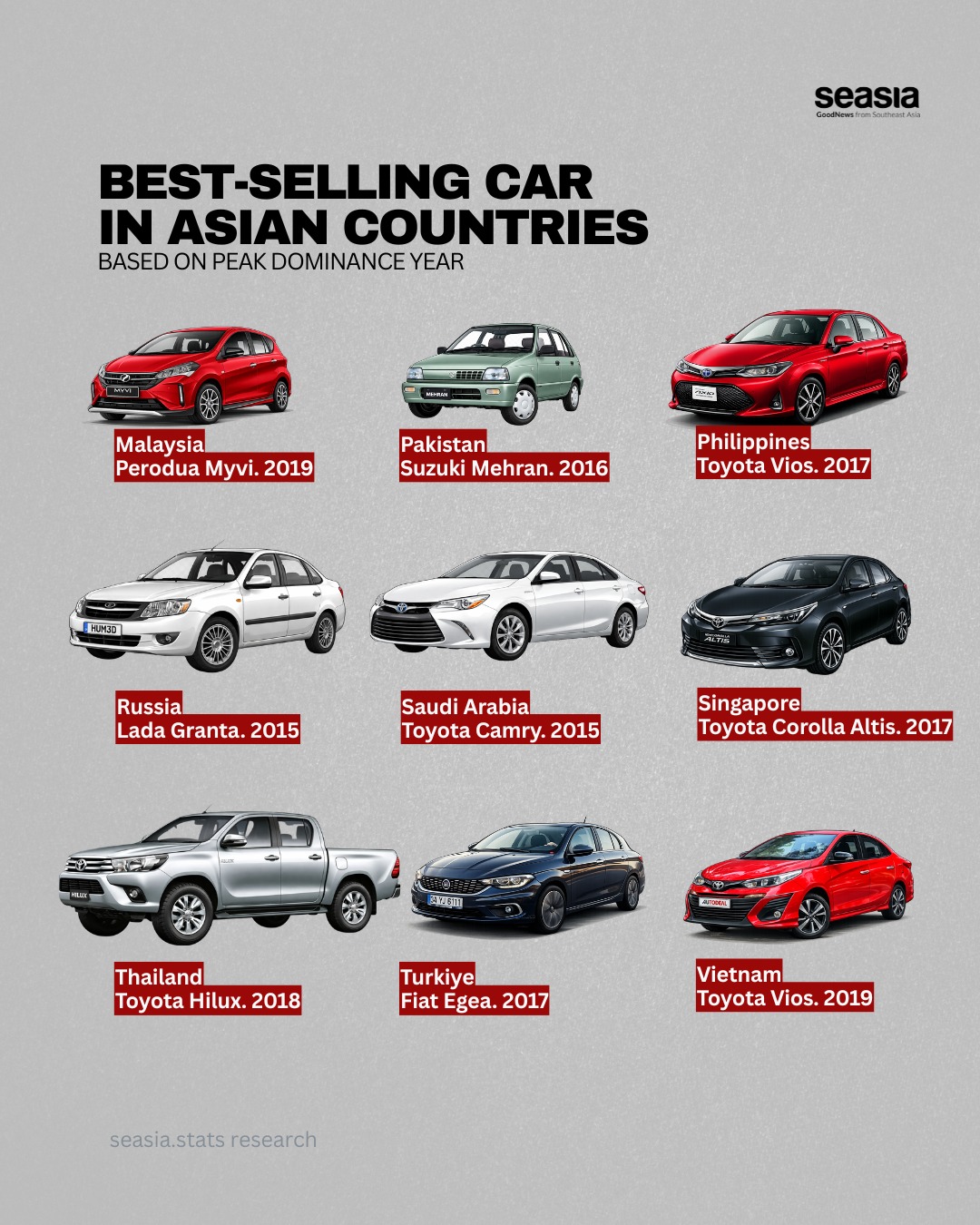
The Philippines and Vietnam both crowned the Toyota Vios in their peak years, and that feels telling too. The Vios occupies a sweet spot in Southeast Asia: compact enough for cities, comfortable enough for families, and credible enough for ride-hailing, small business use, and first-time ownership. It became not just a car, but a default.
Meanwhile, Singapore favored the Toyota Corolla Altis in 2017, reflecting a market where reliability, efficient packaging, and long-term ownership logic often matter more than sheer size.
When Local Heroes Push Back
Still, Toyota does not win everywhere—and those exceptions are often the most revealing.
In Malaysia, the Perodua Myvi topped the market in 2019, and it remains one of the clearest examples of a car becoming a national institution. Malaysian auto media described it bluntly: “The Perodua Myvi remains the best-selling car in the country, and by a clear margin.” Another report noted that it accounted for 34.1% of Perodua’s total sales in 2019.
That is not just commercial success. That is cultural penetration. The Myvi works because it matches Malaysia’s urban realities almost perfectly: affordable, compact, efficient, and domestically resonant.
Elsewhere, similar patterns appear. China’s Wuling Hongguang became a bestseller because it answered the needs of lower-tier cities and small businesses. India’s Maruti Suzuki Alto dominated because it democratized first-time car ownership. South Korea’s Hyundai Grandeur and Russia’s Lada Granta show how national brands still matter when pride, familiarity, and industrial policy align.
The Real Story Is Fit, Not Prestige
What this infographic really shows is that Asia’s most successful cars are rarely the most aspirational. They are the most useful.
They fit narrow streets, large families, uneven roads, rising middle classes, delivery work, school runs, and tight household budgets. In Southeast Asia especially, the bestselling car is often the one that can do five jobs at once.
That is why this list matters. It reminds us that the most popular car in a country is never just about design or status. It is about everyday life—and in that sense, the roads of Asia are telling a much bigger story than the badges on the grille.


