

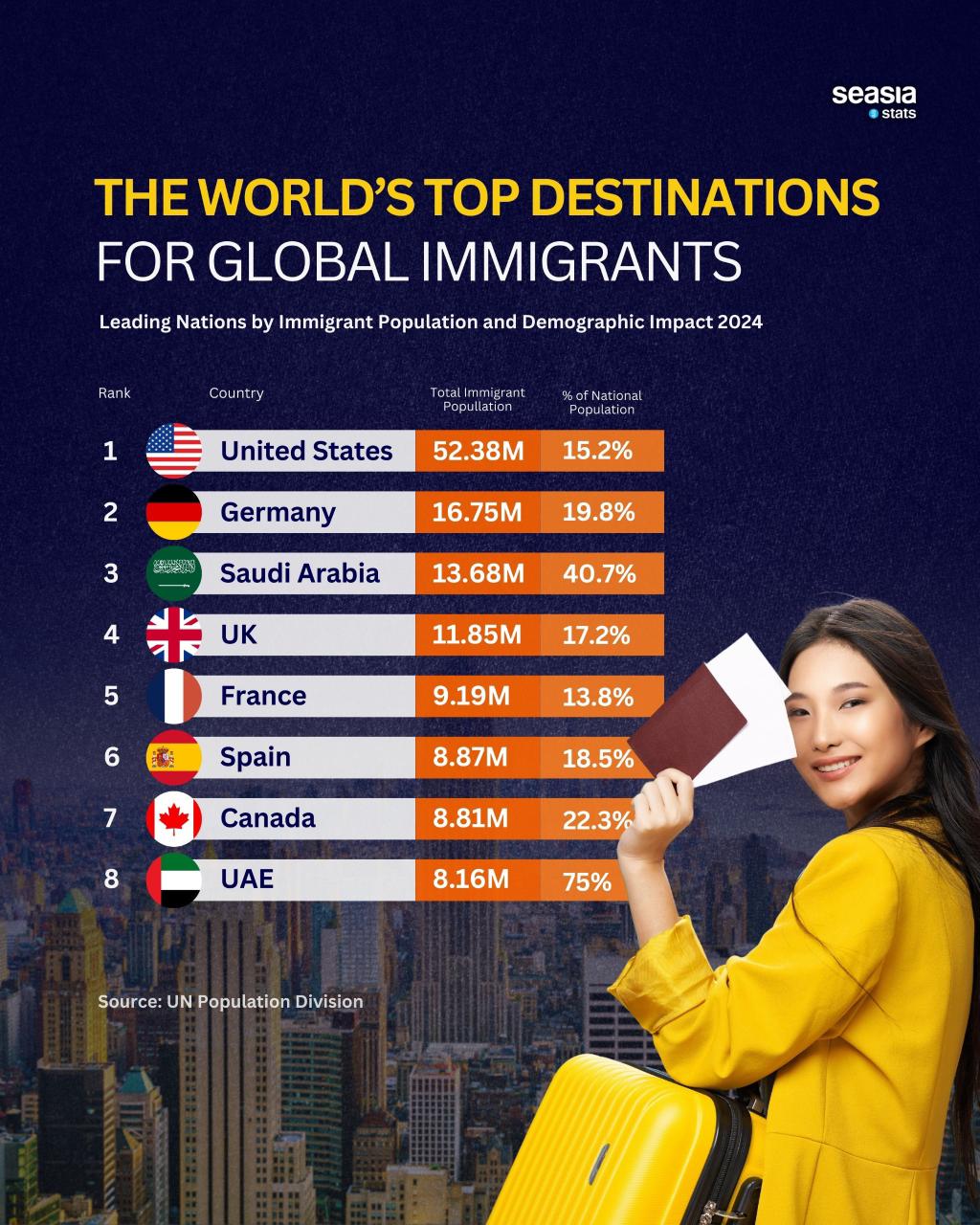
Migration has always been a story of movement—but increasingly, it is also a story of opportunity, ambition, and global connection. The latest figures from the UN Population Division, highlighted by Seasia Stats, reveal not just where people are going, but how deeply migration is reshaping societies across continents.
The United States: Still the World’s Magnet
At the top of the list stands the United States, home to 52.38 million immigrants—by far the largest in absolute terms. That number alone tells a powerful story. For generations, the U.S. has positioned itself as a land of opportunity, drawing talent, labor, and families from every corner of the globe.
Yet what’s equally interesting is the proportion: immigrants make up about 15.2% of the U.S. population. Compared to other countries on the list, that places it in the middle range in terms of demographic impact. The scale is massive, but the population base is even larger.
As migration researchers often note, the U.S. remains “the single largest destination for international migrants globally,” reflecting both economic pull and long-established migration networks.
Europe’s Quiet Transformation
Behind the United States, Germany, the United Kingdom, France, and Spain form a strong European cluster. Germany alone hosts 16.75 million immigrants, nearly 20% of its population. Across the continent, migration has become a defining demographic force.
Europe’s story is not just about numbers—it is about transformation. Aging populations, labor shortages, and evolving immigration policies have made migrants central to economic sustainability. Cities like Berlin, London, and Paris have become multicultural hubs where global identities intersect daily.
This shift has not been without debate, but it underscores a broader reality: migration is no longer peripheral to Europe’s future—it is central to it.
The Gulf: Where Migration Shapes Society
If the United States represents scale, the Gulf states represent intensity. Saudi Arabia ranks third with 13.68 million immigrants, making up 40.7% of its population. Meanwhile, the United Arab Emirates stands out even more dramatically: 75% of its population consists of immigrants.
That figure is extraordinary. In the UAE, migration is not just a demographic feature—it is the foundation of the economy. From construction and services to finance and technology, expatriate workers drive much of the country’s growth.
As global analysts often point out, Gulf economies are “uniquely dependent on migrant labor,” creating societies where international workers are not the minority, but the majority.
Canada’s Balanced Model
Canada, with 8.81 million immigrants and 22.3% of its population foreign-born, represents a different model. Unlike the Gulf, where migration is largely temporary, Canada emphasizes long-term settlement and integration.
Its immigration system is often cited globally as one of the most structured and selective, prioritizing skills, education, and long-term contribution. The result is a country where immigration is not just accepted, but actively encouraged as a pillar of national development.
Southeast Asia: A Region on the Move
While Southeast Asian countries are not featured in the top eight by total immigrant population, the region plays a crucial role in global migration flows—particularly as a source of migrants.
Countries like Indonesia, the Philippines, and Vietnam are among the world’s largest providers of overseas workers. Filipino workers, for example, are present in over 100 countries, contributing significantly to both global labor markets and their home economy through remittances.
At the same time, parts of Southeast Asia are becoming destinations in their own right. Singapore, though not listed here, has one of the highest proportions of foreign workers globally, particularly in sectors like finance, construction, and domestic services. Malaysia and Thailand also host millions of migrant workers from neighboring countries.
According to regional reports, Southeast Asia is increasingly becoming both a sender and receiver of migration—reflecting its growing economic complexity.
A Global Story Still Unfolding
What these numbers ultimately reveal is that migration is no longer a one-directional story. It is a web of movement connecting continents, economies, and cultures.
Whether in the skyscrapers of New York, the factories of Germany, the deserts of the Gulf, or the cities of Southeast Asia, migrants are shaping the modern world in profound ways.
And as global mobility continues to evolve, one thing remains clear: migration is not just about crossing borders—it is about redefining them.


