

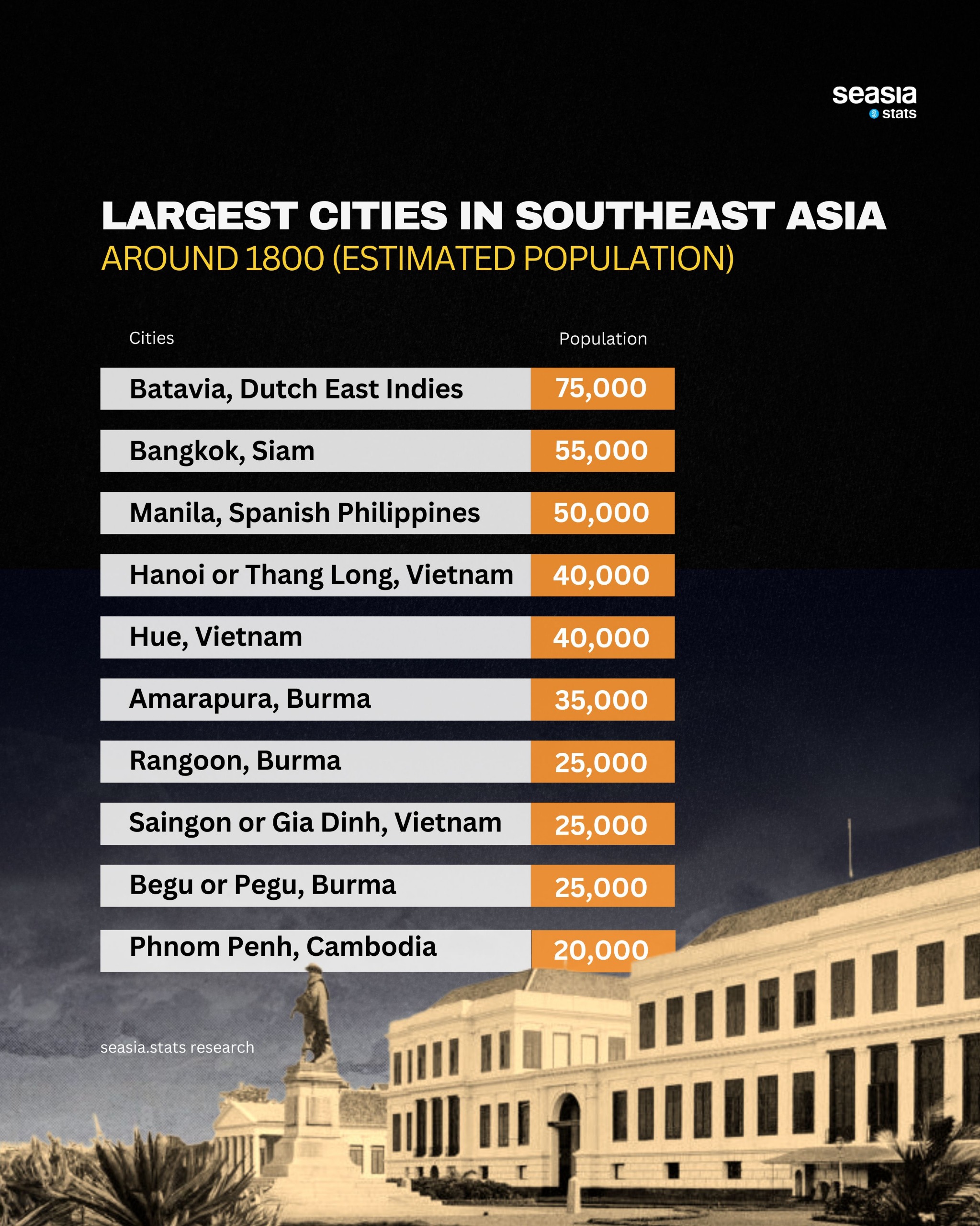
Long before Southeast Asia’s skylines were filled with glass towers and megacities of millions, the region’s urban centers were compact, strategic, and deeply tied to trade, empire, and royal power. Around 1800, the largest cities in Southeast Asia were not sprawling metropolises—but they were already vital nodes in global commerce and regional politics.
A Region of Port Cities and Royal Capitals
At the top of the list stands Batavia—modern-day Jakarta—with an estimated population of 75,000. As the administrative heart of the Dutch East Indies, Batavia was more than just a city; it was a colonial command center linking Europe to Asia’s lucrative spice trade. Its canals, warehouses, and fortified walls reflected a European vision imposed on tropical Southeast Asia.
Following closely behind was Bangkok, then part of Siam, with around 55,000 residents. Unlike Batavia, Bangkok was not a colonial outpost but a royal capital. It grew rapidly under the Chakri dynasty, strategically positioned along the Chao Phraya River, serving as both a political and economic hub.
Manila, with approximately 50,000 people, rounded out the top three. Under Spanish rule, it became one of the most important ports in Asia, famously connecting trade between the Americas and Asia via the Manila-Acapulco galleons. Even at that time, Manila was already a global city in function, if not in size.
Vietnam and Burma’s Cultural Powerhouses
The middle tier of Southeast Asia’s largest cities reveals a different kind of influence—one rooted in culture, administration, and imperial legacy. In Vietnam, Hanoi (then Thăng Long) and Huế each had populations of around 40,000. These were not merely population centers but symbols of dynastic authority, scholarship, and tradition.
Huế, in particular, would later become the imperial capital of the Nguyễn dynasty, known for its citadel and courtly culture. Hanoi, meanwhile, stood as a long-established political and cultural heart of northern Vietnam, with roots stretching back centuries.
In Burma (modern-day Myanmar), Amarapura reached about 35,000 inhabitants. It served as a royal capital during the Konbaung dynasty, reflecting the shifting centers of power within the Burmese kingdom. Unlike colonial cities, Amarapura’s importance was tied to monarchy, religion, and internal governance.
Smaller Cities, Strategic Roles
Further down the list are cities with populations of around 25,000 or less—but their smaller size does not diminish their historical importance. Rangoon (Yangon) and Begu (Pegu) in Burma, along with Saigon (Gia Định) in Vietnam, were already emerging as important التجاري and administrative centers.
Saigon, in particular, would later evolve into one of Southeast Asia’s most dynamic urban economies under French colonial rule, eventually becoming modern Ho Chi Minh City.
Meanwhile, Phnom Penh, with around 20,000 السكان, was a modest but significant capital in Cambodia. Positioned at the confluence of major rivers, it served as both a سیاسی and commercial نقطة اتصال within the Mekong region.
Small Cities, Big Influence
By today’s standards, these population figures may seem surprisingly small. Modern Jakarta alone is home to more than 10 million people—over a hundred times the size of Batavia in 1800. But scale is relative to context.
As urban historians often note, “pre-modern cities were less about size and more about function.” These المدن were not built for mass urban الحياة, but for governance, trade, and symbolic power.
From River Ports to Megacities
The transformation of Southeast Asia’s cities over the past two centuries has been nothing short of extraordinary. What were once compact capitals and trading ports have evolved into sprawling megacities integrated into the global economy.
Yet traces of the past remain. The colonial grids of Jakarta, the royal palaces of Bangkok, the القديمة districts of Hanoi, and the riverfronts of Phnom Penh all echo their 19th-century origins.
In understanding these early المدن, we are reminded that Southeast Asia’s urban story did not begin with skyscrapers—but with rivers, kingdoms, and التجارة that connected the region to the world long before globalization had a name.


