

In a region often imagined through palm-fringed beaches, steaming coastlines, and humid megacities, Southeast Asia’s highest towns tell a very different story. Up in the mountains, the air thins, the temperature drops, and entire communities have built ways of life shaped by altitude. From Papua’s remote uplands to the cool ridges of northern Vietnam and Luzon, these highland settlements reveal a lesser-known geography of Southeast Asia—one that is colder, quieter, and in many ways more dramatic.
Where Southeast Asia Touches the Clouds
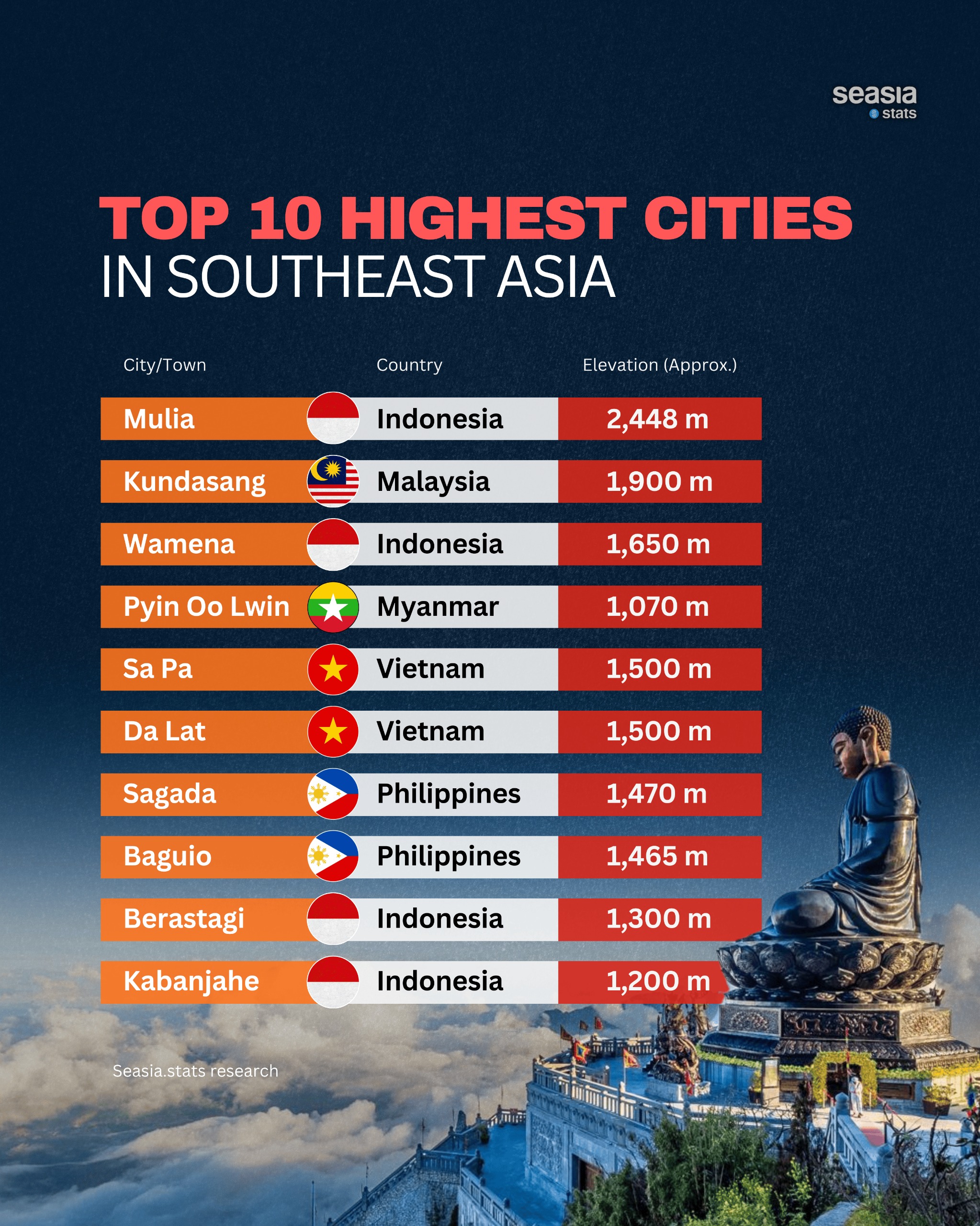
According to Seasia Stats research, Mulia in Indonesia stands as the highest urban settlement on the list at approximately 2,448 meters above sea level, making it one of the most elevated inhabited places in the entire region. Located in Indonesia’s Papua highlands, Mulia represents a side of Southeast Asia that feels far removed from Jakarta, Bali, or even Java’s volcanic heartlands. Life here is defined not by tropical coastlines but by mountain weather, rugged terrain, and logistical isolation.
Not far behind is Kundasang in Malaysia at 1,900 meters, a town famous for its stunning views of Mount Kinabalu and its cool-climate farms. Then comes Wamena, also in Indonesia, at 1,650 meters, a major population center in Papua’s Baliem Valley. These are not just scenic places; they are also strategic and cultural hubs, where altitude shapes transport, agriculture, architecture, and even local identity.
Their presence at the top of the ranking is a reminder that Southeast Asia is far more topographically diverse than it often appears on a map.
The Highland Belt of Everyday Life
Beyond the very highest entries, the list highlights a fascinating “highland belt” stretching across the region. Sa Pa and Da Lat in Vietnam, both listed at around 1,500 meters, have long been among Southeast Asia’s most iconic cool-weather escapes. But they are more than tourism brands. They are historical mountain towns shaped by colonial planning, agricultural adaptation, and ethnic diversity.
Sa Pa, perched in Vietnam’s northwest, is known for terraced rice fields, Hmong and Dao communities, and a misty climate that has become central to its appeal. Da Lat, meanwhile, was developed by the French as a mountain retreat and today remains one of Vietnam’s most distinctive urban environments—part alpine fantasy, part agricultural powerhouse. In fact, many of Vietnam’s vegetables, flowers, and strawberries come from this very highland economy.
The Philippines also appears strongly with Sagada and Baguio, both perched well above 1,400 meters. Baguio has long been known as the country’s “summer capital,” while Sagada is associated with pine forests, caves, rice terraces, and a slower, cooler rhythm of life. These places matter because they show how elevation in Southeast Asia is not just a physical fact—it is a social and cultural distinction. Highland towns often develop different cuisines, crops, clothing needs, and tourism patterns than the lowland capitals.
Indonesia’s Mountain Dominance
What stands out most in the ranking is Indonesia’s dominance. With Mulia, Wamena, Berastagi, and Kabanjahe all appearing, Indonesia holds four of the top ten positions. That makes sense for an archipelago often associated with volcanoes and islands: Indonesia is, in reality, one of the most mountainous countries in Asia.
Its highland towns are particularly important for horticulture, coffee, vegetables, and domestic tourism. In North Sumatra, for example, Berastagi and Kabanjahe serve as gateways to fertile volcanic highlands that supply produce far beyond their local areas. These are places where altitude directly supports economic life.
As The New York Times once noted in a feature on highland destinations, mountain towns often offer “a different national mood” from the capitals below. That observation fits Southeast Asia perfectly. In these upland settlements, the region feels slower, cooler, and sometimes even more intimate.
A Different Southeast Asia
The biggest surprise of this list may simply be how much it challenges the stereotype of Southeast Asia as a flat, tropical world. These cities and towns prove otherwise. They are places of cloud forests, pine ridges, volcanic valleys, vegetable terraces, and mountain mornings cold enough for jackets.
And perhaps that is what makes them so compelling. They remind us that Southeast Asia is not only defined by its seas and shorelines—but also by its heights.


