

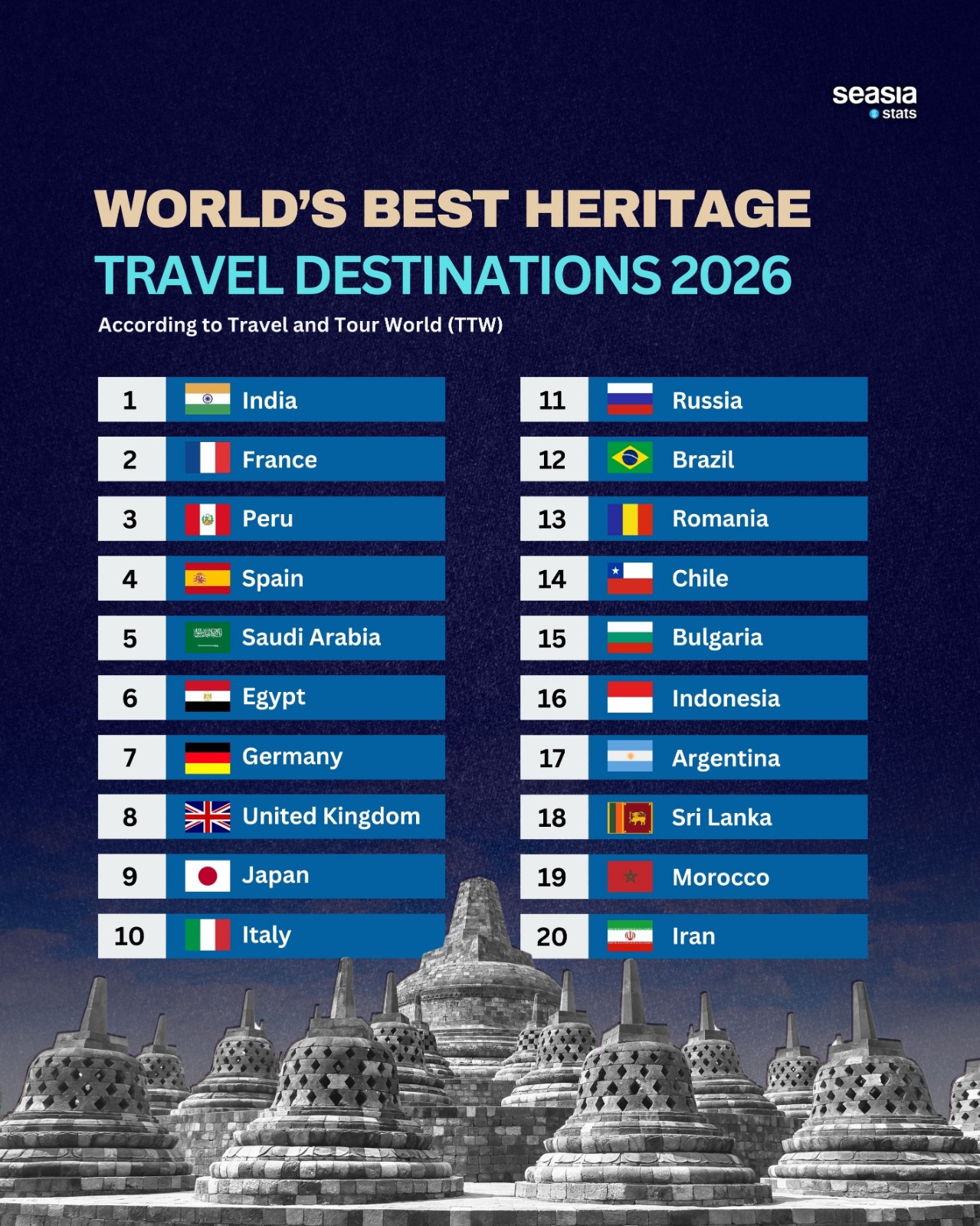
Travel in 2026 is no longer just about ticking destinations off a list. It is about meaning—about walking through places where history still breathes, where culture is layered, and where identity is preserved in stone, ritual, and memory. The latest ranking highlighted by Seasia Stats, based on Travel and Tour World (TTW), reflects this growing shift toward heritage-driven travel, placing India at the very top of the global stage.
Where Civilizations Still Speak
India’s position as the world’s leading heritage destination is rooted in sheer depth. Few countries can match its range—from ancient temples and Mughal architecture to living traditions that continue to shape daily life. TTW notes that heritage tourism is increasingly defined not just by monuments, but by “immersive cultural experiences that connect travelers to the past.” That definition fits India almost perfectly.
France and Peru follow closely behind, offering very different but equally powerful narratives. France’s historic cities, castles, and museums present a curated legacy of European civilization, while Peru’s Incan heritage—anchored by Machu Picchu—offers a dramatic connection to pre-Columbian history. Together, the top three reflect how heritage tourism now spans continents and civilizations, rather than being concentrated in one region.
Europe and the Middle East: Timeless Anchors
The top ten remains heavily influenced by Europe and parts of the Middle East. Spain, Germany, the United Kingdom, and Italy continue to draw travelers through a mix of preserved architecture, museums, and urban heritage. Meanwhile, Saudi Arabia and Egypt are reshaping their global tourism identities.
Saudi Arabia, in particular, has made headlines in recent years for its aggressive investment in heritage tourism, opening previously restricted historical sites and promoting destinations like AlUla. Egypt, long synonymous with ancient civilization, continues to rely on its iconic archaeological legacy while expanding tourism infrastructure.
Reuters has noted that several countries in the Middle East are “investing heavily in tourism as part of broader economic diversification strategies,” a trend that is clearly reflected in this ranking.
Southeast Asia’s Quiet Strength
While Southeast Asia does not dominate the top ten, its presence in the global heritage conversation is undeniable. Indonesia, ranked 16th, stands as one of the region’s most compelling cultural destinations. The inclusion of Borobudur—one of the world’s largest Buddhist temples—symbolizes the country’s deep historical significance.
Indonesia’s heritage extends far beyond a single landmark. From the temples of Java and Bali to the cultural traditions of Toraja and the maritime history of the archipelago, the country offers a layered narrative that is still evolving. In recent years, the government has also made efforts to elevate “super priority destinations,” aiming to distribute tourism beyond Bali and highlight lesser-known heritage sites.
Vietnam, although not listed here, continues to gain global recognition through destinations like Hoi An and Hue, both UNESCO World Heritage Sites. Cambodia’s Angkor Wat remains one of the most iconic heritage landmarks in the world, while Thailand’s Ayutthaya and Sukhothai offer powerful glimpses into the region’s ancient kingdoms.
Beyond Monuments: The Rise of Living Heritage
What is changing in 2026 is not just where people travel, but how they experience heritage. Travelers are increasingly drawn to what experts call “living heritage”—local traditions, food culture, crafts, and everyday practices that have been passed down through generations.
This shift benefits Southeast Asia significantly. The region’s strength lies not only in its monuments but in its cultural continuity. Whether it is traditional markets in Vietnam, temple ceremonies in Bali, or heritage towns in Laos, Southeast Asia offers experiences that feel alive rather than preserved behind glass.
A Global Story Still Expanding
The inclusion of countries like Brazil, Chile, Romania, and Bulgaria in the extended list shows that heritage tourism is becoming more inclusive and geographically diverse. It is no longer limited to the traditional giants of Europe and the Middle East.
As TTW highlights, global travelers are now seeking destinations that offer “authentic storytelling and cultural depth,” rather than just iconic landmarks. That shift opens the door for emerging destinations—including many in Southeast Asia—to rise further in future rankings.
In 2026, heritage travel is no longer about the past alone. It is about how the past continues to shape the present—and where travelers can feel that connection most powerfully.


