

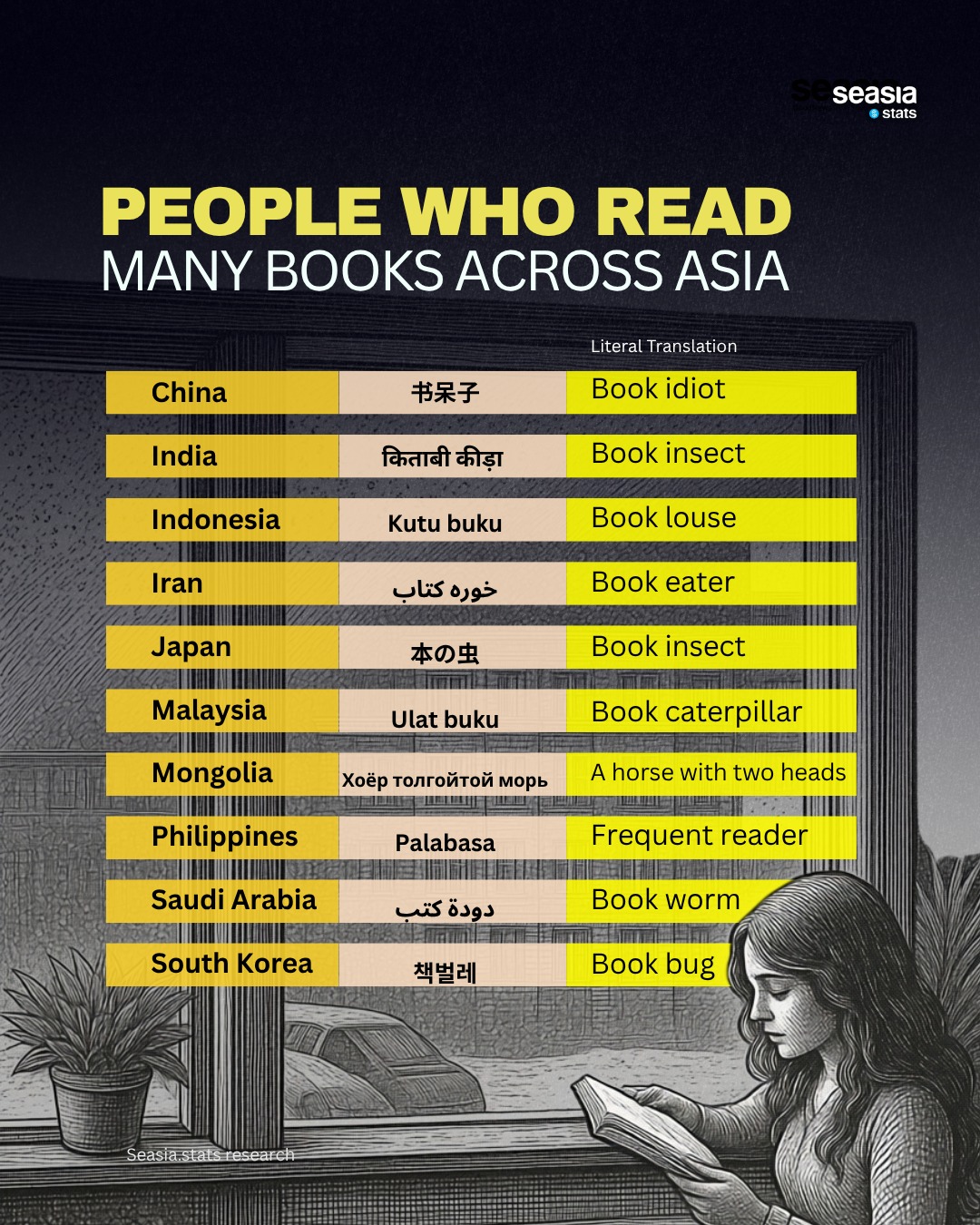
Across Asia, the love of reading is not just a habit—it is a personality, a stereotype, even a playful identity. Languages across the continent have developed vivid, sometimes humorous ways to describe people who devour books. And while English settles comfortably on the term “bookworm,” Asia offers a far richer, more imaginative vocabulary that reveals how deeply reading is woven into cultural life.
Tiny creatures, big meaning
One of the most striking patterns across Asian languages is the use of small creatures to describe avid readers. In India and Japan, the literal translation comes out as “book insect,” while South Korea uses “book bug.” These metaphors are not accidental—they reflect the idea of someone quietly and persistently immersed in pages, much like a tiny creature burrowed into its world.
Southeast Asia adds its own flavor to this imagery. In Indonesia, the phrase “kutu buku” translates to “book louse,” while in Malaysia, “ulat buku” becomes “book caterpillar.” Both expressions carry a similar tone: someone who is constantly attached to books, almost inseparable from them.
Rather than being negative, these labels are often affectionate or teasing. They capture a familiar figure in many Asian societies—the diligent student, the quiet thinker, the person who prefers pages over noise.
Southeast Asia’s cultural nuance
In Southeast Asia, these expressions also reflect how education and reading are socially valued. Countries like Indonesia, Malaysia, Vietnam, and the Philippines have long emphasized education as a pathway to upward mobility, making the “book-loving” identity something both admired and gently joked about.
The Philippines stands out for taking a more direct approach. The word “palabasa” simply means “frequent reader,” avoiding metaphor altogether. It reflects a linguistic simplicity, but also a cultural clarity—reading is seen as a straightforward, positive trait rather than something that needs symbolic framing.
In Vietnam and Thailand, while not listed in this specific dataset, similar cultural attitudes exist. Reading is often associated with discipline and academic success, particularly among younger generations navigating competitive education systems.
When metaphors get more intense
Elsewhere in Asia, the imagery becomes more dramatic. In Iran, an avid reader is called a “book eater,” suggesting not just interest, but an almost physical hunger for knowledge. It is a powerful metaphor, one that elevates reading from hobby to necessity.
China offers a more self-aware twist. The term translates to “book idiot,” a phrase that can carry a humorous or slightly critical tone. It reflects a long-standing cultural conversation about balance—between intellectual life and practical wisdom. Someone who reads too much, the phrase suggests, might risk losing touch with the real world.
Then there is Mongolia, perhaps the most poetic of all. The phrase translates to “a horse with two heads,” an image that hints at dual awareness, expanded thinking, or even intellectual advantage. It suggests that reading gives a person something extra—another perspective, another mind.
A shared love, expressed differently
Despite the differences in imagery, the underlying message across Asia is remarkably consistent. Reading is valued. Knowledge is respected. And those who immerse themselves in books are recognized—whether as insects, eaters, or simply devoted readers.
As The Guardian once observed in a broader discussion on reading culture, “the act of reading remains one of the most quietly powerful forms of self-transformation.” That idea resonates strongly across Asian societies, where education continues to be closely tied to personal and national progress.
More than just words
These expressions are more than linguistic curiosities. They are cultural mirrors. They show how societies perceive learning, how they balance intellect with everyday life, and how they celebrate curiosity—even when they poke fun at it.
From “book louse” in Indonesia to “palabasa” in the Philippines, from “book eater” in Iran to “book insect” in Japan, Asia’s languages remind us that while the act of reading may be universal, the way we talk about it is beautifully diverse.


