

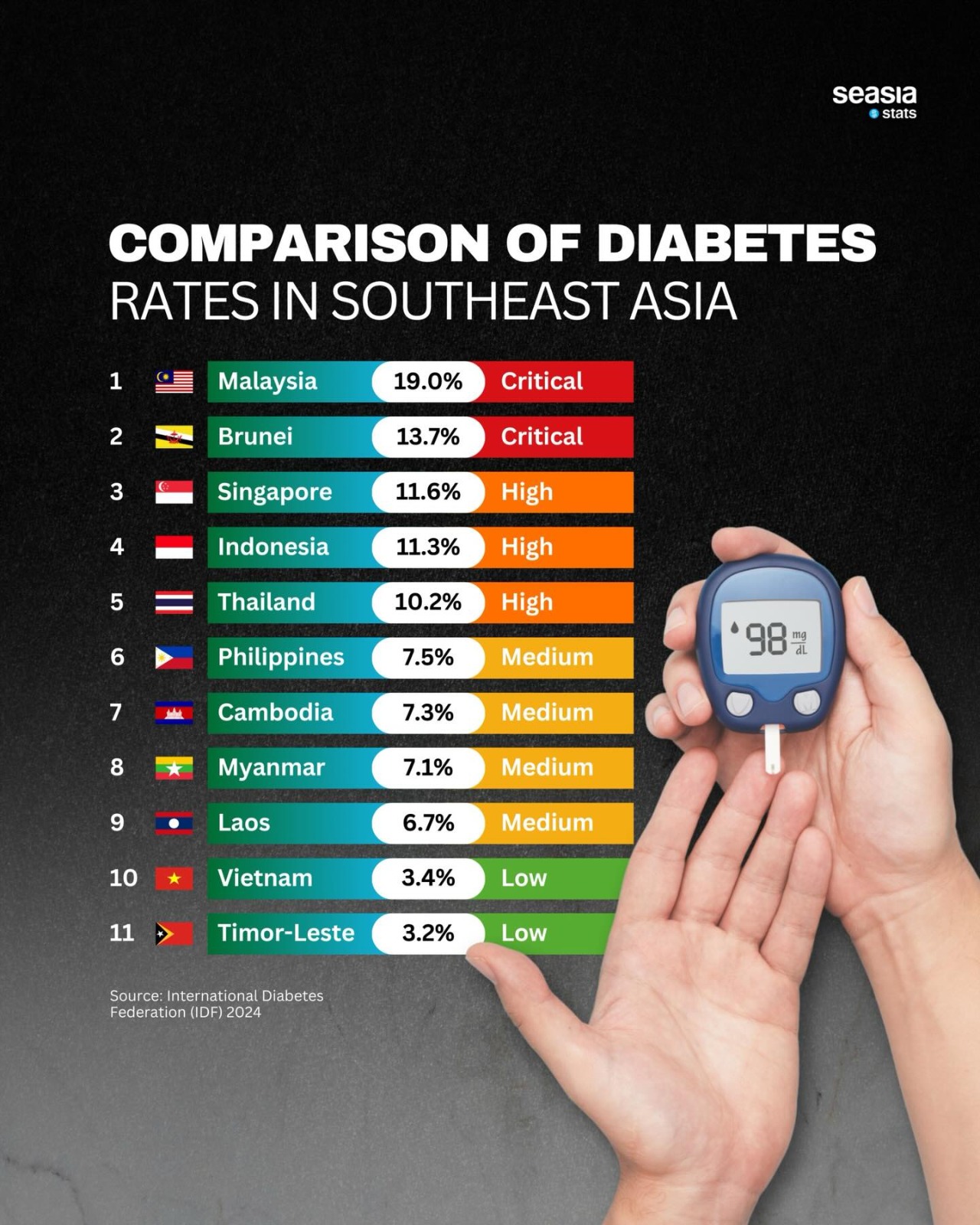
Diabetes has quietly become one of Southeast Asia’s most pressing public health concerns, cutting across borders, lifestyles, and income levels. According to the International Diabetes Federation (IDF) 2024 data, the prevalence of diabetes in the region varies widely—from critically high levels in some countries to comparatively low rates in others. This disparity tells a deeper story about urbanization, dietary shifts, healthcare access, and changing lifestyles across ASEAN.
Malaysia and Brunei: The Region’s Critical Zone
At the top of the regional ranking is Malaysia, where 19.0% of the adult population is living with diabetes—placing the country in the “Critical” category. This is one of the highest rates not only in Southeast Asia but globally. Closely following is Brunei at 13.7%, also categorized as critical. In both nations, rapid urban development, sedentary lifestyles, and high sugar consumption have contributed to rising cases.
Public health experts in Malaysia have pointed to the popularity of sweetened beverages and processed foods as key drivers. Brunei, with its relatively small population, faces similar challenges, particularly as modern lifestyles replace traditional diets.
High Prevalence in Singapore, Indonesia, and Thailand
The next group of countries falls into the “High” category. Singapore reports a diabetes rate of 11.6%, reflecting the health challenges of a highly urbanized and aging population. Indonesia (11.3%) and Thailand (10.2%) follow closely, showing that the issue extends beyond high-income economies to large middle-income nations.
In Indonesia, rapid urban growth and increased consumption of processed foods have been identified as contributing factors. Thailand, meanwhile, faces similar issues alongside demographic changes such as an aging population. Singapore has responded with aggressive national campaigns promoting healthier eating and active living, serving as a model for the region.
The Middle Tier: A Widespread but Manageable Burden
A large portion of Southeast Asia falls into the “Medium” category, including the Philippines (7.5%), Cambodia (7.3%), Myanmar (7.1%), and Laos (6.7%). While these figures are lower than those of their neighbors, they still represent a significant health burden.
In the Philippines, rising urbanization and Westernized diets are contributing to increasing rates. Cambodia and Laos, though still maintaining more traditional lifestyles, are experiencing gradual increases as economic development changes consumption patterns. Myanmar’s healthcare system faces additional challenges in screening and early diagnosis, which may influence reporting accuracy.
Lower Rates in Vietnam and Timor-Leste
At the lower end of the spectrum are Vietnam (3.4%) and Timor-Leste (3.2%), both categorized as having low prevalence rates. These countries still maintain more traditional dietary patterns, often centered around fresh vegetables, rice, and less processed food. However, experts caution that as economic development accelerates, these rates could rise in the coming decades if preventive measures are not taken early.
A Regional Wake-Up Call
Across Southeast Asia, diabetes is closely linked to lifestyle transitions—urban living, reduced physical activity, and increased consumption of sugar-rich foods. Governments across ASEAN have begun implementing policies such as sugar taxes, public awareness campaigns, and improved healthcare screening systems.
Looking ahead, regional cooperation in health education, food policy, and preventive care will be critical in managing the diabetes burden. The wide disparity between countries—from 19% in Malaysia to just over 3% in Timor-Leste—shows that outcomes can vary dramatically depending on lifestyle, policy, and public awareness.
Disclaimer: This information is for general knowledge only and is not medical advice. Always consult a healthcare professional for diagnosis, treatment, or medical concerns.


