

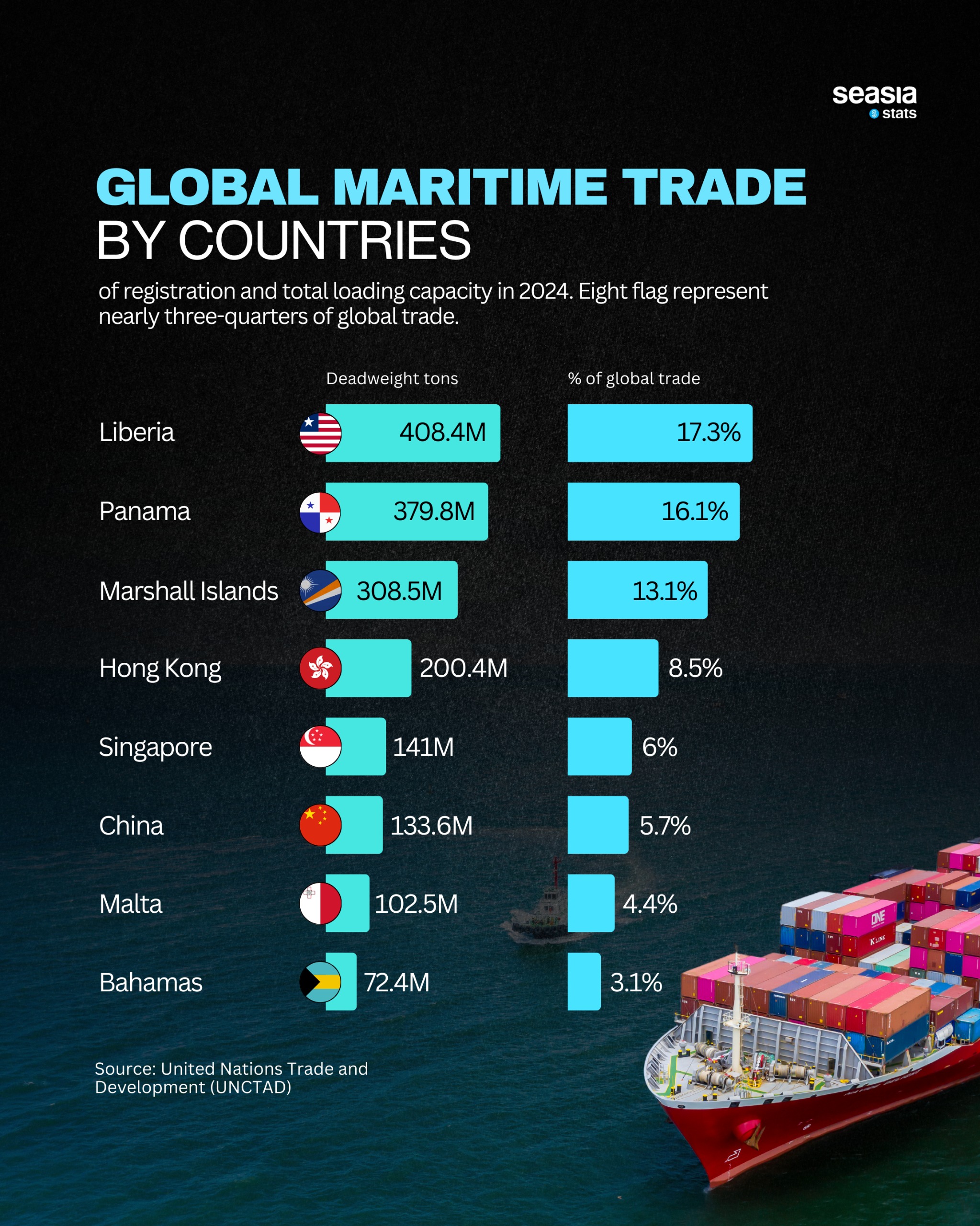
A small group of countries continues to steer the global maritime industry, with Liberia emerging as the top flag state in terms of shipping capacity. According to the latest data from the United Nations Conference on Trade and Development (UNCTAD), eight countries account for nearly 75% of global maritime trade, based on vessel registration and loading capacity.
Liberia, Panama, and the Marshall Islands Dominate the Seas
At the top of the chart is Liberia, holding 408.4 million deadweight tons (DWT), which translates to 17.3% of global maritime trade. Its dominance is largely due to its open registry system, low fees, and a legal framework that attracts international shipowners.
Panama, long known as a strategic maritime player, follows closely with 379.8M DWT (16.1%). The Marshall Islands — a small Pacific nation — ranks third with 308.5M DWT (13.1%), making it a favored flag of convenience for global fleets.
Asia's Maritime Giants: Hong Kong, Singapore, and China
Hong Kong plays a key role in East Asian shipping, contributing 8.5% of global maritime capacity, or 200.4M DWT. Not far behind is Singapore, Southeast Asia’s maritime powerhouse, with 141M DWT (6%).
China, despite being the world’s largest exporter, accounts for 133.6M DWT (5.7%), suggesting that many of its vessels operate under foreign flags for operational or regulatory advantages.
Europe and the Caribbean in the Mix
Malta, an EU member with a robust maritime sector, contributes 102.5M DWT (4.4%), while the Bahamas rounds out the top eight with 72.4M DWT, representing 3.1% of global trade.
Why Flag States Matter
These figures highlight more than just numbers — they point to the strategic decisions made by shipping companies. Factors such as tax benefits, regulatory flexibility, political stability, and legal protections often influence a shipowner’s choice of flag state.
Liberia and Panama remain attractive due to their lenient regulatory environments and strong global reputation. Meanwhile, smaller nations like the Marshall Islands and Malta offer competitive incentives, proving that even smaller states can have global influence through smart maritime policies.


