

As global temperatures rise and urbanization accelerates, air conditioning has become less of a luxury and more of a necessity. Behind this growing demand lies a highly concentrated global trade network, dominated by a small group of exporting countries with strong manufacturing capabilities and efficient supply chains.
Data from UN Comtrade (2024) reveals clear winners in the global air conditioning export market, with Asia playing a central role. From mass production to regional manufacturing hubs, these countries are shaping how the world stays cool.
China’s Overwhelming Dominance in the Cooling Industry
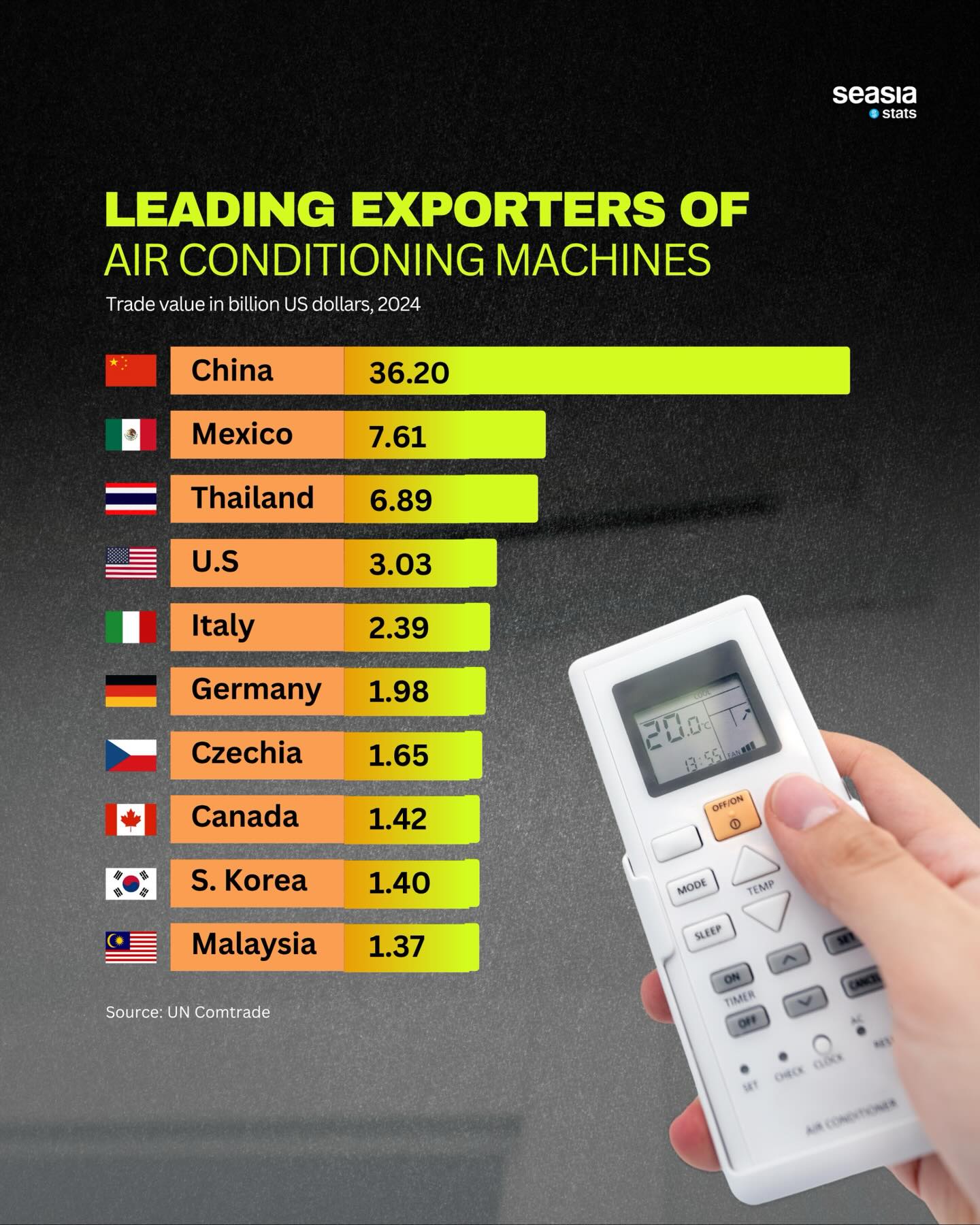
China stands far ahead of the rest of the world in air conditioning exports, shipping units worth USD 36.20 billion in 2024 alone. This figure dwarfs every other exporter, underscoring China’s unmatched scale in industrial manufacturing and global distribution.
The country’s dominance is driven by a combination of cost efficiency, integrated supply chains, and the presence of global appliance giants that serve both household and industrial markets. From residential split AC units to large-scale commercial cooling systems, China has positioned itself as the default supplier for much of the world.
Beyond volume, China’s ability to rapidly adapt production to new technologies—such as energy-efficient and smart cooling systems—has further cemented its leadership in a market increasingly shaped by climate concerns and sustainability standards.
Mexico and Thailand Emerge as Key Manufacturing Hubs
Trailing China at a considerable distance are Mexico (USD 7.61 billion) and Thailand (USD 6.89 billion), both of which play crucial roles as regional manufacturing centers. Their success reflects strategic geographic positioning and strong integration into global supply chains.
Mexico benefits significantly from proximity to the United States, allowing for efficient cross-border trade and nearshoring advantages. Thailand, meanwhile, has become one of Southeast Asia’s most important appliance manufacturing bases, supplying both regional markets and distant economies.
Their rise shows that while China dominates globally, regional hubs remain essential in balancing supply, reducing logistics costs, and meeting localized demand—especially as companies diversify production to manage geopolitical and economic risks.
Europe, North America, and Asia’s Supporting Players
Beyond the top three, a second tier of exporters continues to shape the global air conditioning market. The United States (USD 3.03 billion), Italy (USD 2.39 billion), and Germany (USD 1.98 billion) represent advanced manufacturing economies that focus on higher-end, specialized, or premium cooling systems.
Countries such as Czechia, Canada, South Korea, and Malaysia contribute smaller but still meaningful export values, reflecting niche strengths, regional demand, or integration into multinational production networks. While their volumes are lower, these exporters add resilience and diversity to the global market.
Together, this group highlights how air conditioning trade is not solely about scale, but also about technology, quality, and strategic positioning—especially as climate change drives long-term growth in cooling demand worldwide.


