

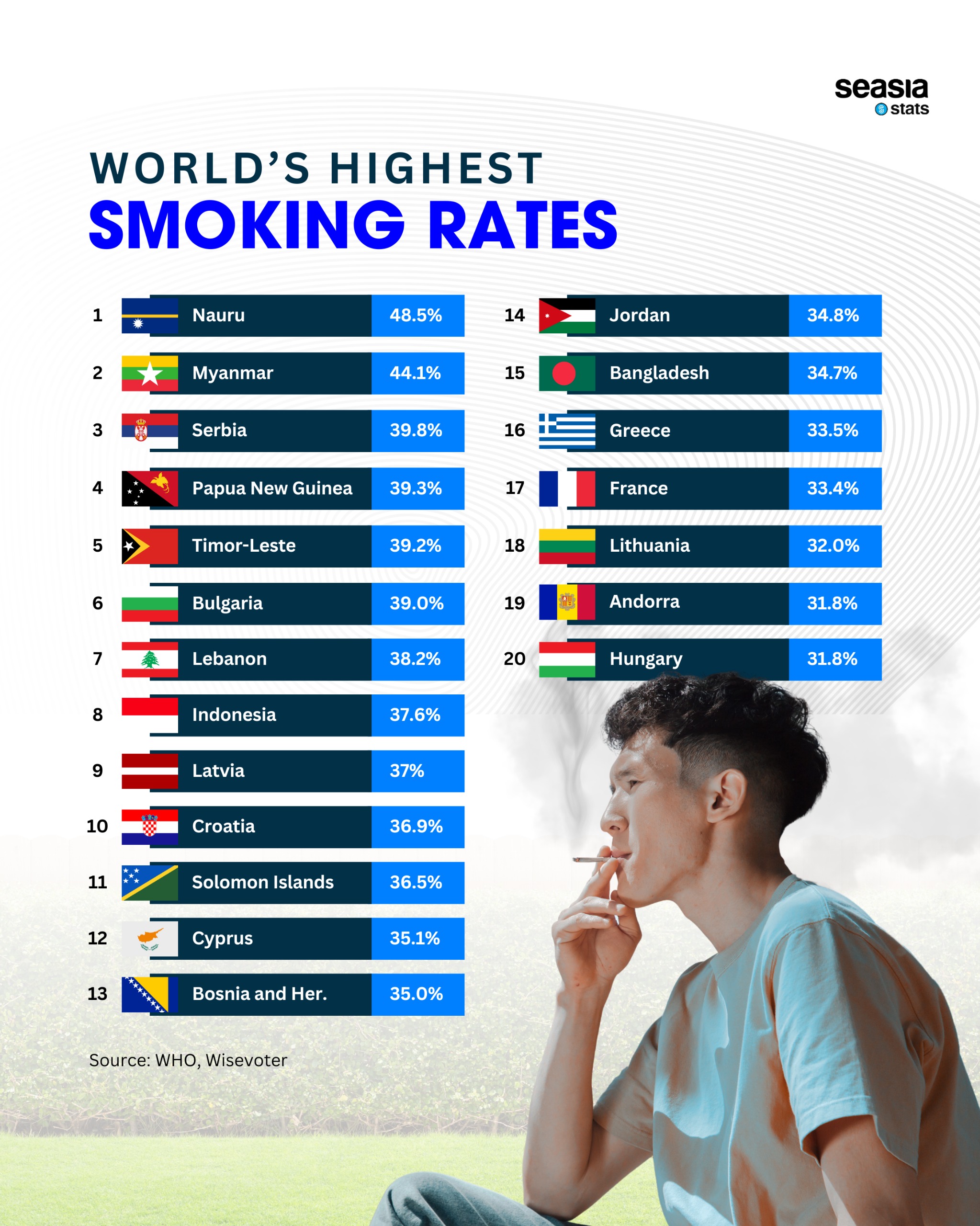
Tobacco consumption remains a significant public health challenge worldwide. According to data from the World Health Organization (WHO) and Wisevoter, these 20 countries have the highest smoking rates, reflecting deeply ingrained habits and cultural influences.
Top 5 Countries with the Highest Smoking Rates
-
Nauru (48.5%)
The small Pacific island nation has the world’s highest smoking rate, with nearly half of its population engaging in the habit. -
Myanmar (44.1%)
Tobacco use is widespread in Myanmar, with a high percentage of the population smoking traditional cigarettes and chewing betel quid. -
Serbia (39.8%)
Smoking is deeply ingrained in Serbian culture, contributing to a high prevalence among adults. -
Papua New Guinea (39.3%)
In Papua New Guinea, both smoking and chewing tobacco are common practices. -
Timor-Leste (39.2%)
Smoking rates in Timor-Leste remain high, particularly among men.
Countries with Smoking Rates Above 35%
- Bulgaria (39%) – One of the highest smoking rates in Europe.
- Lebanon (38.2%) – Smoking is a major public health concern.
- Indonesia (37.6%) – The world’s largest cigarette market, with a strong smoking culture.
- Latvia (37%) – High tobacco use despite EU regulations.
- Croatia (36.9%) – A major public health issue in the Balkans.
- Solomon Islands (36.5%) – High rates of both smoking and tobacco chewing.
Countries with Smoking Rates Between 30-35%
- Cyprus (35.1%)
- Bosnia and Herzegovina (35%)
- Jordan (34.8%)
- Bangladesh (34.7%)
- Greece (33.5%)
- France (33.4%)
- Lithuania (32%)
- Andorra (31.8%)
- Hungary (31.8%)
The Global Impact of Smoking
These statistics highlight the ongoing challenge of tobacco control worldwide. While many countries have implemented strict anti-smoking policies, cultural and economic factors continue to fuel high smoking rates. Addressing this issue requires stronger public health campaigns, taxation, and smoking cessation programs to reduce the long-term health risks associated with tobacco use.


