“From Volcanic Crater to Sacred Temple, Gateway to the World of Nats in the Heart of Myanmar”
Burma has a colorful history and rich cultural heritage, including one of the very impressive ‘Taung Kalat’ Buddhist monastery or the legend of Mount Popa.
Mount Popa is a dormant volcano located in the Pegu Mountains of central Myanmar. Locals know Mount Popa as ‘Taung Ma-gyi,’ which means ‘Mother Hill,’ partly because of its majestic shape.
The top of the mountain offers breathtaking views and is surrounded by legendary stories that make Mount Popa attractive to tourists as well. Apart from being a tourist destination, Mount Popa is also a frequent pilgrimage site for Buddhists today.
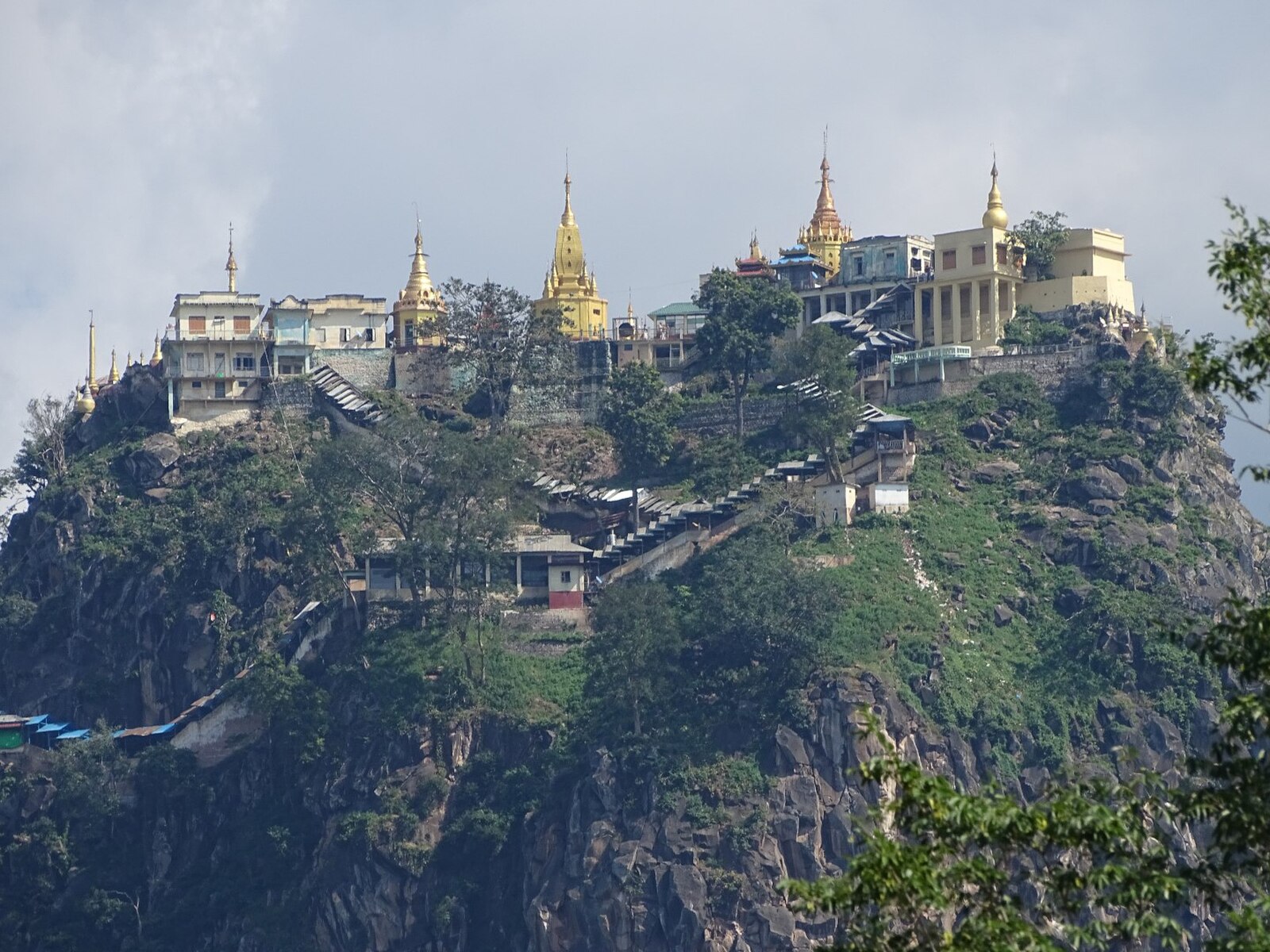
An interesting and iconic feature of Mount Popa is a gilded monastery built on top of ‘Taung Kalat,’ which is part of the volcanic plug.
The monastery is often considered an integral part of Mount Popa. With 777 steps to climb to reach the top of Taung Kalat, visitors are treated to incredible views and the chance to explore a gilded monastery with a legendary story.
Mount Popa is considered sacred in Myanmar and is believed to be the abode of the Nat gods.
So, how did Mount Popa come to be regarded as a sacred mountain?
Find out more, Seasians!
The Story of the Legendary Great Nat of Mount Popa
The story of the ‘Great Nat’ of Mount Popa has been widely known for a long time in Myanmar. In Burmese society, ‘Nat’ is believed to be a diverse group of spirits, ranging from forest spirits to protective spirits.
Local people also believe that the ‘Great Nat’ is a special group of 37 Nat that plays an important role in the spiritual lives of Burmese people in different parts of the country.
Before Buddhist presence in Myanmar in the 3rd century BC, these ‘Nats’ were the main reference in the rituals of worship for the Burmese people.
Of the 37 Great Nats venerated at Mount Popa, the majority are humans who suffered tragic deaths, creating legends about them.
Among the 37 revered Nats, belief holds that only four still exist, namely Mai Wunna, Byatta, as well as Maung Tint Dai and Saw Me Yar.
The Legend of the Great Nat of Maung Tint Dai and Saw Me Yar
The story of the ‘Great Nat’ dates back to the 6th century BC about Maung Tint Dai, a blacksmith in the kingdom of Tagaung, and his sister, Saw Me Yar.
It is said that Maung Tint Dai had extraordinary abilities that made the Tagaung King feel threatened. This prompted the Tagaung King to plan a trick so that Maung Tint Dai could be killed.
When Maung Tint Dai was captured, he was tied to a covered Champa tree, then burnt alive. Seeing this, Saw Me Yar, as his sister, was determined to save Maung Tint Dai by jumping into the fire, so both lost their lives in the same place.
This tragic event gave birth to the belief that the souls of Maung Tint Dai and Saw Me Yar became nat and inhabited the tree that had been burned by the fire, cursing anyone who passed under it.
King Tagaung's fear of this curse led him to order his subordinates to cut down the Champa tree and throw it into the Irrawaddy river.
As a result, the tree drifted with the river towards Bagan. When the Champa tree approached Bagan, King Thglyang of Bagan rescued it, then transformed it into statues of Maung Tint Dai and Saw Me Yar which were then kept at Mount Popa.
Read also: Shwedagon Pagoda: Unveiling the History and Significance of Myanmar's Holiest Site
The Legend of the Great Nat Byatta and Mai Wunna
This story from the 11th century AD tells of the lives of Byatta and Mai Wunna under the reign of King Anawrahta.
Byatta was a flower picker from India, who was able to run 50 km from Bagn to Mount Poap 10 times a day, just to provide fresh flowers for the King.
The story begins when Byatta meets Mai Wunna, a woman who is the mistress of a flower eater living in the mountains. Byatta was mesmerized and fell in love with Mai Wunna, which eventually led to them getting married and having two sons.
Their marriage was quickly overheard by the King, who was enraged and ordered Byatta's execution. After hearing the news of Byatta's death, Mai Wunna was plunged into deep sorrow for the rest of her life.
Because of this story, a legend was born stating that the couple Byatta and Mai Wunna became the nat who resided on Mount Popa along with Maung Tint Dai and Saw Me Yar.
Read also: Bagan, The Land of Thousand Pagodas in Myanmar
This legend about Mount Popa reflects the loyalty between individuals and the sacrifices made by both in the face of life's difficulties.
Even today, the legend of Mount Popa remains a part of Myanmar's culture, with celebrations and festivals held every year, attracting thousands of visitors to make pilgrimages and offerings to the Great Nats while wishing them good luck for the coming year.
The popularity of the Mount Popa cult shows that this ancient tradition remains influential in everyday life, making it one of Myanmar's most popular cultural features.
Located majestically in the central plains of Myanmar, Mount Popa is a legendary prefecture of pilgrimage, a spiritual center, and a place of unique natural charm, offering a combination of myth, natural beauty, and panoramic views that make it a must-see destination for travelers interested in legendary history and culture.
Ready to explore, Seasians?
This article was created by Seasians in accordance with the writing rules on Seasia. The content of this article is entirely the responsibility of the author.