Thailand stood at the eye of a financial storm that would soon engulf an entire region. On July 2, 1997, burdened by an overwhelming amount of short-term foreign debt, the Thai government made the critical decision to float the baht after a series of speculative attacks had severely depleted the country’s foreign currency reserves.
The move was intended to stimulate export earnings and stabilize the economy. But instead of relief, it marked the beginning of a deeper unraveling. The baht plunged—losing over 50% of its value within months—and investor confidence in the so-called “Asian economic miracle” evaporated almost overnight. Foreign investors began rapidly dumping Asian currencies and assets, triggering a domino effect that spread across Southeast and East Asia.
By the end of 1997, Thailand’s foreign reserves had plummeted from nearly US$38 billion to under US$2 billion. Its economy was in free fall, and the ripple effects had already reached neighboring economies, sparking what would later be known as the Asian Financial Crisis.
Hitting the Lowest Point to Climb Higher
The financial turmoil in Thailand can be traced not only to speculative attacks and quick capital flight, but to a deeper structural issue: overinvestment with diminishing returns. Between 1990 and 1996, Thailand’s gross domestic investment ratio—investment as a share of GDP—hovered between 40% and 44%, far higher than the 25–30% range seen during previous decades. Despite this massive inflow of capital, productivity gains lagged behind, signaling that many of these investments were overoptimistic and unproductive.
By 1996, the economy had clearly lost momentum. Real export earnings dropped sharply, and for the first time in years, exports of labor-intensive goods—such as footwear, textiles, garments, and plastics—stagnated or declined. In nominal dollar terms, Thailand’s exports in 1996 were even lower than in 1995—a critical red flag.
As growth momentum dissipated, so did investor confidence. Credit boomed unsustainably—financial sector claims on the private sector rose sharply, and short-term foreign debt swelled to an estimated 65% of total external obligations. Meanwhile, by spring 1997, Thailand had exhausted over 90% of its foreign reserves attempting to defend the baht peg—a stark indication of how fragile its financial position had become.
In sum, Thailand had hit bottom: excess investment, slowing exports, eroding reserves, and expanding debt. Yet this breaking point would become the inflection moment from which the nation began its climb toward transformation.
Painful Reforms, Powerful Lessons
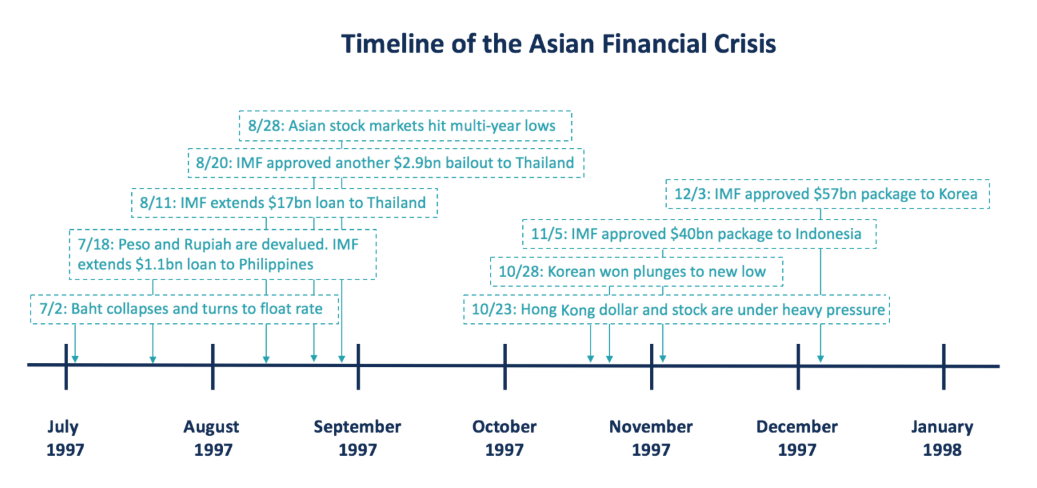
At the peak of the crisis in late 1997, Thailand’s external debt reached US$109.3 billion, with 65% of it maturing in the short term—a structure that left the country dangerously exposed to external shocks. In response, Thailand undertook a series of painful but necessary reforms under the guidance of the International Monetary Fund (IMF).
The IMF provided a bailout package worth approximately US$20 billion to help Thailand avoid sovereign default. In return, the country was required to implement deep structural reforms and maintain fiscal discipline.
Key measures included the deregulation of the banking sector, stricter financial supervision, and the adoption of liberal market policies. These reforms came at a steep social and economic cost—unemployment rose, small businesses collapsed, and inequality widened—but they laid the foundation for long-term resilience.
To manage the overwhelming volume of non-performing loans (NPLs), the government established the Thai Asset Management Corporation (TAMC). TAMC served as a centralized body to absorb and restructure toxic assets, and it has since become a global model for post-crisis financial cleanup.
Evolving Beyond the Crisis
The crisis also sparked a broader shift in Thailand’s economic vision. It catalyzed the emergence of Thailand 4.0, a long-term national strategy aimed at transforming the country from a middle-income economy reliant on manufacturing into a value-based, innovation-driven economy.
Thailand 4.0 is more than a policy—it is a strategic reimagining of Thailand’s future. The initiative emphasizes smart city development, digital infrastructure, and high-tech industrial transformation, with a projected economic boost of over 2 trillion baht. It also aims to create millions of new quality jobs and reduce dependency on low-cost labor.
Thailand’s recovery underscores that structural hardship, if met with bold reforms and long-term vision, can lay the groundwork for lasting resilience. Rather than merely restoring economic figures, the country rebuilt its institutions and redefined its future direction—transforming a painful crisis into a catalyst for reinvention.
Source:
- https://www.sciencedirect.com/science/article/abs/pii/S0305750X98000692
- https://www.bot.or.th/en/our-roles/special-measures/Tom-Yum-Kung-lesson.html
- https://www.jica.go.jp/english/jica_ri/news/topics/2010/thailand_after_the_finacial_crises.html
- https://corporatefinanceinstitute.com/resources/economics/asian-financial-crisis/#:~:text=pada%208%20November.-,Ringkasan,banyak%20negara%20Asia%20Tenggara%20anjlok.
- https://www.tempo.co/ekonomi/menengok-krisis-moneter-asia-1997-asal-usul-penyebab-dan-dampaknya-43930#goog_rewarded
- https://www.columbia.edu/cu/thai/html/financial97_98.html
- https://www.indonesia-investments.com/id/budaya/ekonomi/krisis-keuangan-asia/item246
- https://www.imf.org/external/pubs/ft/fandd/1999/09/lane.htm
This article was created by Seasians in accordance with the writing rules on Seasia. The content of this article is entirely the responsibility of the author.