

Point Nemo, widely referred to as the "Oceanic Pole of Inaccessibility," is considered the most isolated point on the planet. Situated in the South Pacific Ocean, it lies so far from any land that reaching it without proper planning is nearly impossible.
Its name, inspired by the legendary Captain Nemo from Jules Verne's "Twenty Thousand Leagues Under the Sea", perfectly reflects its enigmatic and solitary nature.
For explorers, scientists, and the curious, Point Nemo represents a unique intersection of geography, oceanography, and even space exploration.
Understanding Point Nemo’s Location
Point Nemo is not only far from human habitation but also geographically remarkable. Its precise coordinates are 48°52.6′S 123°23.6′W, placing it about 2,688 kilometers (1,670 miles) away from the nearest land.
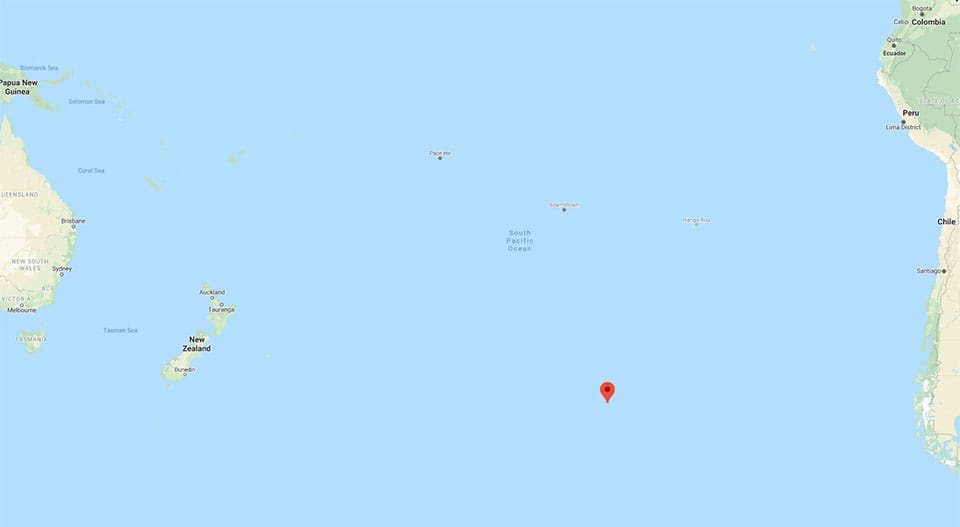
To put this into perspective, the closest landmasses are Ducie Island in the Pitcairn Islands to the north, Motu Nui near Easter Island to the northeast, and Maher Island in Antarctica to the south. This extreme distance makes it the farthest point from any coastline, earning it the title of the most inaccessible place on Earth.
The sheer remoteness of this location demonstrates the vastness of our oceans and the isolation that can exist even on a planet heavily populated by humans.
The Meaning Behind the Name
The name “Nemo” is derived from Latin, meaning “nobody” or “no one,” which accurately reflects the absence of human life in this part of the Pacific.
Additionally, the name honors Captain Nemo, the fictional submarine captain from Jules Verne’s 1869 classic "Twenty Thousand Leagues Under the Sea".
Captain Nemo’s character embodies mystery, solitude, and the spirit of exploration, qualities mirrored in this isolated part of the ocean. The combination of linguistic and literary references emphasizes both the loneliness and adventurous spirit associated with this point in the Pacific Ocean.
A Biological Desert in the Ocean
From a marine perspective, Point Nemo is often described as a biological dead zone. Its isolation and weak ocean currents result in limited nutrient availability, making it difficult for larger marine species to thrive.
Unlike more productive parts of the ocean teeming with life, this area is sparsely populated with marine organisms, highlighting how geography and oceanography can directly influence biodiversity.
Scientists have expressed interest in Point Nemo because its unique conditions provide insights into how extreme environments affect marine life and the processes governing the deep ocean.
Point Nemo and Space Exploration
Perhaps one of the most surprising facts about Point Nemo is its connection to space exploration. Despite being the furthest point from land, the humans closest to this location are often astronauts aboard the International Space Station, orbiting roughly 400 kilometers above the Earth.
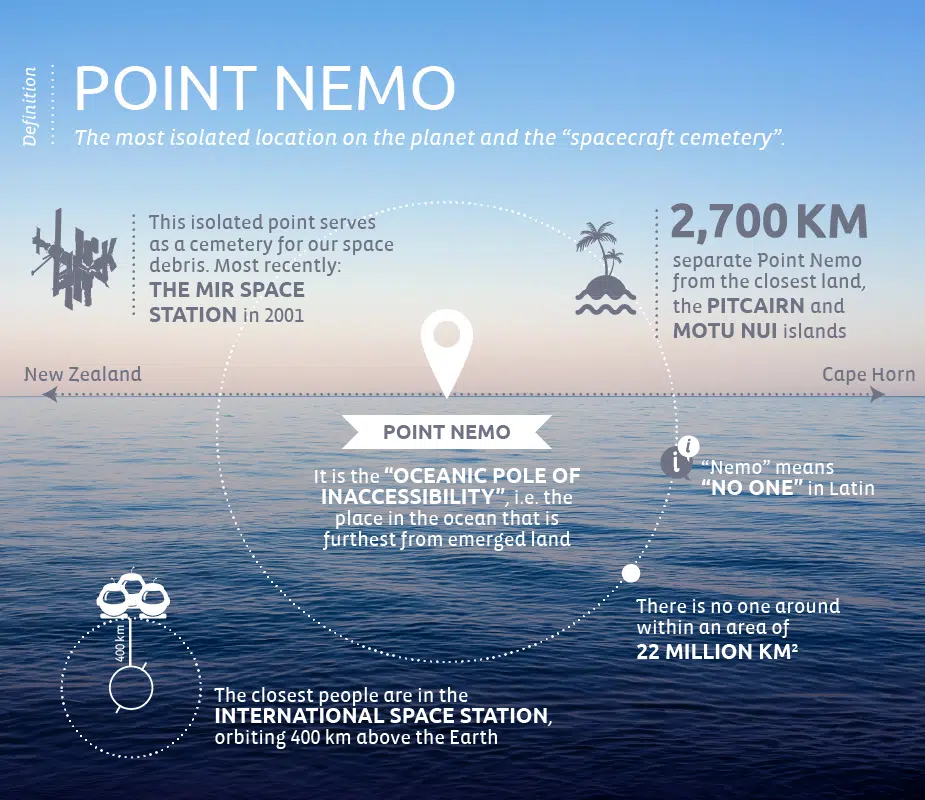
More importantly, space agencies use this remote area as a “spacecraft cemetery.” Decommissioned satellites, spacecraft, and space stations are directed to re-enter Earth’s atmosphere and crash into the waters surrounding Point Nemo.
For example, the Russian space station Mir, weighing over 120 tons, was deliberately deorbited and sunk in this region in 2001. Over time, more than 300 spacecraft have ended up in this “ocean graveyard,” ensuring space debris does not threaten populated areas.
Scientific Importance of Point Nemo
Beyond its role in space history, Point Nemo continues to attract scientific interest. Oceanographers are particularly curious about the ocean currents, temperatures, and ecological conditions of this remote region.
Understanding Point Nemo helps researchers gain insights into how isolated oceanic zones function, how climate change might affect even the most secluded parts of the ocean, and the dynamics of the South Pacific marine ecosystem.
Despite its desolation, the area provides valuable data for understanding global ocean systems and the hidden mechanisms that influence life in the deep sea.
Point Nemo: A Fascinating Intersection of Ocean and Space
Point Nemo’s combination of isolation, biological scarcity, and its use as a spacecraft repository creates a unique narrative that bridges oceanography and space science.
While humans may never set foot there easily, the location serves as a laboratory for understanding extreme conditions both on Earth and in space.
Its story emphasizes the reach of human exploration, from mapping remote ocean points using geospatial technology to safely deorbiting spacecraft thousands of kilometers away from civilization.
Discover the Mystery of Point Nemo
Though no one lives at Point Nemo, and life is sparse in its surrounding waters, it remains a remarkable testament to both the mystery of the oceans and the reach of human innovation. From its designation as the most remote point on Earth to its practical use in space exploration, Point Nemo symbolizes curiosity, discovery, and the challenges of isolation.
Whether you are a lover of the oceans, a space enthusiast, or simply fascinated by the extremes of our planet, Point Nemo is a location that inspires awe and wonder.
Next time you look at the vast Pacific Ocean, remember: the most remote place on Earth is more than just water, it’s a blend of scientific intrigue, adventure, and a reminder of how much of our planet remains unexplored. Explore more about the world’s hidden corners and discover the wonders that lie beyond the horizon.



