


For most of us, the word “mummy” immediately brings to mind ancient Egypt, with its pyramids and bodies wrapped in linen. But new research is shaking that assumption.
A study published in the journal Proceedings of the National Academy of Sciences (PNAS) reveals that the world’s oldest mummies do not come from Egypt or South America, but from Southeast Asia and southern China.
Researchers examined 54 ancient burial sites across southern China, Viet Nam, Laos, Malaysia, Thailand, the Philippines, and Indonesia. The findings were startling: many of the remains, dating back between 4,000 and 12,000 years, were discovered in tightly crouched positions, with bones showing signs of charring.
This evidence points to a practice of smoke-drying the dead thousands of years before Egypt developed its resin-based embalming techniques.
Not Burned, but Smoked

At first glance, these remains look like victims of fire. However, in-depth analysis using advanced techniques such as X-ray diffraction and infrared spectroscopy tells a different story.
The bones were indeed exposed to heat, but not through open flames as in cremation. Instead, the bodies were heated in low-oxygen, smoky environments.
Researchers call this process “smoke-drying.” The dead were deliberately placed in extreme crouching positions and kept near slow, smoky fires for months. This gradually dried out the bodies, slowing decomposition.
While soft tissues like skin and hair only survived for decades or centuries, unlike Egyptian mummies that can last millennia, this method was sufficient to preserve the overall form of the body.
The Ritual Meaning Behind the Smoke
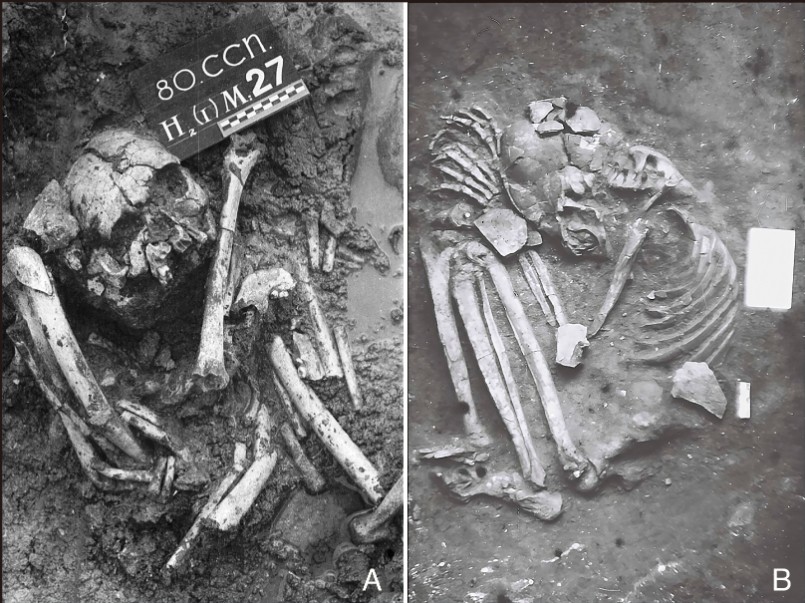
According to lead researcher Hsiao-chun Hung of the Australian National University, this was far more than just a way to prevent decay. Smoking the dead likely had spiritual, religious, or cultural significance.
It may have allowed families or communities to keep their ancestors’ physical presence close for longer, as if the deceased were still “living” among them.
Interestingly, the discovery also suggests that ancient hunter-gatherer groups who were often nomadic may have wanted to carry their loved ones’ bodies with them. Archaeologist Peter Bellwood, a co-author of the study, explains that smoking made the bodies lighter and more durable, making transport possible.
"One possibility here is that this smoking and binding was done so that they could carry the mummies around," he says, as quoted by ABC.
Rewriting the History of Mummies
Before this study, the oldest recognized examples of mummification came from the Chinchorro culture in what is now Chile, around 7,000 years ago. The Chinchorro people removed the internal organs, replaced them with natural fibers and plants, and then dried the bodies in the desert.
Ancient Egypt only began using chemical preservatives and embalming techniques around 2600 BCE, about 4,500 years ago. Until now, these two regions were considered the pioneers of mummification traditions.
However, the new findings show that the practice of body preservation was already taking place in Southeast Asia as far back as 12,000 to 14,000 years ago. This means Southeast Asia could be considered one of the earliest centers of ancestor veneration through preserved bodies.
The Mystery of the Extreme Crouching Position
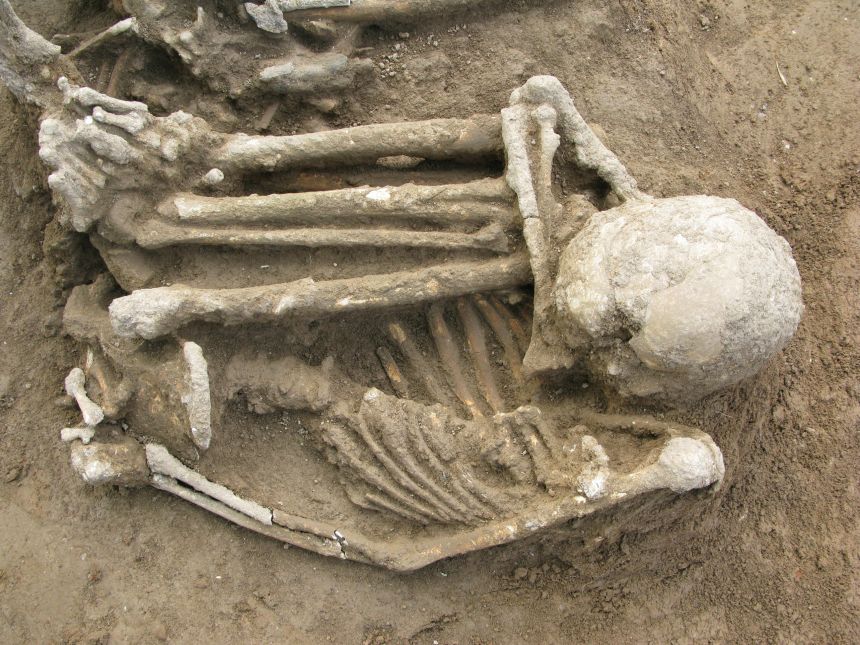
One aspect that puzzled researchers was the highly unusual posture of the bodies. Many skeletons were found in a state of “hyperflexion,” with knees pressed tightly to the chest and arms and legs bound stiffly. Such a position could not have occurred naturally without intervention before burial.
Senior researcher Hirofumi Matsumura from Sapporo Medical University was the first to highlight this anomaly. In his view, the extreme posture was probably caused by the body being tightly bound and then slowly dried using smoke. By the time of burial, most of the soft tissue would have disappeared, leaving behind a relatively intact skeleton.
Evidence That Is Almost Invisible
One of the biggest challenges for this research was that only bones remained at the burial sites, with no preserved skin or hair. So how could researchers be sure that these bodies were once mummified?
The answer lies in microscopic heat traces. Around 84 percent of the samples showed internal structural changes in the bones caused by prolonged exposure to low heat.
Some bones also contained traces of charcoal on certain parts, such as the elbows, forehead, and shins, areas where flesh is thin and would have been easily scorched when exposed to a small fire. All of this is consistent with the process of smoke-drying rather than full cremation.
A Tradition That Survived for Thousands of Years
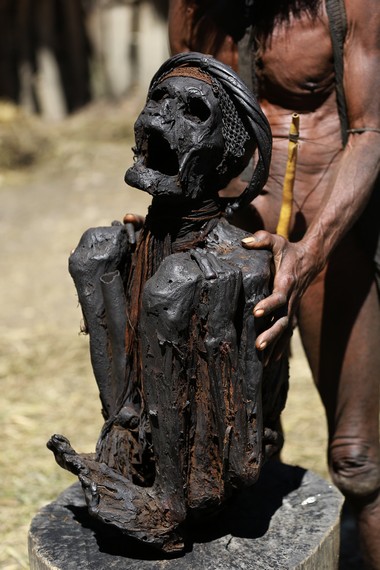
Even more remarkable is that this practice is still alive today. In 2019, the research team visited Papua, Indonesia, to observe the Dani and Pumo tribes. They continue to mummify their dead with smoke: the body is tightly bound, positioned, and smoked until it turns completely black.
This suggests an unbroken cultural thread stretching back at least 12,000 years, and perhaps even further to the time when modern humans first spread from Africa to Southeast Asia about 60,000 years ago. Some experts even suspect that this practice could date as far back as 42,000 years, though evidence has yet to be found.


