In recent years, the geopolitical dynamics of the Indo-Pacific region have undergone a dramatic shift, marked by the escalating rivalry between the United States and China. Amid this power struggle, Japan and Indonesia, two democracies with significant maritime interests, are striving to deepen their relationship by elevating their status to a Strategic Partnership and signing a Defense Cooperation Agreement (DCA) in May 2026.
However, behind the narrative of a mutually beneficial partnership, a critical understanding is still needed regarding whether this agreement truly reflects strategic goodwill, or whether it will ultimately trap Indonesia in a potentially unfavorable current of great power rivalry.
The Rational Logic Behind the Partnership
Pragmatically, this collaboration is based on several points of agreement. For the Japanese government, Indonesia in Southeast Asia is a rational partner. Japan needs secure trade routes through the South China Sea, the Lombok Strait, and the Malacca Strait.
Indonesia, with its Global Maritime Fulcrum vision, needs technology transfer and defense equipment modernization. Japan, constrained by its pacifist constitution, sees Indonesia as an ideal "non-combatant security partner" for intelligence sharing and joint training without direct involvement in conflict.
Both countries also share concerns about the rapid changes in the status quo in the region, albeit with varying intensity on the ground.
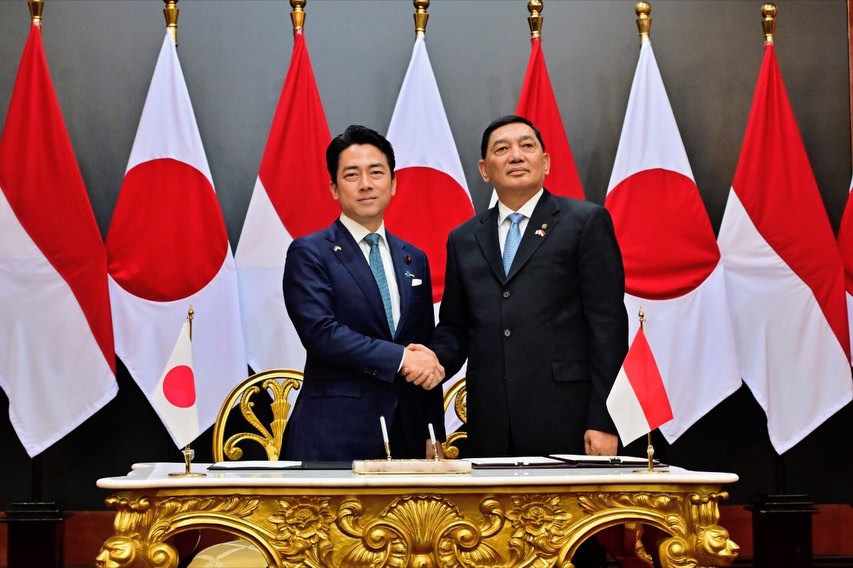
From Indonesia's perspective, the DCA represents a significant diversification of the country's defense resources. Indonesia has historically relied on the US, Russia, and China. Considering that adding Japan as a supplier of radar technology, patrol boats, and possibly aircraft technology transfer, it is a smart move by Jakarta to reduce its monopoly dependence.
However, herein lies the first irony: its claimed independence is built on the framework of another country's military strategy.
Free and Open Indo-Pacific VS Global Maritime Fulcrum
A major criticism of this partnership is the potential for misaligned interests. Japan promotes the Free and Open Indo-Pacific (FOIP) concept, a projection of the US-Japan security alliance. FOIP, in practice, is a strategy to contain Chinese expansion.
Meanwhile, Indonesia adheres to the Free and Active doctrine and a more inclusive maritime fulcrum vision, refusing to become a pander to any power.
The problem is that the text of defense cooperation agreements is often vague regarding operational scope. Words like maintaining regional stability or logistics cooperation can be loosely interpreted.
In a crisis situation, for example, if an incident occurs in the South China Sea, does the DCA obligate Indonesia to provide rights of passage or basing facilities to Japanese forces? As long as threat perceptions between Tokyo and Jakarta are not aligned, Japan may perceive Indonesia as a silent ally, while Indonesia views this as merely technical cooperation.
This gap is dangerous, as it could trigger strategic misunderstandings with other state actors, especially China.
The Threat of a Covert Militarization Agenda
For Indonesia, the DCA also needs to be understood within the context of Japan's changing domestic dynamics. Under Prime Minister Kishida, Japan has historically implemented its largest defense doctrinal shift since World War II, including accelerating counter-strike capabilities and increasing its military budget to 2% of GDP.
While a decade ago, Japan was a secure militarily secure partner and not a threat in the Indo-Pacific, Japan's posture is now slowly shifting to an offensive force.
Indonesia needs to ask: will this agreement open the door to a more permanent Japanese military presence around Indonesian waters?
The US-style hub-and-spoke concept, where Indonesia serves as a logistics depot or access point for Japanese patrols in the western Pacific, must be firmly rejected. Otherwise, Indonesia will be trapped in a buffer state position in the escalating US-China rivalry.
Vulnerabilities in the Domestic Sector and Political Economy
Another aspect that has escaped public scrutiny is the technical details of technology transfer and the defense industry. Japan is known for its strict licensing system and rigid intellectual property rights.
In many previous partnerships, Indonesia has tended to be merely an assembler or user, not a technology controller. The defense cooperation agreement with Japan has the potential to repeat the old pattern, where Indonesia purchases expensive weapons systems without the right to modify or resell them. This contradicts the government's ambition to develop a sustainable defense industry independence.
The dominance of foreign defense industries, including Japanese technology, through the DCA is likely to stifle domestic research. The unclear offset policy will actually result in the outflow of state funds without the transfer of substantive knowledge.
This is not a strategy, but rather a new form of dependence on foreign defense technology.
By signing the DCA, Indonesian diplomacy is allegedly signaling internationally that it is leaning toward the Japan-US bloc. Although domestic policymakers have consistently stated that the DCA is not a military alliance, the reality of perception in international relations is more important than mere statements of intent.
China, Indonesia's largest trading partner, is certain to be deeply aware of Jakarta's changing strategic calculations.
Therefore, if China retaliates with economic pressure or increases the presence of its fishing vessels in Natuna waters, Indonesia should have mature crisis management capabilities in managing relations between major powers.
Will the DCA with Japan be present to defend Indonesia's position in the region? It's highly unlikely, given that the DCA does not actually have a mutual defense clause like NATO's Article 5.
In times of crisis, Jakarta will ultimately stand alone, but it will have lost some of its room for maneuver from Beijing's perspective.
The Indonesia-Japan DCA is not a fundamentally flawed policy, but it is vulnerable to implementation oversights if not carefully managed. The Indonesian government should not be caught up in the euphoria of gaining access to modern technology from Japan without first understanding the geopolitical landscape.
First, Indonesia should ensure that the DCA is explicitly limited, covering only joint exercises, maritime safety, and disaster relief, and not basing rights or rapid troop deployment.
Second, Indonesia must require binding technology transfer clauses with specific timeframes.
Third, and most importantly, Indonesia must immediately formulate a clear maritime Grand Strategy that positions cooperation with Japan solely as a tool to modernize the Indonesian National Armed Forces (TNI), not as an instrument to counterbalance China's power in the Indo-Pacific.
Without strategic clarity, the Strategic Partnership through the DCA will be little more than a beautiful dance on a ship that is beginning to crack in the storms of great power rivalry. Indonesia must truly be the captain of its national interests, not the helmsman for fulfilling the ambitions of foreign powers.
This article was created by Seasians in accordance with the writing rules on Seasia. The content of this article is entirely the responsibility of the author.