


There is no lion or tiger in Papua, but the island has its own “tiger.” It is not a big cat, but a small, spotted marsupial called the quoll. Native to Papua and New Guinea, this agile, nocturnal hunter is often seen as a pest that raids chicken coops. Yet behind its troublesome reputation lies an important ecological role: keeping the balance of forests and savannas.
Once common in the wild, quoll populations are now at risk from hunting, habitat loss, and invasive predators. While studies in Papua remain limited, the experience in Australia shows a sharp decline that should serve as a warning. New research and conservation efforts, combining Indigenous knowledge with modern science, offer hope that this “Papua’s tiger” can make a comeback.
A Little-Known Predator of Papua’s Forests
In the forests and savannas of Papua lives a small carnivore few people know. With white spots, a pointed snout, and nocturnal habits, the quoll roams the forest floor, climbs trees in search of prey, and sometimes sneaks near villages after dark. While the name “quoll” may be unfamiliar to most Indonesians, it has long been part of daily life for many Papuans.
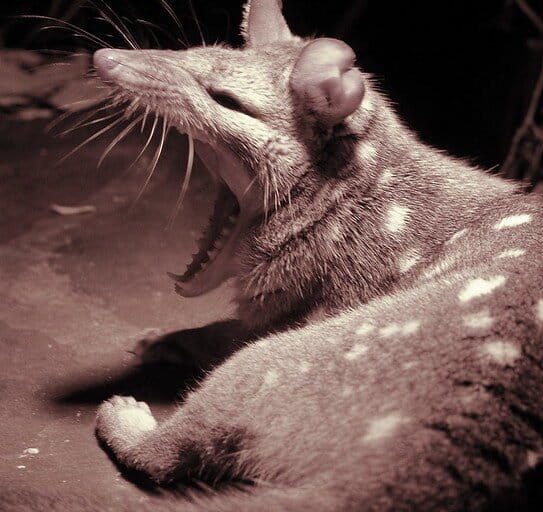
Some locals see quolls as pests because they raid chicken coops, while others hunt them for food. Yet these marsupials are important predators that feed on insects, reptiles, and small animals, keeping prey populations in check. This role earns them the nickname “Papua’s little tiger.”
“Papua does not have large carnivores like tigers. The quoll is the biggest native mammalian predator here,” said Hari Suroto, an archaeologist and lecturer at Cenderawasih University, as quoted by Tempo.co.
Meet the Papua Quoll
Quolls belong to the genus Dasyurus, a group of carnivorous marsupials. The species found in Papua is Dasyurus albopunctatus, known locally as gumben jen or Papua quoll. It is the second-largest marsupial predator in New Guinea, following its Australian relatives. Although small compared to tigers or leopards, it plays a key ecological role as a mid-level predator.
Adult quolls measure about 25–75 centimeters long, with bushy tails of 20–35 centimeters. Their brown fur is marked with distinct white spots, helping them blend into foliage. They resemble large rats at first glance, but their sharp teeth, strong claws, and pointed snouts reveal a true hunter built for climbing and foraging.

Like other marsupials, females carry their young in a pouch until they are old enough to explore. Males, on the other hand, often die shortly after the breeding season due to exhaustion and drastic weight loss, leaving females as the key to sustaining populations.
Despite their size, quolls are fierce hunters. They feed on insects, small reptiles, birds, and rodents, sometimes even taking down prey larger than themselves, such as small kangaroos or bandicoots. Their predatory role helps control pests and maintain ecosystem balance, preventing outbreaks of rats or insects that could damage crops and forests.
Human–Wildlife Conflicts
The quoll’s relationship with humans is complex. In many Papuan villages, it is viewed both as a nuisance and a resource. People sometimes trap or hunt them for meat, especially when poultry losses occur. These local practices show that conservation in Papua must consider both ecological and social aspects. It is not only about protecting a species, but also about respecting local livelihoods.
Across Australasia, there are six quoll species:
-
Dasyurus albopunctatus – the New Guinean quoll, found in Papua (Indonesia) and Papua New Guinea
-
D. spartacus – the bronze quoll, limited to the Trans-Fly savannas of southern New Guinea
-
Four Australian species: the northern quoll (D. hallucatus), tiger or spotted-tailed quoll (D. maculatus), eastern quoll (D. viverrinus), and western quoll or chuditch (D. geoffroii)
Together, they represent a remarkable lineage of carnivorous marsupials unique to the Australasian region.
Looming Threats
Quoll populations in Papua are poorly understood because of limited long-term research. However, the Australian experience serves as a warning. Northern quolls have declined dramatically since the arrival of the toxic cane toad (Rhinella marina). When quolls eat these toads, they are fatally poisoned, prompting the IUCN to list the species as Endangered.
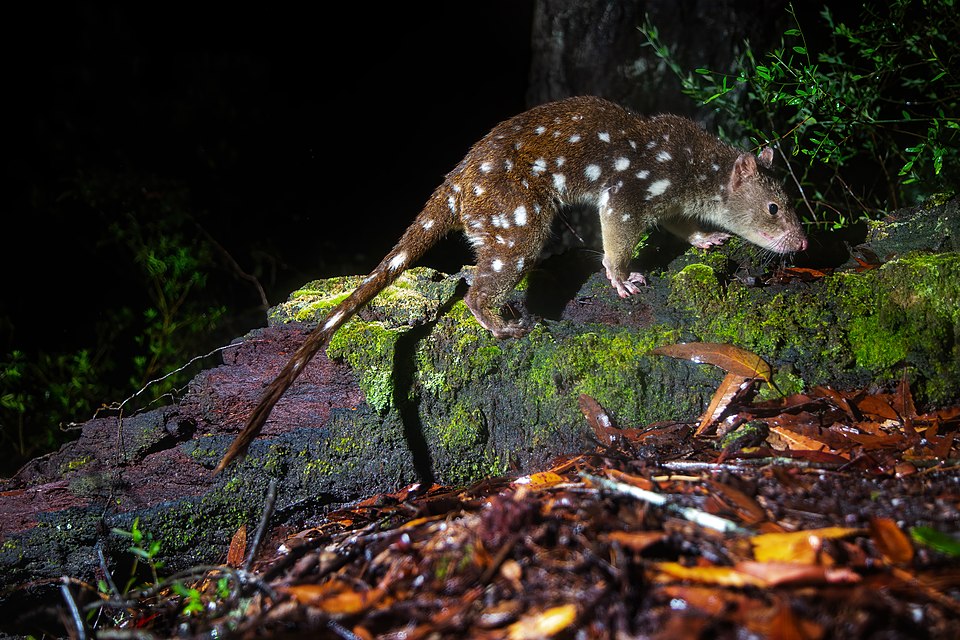
In Papua, different threats loom. The Trans-Fly savanna in southern New Guinea, the stronghold of the bronze quoll (D. spartacus), faces recurrent fires, both natural and human-induced, that alter vegetation and fragment habitats. Farming, plantations, and infrastructure projects add more pressure, isolating small quoll populations. The IUCN estimates fewer than 10,000 mature individuals remain.
In the Papuan highlands, where D. albopunctatus lives, forest loss from logging and shifting cultivation continues. Stray dogs and feral cats further endanger these marsupials, competing for food and sometimes preying on them.
Many villagers kill quolls in retaliation for poultry raids, further depleting local populations. Yet as the largest native mammalian predator in Papua, their disappearance would leave a major ecological void. Currently, the IUCN lists the Papua quoll as Near Threatened, a status that could worsen if pressures continue unchecked.
Hope from New Research
Recent studies in Australia offer valuable lessons. In 2024, researchers at Mulligans Flat Woodland Sanctuary found that translocated quolls could successfully integrate with resident populations after a brief adjustment period, showing that reintroduction programs can work.
In Western Australia’s Pilbara region, scientists discovered that quolls living near mining areas expend more energy searching for food, making them more vulnerable to predators. This insight underscores how industrial development can indirectly harm wildlife, something increasingly relevant for Papua.
Another study revealed that quolls have two activity peaks, after sunset and before dawn, information that can help optimize camera-trap surveys in Papua’s forests.
Innovative conservation techniques are also emerging. In Australia, quolls have been trained to avoid cane toads through “conditioned taste aversion,” feeding them non-lethal samples that make them feel sick, teaching them to avoid the toxic prey later. Conservationists also establish “island arks,” predator-free refuges where safe populations can thrive as genetic backups.
For Papua, similar ideas could work in remote mountain valleys, supported by local ecological knowledge. Indigenous communities often know migration routes, breeding seasons, and nesting sites. Combining traditional wisdom with modern science could make quoll conservation more grounded and resilient.


