


Not many people know that the name Philippines originated during the Spanish exploration of the 16th century. In 1543, Spanish explorer Ruy López de Villalobos named two islands—Leyte and Samar—Las Islas Felipinas to honor Prince Philip of Asturias, who later became King Philip II. In Spanish, Felipinas means “belonging to Philip.”
This naming took place even before Spain established a permanent colony in the archipelago. After Miguel López de Legazpi began colonization in 1565, the term Felipinas came to refer to the entire group of islands. From this name, the modern country name Philippines was derived.
King Philip II: The Man Behind the Name
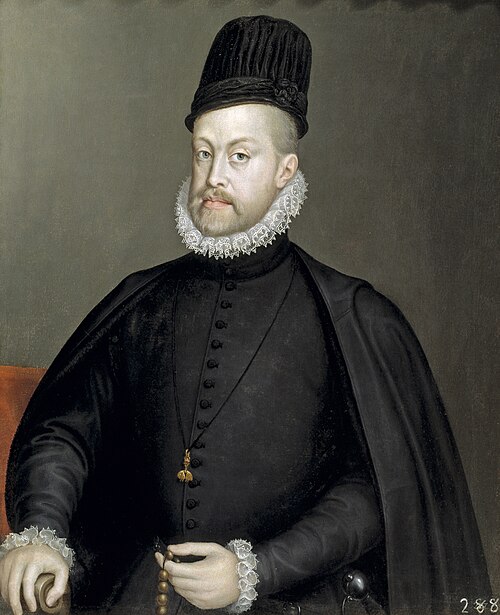
King Philip II ruled Spain from 1556 to 1598. He is remembered as a monarch of the Spanish Golden Age, a period when the Spanish Empire controlled vast territories across several continents.
The famous phrase “The empire on which the sun never sets” emerged during his reign, reflecting the global reach of Spain’s power, which extended across Europe, the Americas, and Asia, including the islands now known as the Philippines.
Philip II was the son of Holy Roman Emperor Charles V and Isabella of Portugal. Historically, he was nicknamed Felipe el Prudente or “Philip the Prudent.”
However, his reign was also marked by significant events, including the failed Spanish Armada invasion of England in 1588, state bankruptcies, and religious conflicts in Europe.
As a devout Catholic monarch, Philip II sought to uphold Spain’s dominance through wars against the Ottomans and Protestants. He also expanded Spanish political influence in Europe, including through the Treaty of Joinville (1584).
Spanish Arrival and the Beginning of Colonization
Spanish involvement in the Southeast Asian archipelago began earlier, when Ferdinand Magellan—a Portuguese navigator sailing under the Spanish flag—arrived in 1521. He is often considered the first European to reach the islands.
However, Magellan’s stay was brief. He was killed in the Battle of Mactan after attempting to convert local rulers to Catholicism.
News of these new lands sparked Spain’s ambition to expand its influence in Asia. Two decades later, Villalobos’s expedition named the islands Las Islas Felipinas, and in 1565, Legazpi initiated formal colonization.
For more than 300 years afterward, the Philippines remained under Spanish rule.
Changing Names and the Traces of Colonial Rule
Over the course of history, the official name of the archipelago changed several times. In various colonial documents, the Philippines was at times referred to as Las Islas Filipinas, Las Islas del Poniente (the Islands of the West), or Archipiélago de San Lázaro.
However, as time went on, Filipinas became the most commonly used name. Later, it was adapted into English as Philippines.
The name endured even after the colonial era ended. When the United States took control of the Philippines from Spain through the Treaty of Paris in 1898, the term Philippines continued to be used in official documents.
From Spain to the United States: A Transfer of Power
After more than three centuries under Spanish rule, the Philippine independence movement began to rise in the late 19th century. Nationalist figures like José Rizal, through their writings, exposed the injustices of colonial rule and inspired widespread resistance.
The Philippine Revolution broke out in 1896, led by Emilio Aguinaldo. Although Spain eventually agreed to negotiations, the fate of the Philippines was decided without its people’s participation. In the Treaty of Paris (December 10, 1898), Spain ceded the Philippines, Guam, and Puerto Rico to the United States in exchange for 20 million U.S. dollars.
However, the Filipino people rejected this transfer of power. The Philippine–American War erupted in 1899 and lasted for two years, claiming thousands of lives. After the war ended, the United States established the Commonwealth of the Philippines in 1935 as a transitional step toward full independence.
World War II and the Birth of the Republic of the Philippines
Plans for Philippine independence were temporarily delayed when Japan invaded the country on December 8, 1941, just ten hours after the attack on Pearl Harbor. General Douglas MacArthur, who commanded both American and Filipino forces, withdrew to Australia, leaving behind his famous promise: “I shall return.”
MacArthur fulfilled that promise in October 1944, when he led a massive landing on Leyte Island. After months of intense fighting, Japan was eventually defeated. The Commonwealth government was restored, and in 1946, the Philippines officially became an independent republic.
A Name Woven Into a Long History
Since it was first called Las Islas Felipinas more than four centuries ago, the name has endured through multiple eras of foreign rule—Spanish, American, Japanese—before the country finally stood as a sovereign nation.
Although its name originated as a tribute to a Spanish king, Philippines has become an inseparable part of the nation’s historical identity. It reflects a long journey from European exploration and colonization to a hard-fought independence and the establishment of the modern republic we know today.


