


If you walk through in Greater Tangerang, Banten, such as in Teluknaga, Neglasari, Karawaci, and so on, there are Chinese community in Greater Tangerang. But when you start talking to them and even visiting their houses, you can realize that they don’t speak Chinese (Hokkien and Mandarin), they tend to speak Betawi and Banten Sundanese, but at the same time, they still retain the Qing-era wedding ceremony rather than other Chinese Indonesians. This community is called “Benteng Chinese” or more popular term is “Ciben”.
Benteng Chinese are different from Tangerang Chinese because they had come to Tangerang very long time ago before The Dutch Occupation of Indonesia and the word “Benteng” refers to the ancient name of Tangerang where Dutch East India Company built the fortress (in Indonesian, Betawi, and Sundanese called “Benteng”) as a part of defense system from Banten Sultanate. Beside Tangerang, Benteng Chinese live in several regions in Banten, Jakarta, and West Java and even the community are also found in the United States, Australia, New Zealand, and the Netherlands after the transition period of 1945–1950 of Indonesia.
The history of arrival of Benteng Chinese to Tangerang based on Sundanese historical record called Tina Layang Parahyang (Notes from Parahyangan) that mentions the arrival of Chinese people in the Tangerang area. The record tells the story of the landing of a fleet of ships led by Tjen Tjie Lung or Halung around 1407 at the mouth of the Cisadane, now known as Teluknaga, specifically in Kampung Melayu. At that time, the seat of government was in Tegal Luar (the highland region) ruled by Sanghyang Anggalarang as the representative of Sanghyang Banyak Citra from a kingdom in the Parahyangan region. The Halung group's ship was stranded due to damage and ran out of supplies. Their original destination was Jayakarta (Jakarta). Their departure from their ancestral land was caused by the fact that at that time, war was raging incessantly, therefore, the search for a more decent livelihood was often undertaken.
Evidence of the early life of the indigenous people and the presence of a number of Chinese people before and beginning of the AD can be found in several discoveries at the Serpong Site, Rawa Kidang Site, Sugri Site, and Kramat Tangerang Site. At these sites, bones, bronze axes belonging to the Dongson culture, pottery, stone coffins, bowls and plates made in China were found. The Halung group consisted of at least seven families, or around 100 people, who were on the shipwreck. They then went to Sanghyang Anggalarang to ask for help. The group also included nine young women and small children. The nine young women were beautiful. Because of their beauty, they were able to make the Anggalarang guards fall in love with them, and eventually the nine young women were married to them.
As compensation, the Halung group was given a plot of land on the north coast of Java, east of the Cisadane River, which is now called Kampung Teluknaga. In addition to the nine girls, many of Chinese men married local girls because, in general, they rarely brought wives with them. It was only after 1850, when their lives had been stabled, that they returned to their hometowns to bring back relatives and family members for those who had married.
The second wave of Chinese arrivals in Tangerang is estimated to have occurred in 1740. At that time, there was a rebellion by the Chinese due to the decision of Governor-General Valkenier to arrest Chinese people who were suspected. The Chinese community's rebellion in 1740 led to the massacre of around 10,000 innocent Chinese people by the Dutch East India Company and the burning of their homes. Many of the Chinese fled to Tangerang and the surrounding area to save themselves. The Dutch East India Company then sent the remaining Chinese to Tangerang to farm.
The Dutch established settlements for the Chinese in the form of huts that are still known today as Pondok Aren, Pondok Cabe and so on. Around Tegal Pasir or Kali Pasir, the Dutch established a Chinese settlement known as Petak Sembilan. Petak Sembilan was one of the precursors to the city of Tangerang, a place inhabited by the Chinese community.
This settlement later developed into a trading centre and became part of the city of Tangerang, the Pasar Lama area today, as the first settlement for the Chinese community in Tangerang. Later, the Chinese people in this area built the Boen Tek Bio Temple/文德廟 (Mandarin: Wen-de Miao, Boen/文= Literature, Tek/德= Virtue, Bio/廟 = place of worship) in 1684, and it is currently the oldest building in Tangerang. At the end of the 1800s, a number of Chinese people were moved to the Pasar Baru, Tangerang, and since then began to spread to other areas such as Mauk, Serpong, Cisoka, Legok, and even as far as Parung in the Bogor area. That is why many Chinese people live in the remote villages of Tangerang. It is also mentioned that Pasar Baru in the past was a place of trade for Chinese people who came by river with the local population.
In Dutch administration era, many ethnic-Chinese allies and officials of the Dutch colonial authorities held office or so-called Kapitan Cina (Captain of The Chinese) and owned landed estates (particuliere landerijen) in the historic Tangerang area. According the Benteng Chinese descent historian Mona Lohanda say that "Tangerang was practically a Chinese private domain". These landlords and bureaucrats also sponsored a large-scale migration of Chinese indentured laborers, who played a crucial role in the agricultural and economic development of the region.
It remained peaceful until the era of the Independence of Indonesia. In the Indonesian revolution from 1945 to 1949, the tension between Benteng Chinese and Indigenous were arisen when many Benteng Chinese perceived to be in favour of the Dutch colonial status quo. On 23 June 1946, riots targeting Benteng Chinese homes broke out in Tangerang, where revolutionary militiamen sympathetic to the Indonesian Republican cause looted Chinese possessions, including Chinese prayer tables. These riots were apparently triggered by placement of an Indonesian flag with a Dutch flag by a Dutch colonial army of Chinese descent. Indonesian journalist Rosihan Anwar wrote in the Merdeka daily on 13 June 1946 that relationship between indigenous and Chinese Indonesians had reached an all-time low.
Conditions worsened after Pao An Tui, a pro-Dutch Benteng Chinese youth group, mobilized armed groups to evacuate Benteng Chinese residents to Batavia. Anti-Chinese rioting was successfully suppressed by the alliance of Pao An Tui and Dutch colonial troops. At the time, nearly the entire Benteng Chinese population was displaced, and upon returning, they found that their properties were no longer intact, such as their land holdings had been confiscated or their homes had been looted.
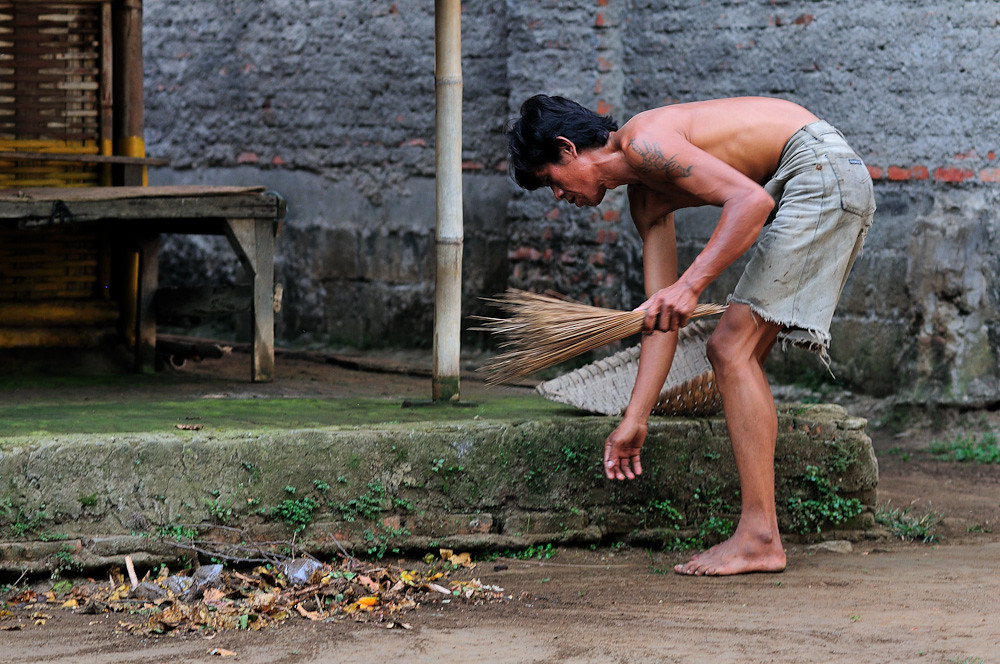
Because of long process of intermarriage between Benteng Chinese with indigenous people in Banten, such as Betawi and Sundanese, they look different in physical appearance and complexion rather than other Chinese Indonesians. It happens in not only in Benteng Chinese, but another Peranakan Chinese in Malaysia, Singapore, Indonesia, and Thailand. For them, they call themselves as Hitachi (“Hitam tapi Cina” means “Tan but Chinese”, due to tan complexion on their appearance). Majority are no longer speaking Chinese, especially Hokkien and Mandarin Chinese, instead they speak Banten Sundanese, Betawi and Indonesian with the hint of Hokkien loanwords. Many Benteng Chinese’s livelihoods are becak (pedicab or cycle rickshaw) riders, farmers, cattlemen, or even shopkeepers.
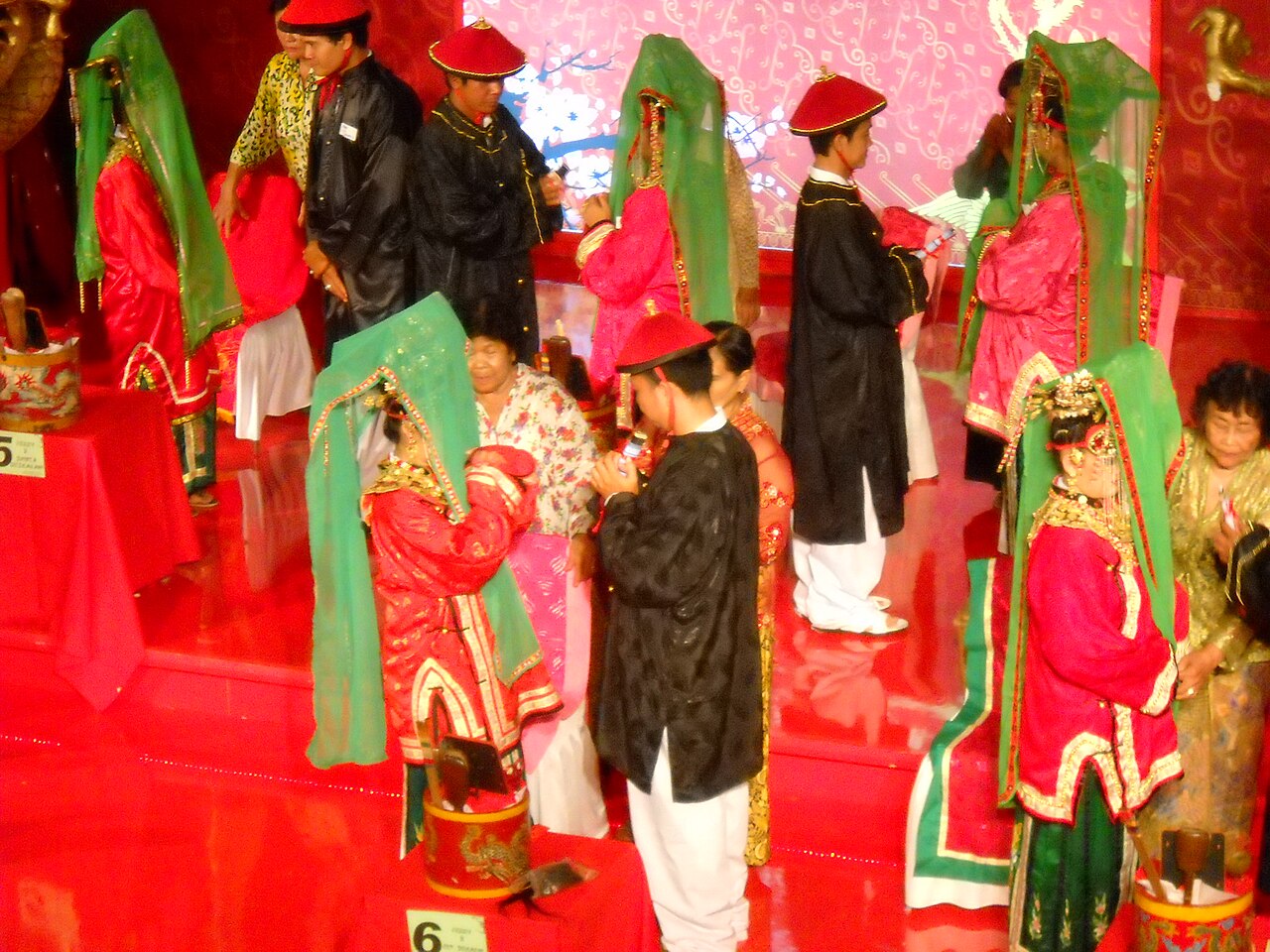
Benteng Chinese people still preserve their traditions and cultures. Cio Tao, a sacred wedding ceremony as the result of Chinese and local Indonesian culture acculturation, is still practiced today and this tradition is traced back in Qing-era when many Benteng Chinese had settled down in Tangerang before the Dutch administration of Indonesia.
The traditional Cio Tao wedding process begins with the bride and grooms’ parents sending prayers to Thien — a divine figure considered to be The Almighty — and to the families’ ancestors. Various offerings are presented on the altars. Parents proceed to light candles for their soon-to-be wedded children as a symbol of guidance and love. The bride and groom must also pray at the altars to honor deceased ancestors. Wine is then poured underneath the altar of Thien.
Next comes the Cio Tao ceremony. In Hokkien Chinese, Cio Tao means “to comb”. The bridal hair is decorated with 21 flower-shaped accessories made of either brass, copper, silver, or gold. These metal flowers are called kembang goyang. The bride must then wear a red dress, a long green skirt underneath, and a neckpiece covered in gems. The groom is made to wear a black robe and a traditional Chinese headpiece in red. Money is given to both the bride and groom as provisions to be used later on in the pair’s lives.
Subsequently, the bride and groom are gathered with two young children to carry out the 12 Bowls tradition. Parents then cover the bride’s face with a green veil. Coins are thrown around for guests to pick up. This act is called saweran, which is a traditional custom borrowed from Indonesian culture. Previously, saweran used yellow rice from China. However, limitations encouraged Indonesians to replace it with coins, which is how this custom came to be common within Chinese Indonesians, especially to the Benteng Chinese. The groom unveils the bride. The act of veiling and unveiling represents the bride being sent off to a new household. Afterwards, the newly wedded couple feed each other traditional cakes and desserts, such as onde, agar-agar, kue lapis, ronde, and bika ambon.
These cakes are also the result of fusing Chinese and Indonesian cultures. To mark the end of the wedding ceremony, a tea drinking tradition called teh pai is commenced. This tradition is also carried out to honor each family’s living elders
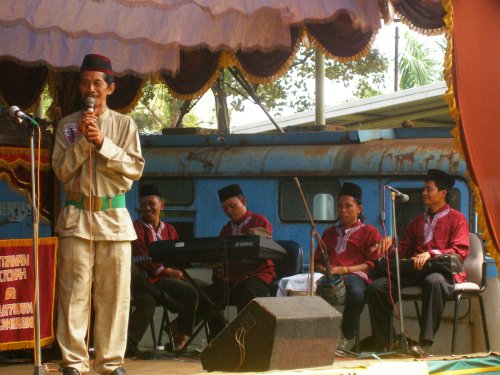
Another Benteng Chinese tradition and culture is Gambang Kromong. Gambang Kromong is a traditional music from Greater Jakarta, including Tangerang and sometimes it is played in some occations, including Benteng Chinese wedding ceremony.
According to a historian and content creator from Benteng Chinese descent, Nilsen Kwa, Gambang Kromong is a mixture of Traditional Chinese music from Fujian and indigenous musical instruments such as gendang, kempul, and kromong. The song that are played with Gambang Kromong are Pobin songs, such as Kong Djie Lok, Ban Kim Hoa, Ma To Djin, Peh Pan Tao, Pat Sian Kwee Hai, Si Djin Kui Hwee, etc. Many songs that are played in Gambang Kromong use Traditional Chinese partiture. Many Pobin songs are no longer played in recently, except Pobin Kong Dji Lok which is often heard until today.
The existence of Benteng Chinese can be proved that combination and intermarriage of Chinese and indigenous can’t be avoided. Through interaction and cultural contact, acculturation will occur. However, this does not mean that it will replace the original culture, but it will create a new culture that complements each other.
Sources:
- Antakara. The Chinese Benteng: Preserving Tradition in the Midst of Modernization. Medium. Published in 23 December 2022.
- Institute of Southeast Asian Studies. 1997. Political Thinking of the Indonesian Chinese, 1900-1995: A Sourcebook. Singapore: NUS Press.
- Kwa, Nilsen. Leluhur dari Musik Gambang Kromong. TikTok. Published in 6 September 2023.
- Leo, P.J. The Life of Benteng Chinese. The Jakarta Post. Published in 31 March 2012.
- Lohanda, Mona. 1996. The Kapitan Cina of Batavia, 1837-1942: A History of Chinese Establishment in Colonial Society. Jakarta: Djambatan.
- Mozingo, David. 2007. Chinese Policy Toward Indonesia, 1949-1967. Singapore: Equinox Publishing.
- Mengintip Sejarah Cina Benteng di Tangerang. BBC News Indonesia. Published in 18 June 2013.
- S., Euis Thresnawaty. Sejarah Sosial-Budaya Masyarakat Cina Benteng di Kota Tangerang (Social-Cultural History of Cina Benteng in Tangerang City). Published in 20 January 2015. Vol. 7, no. 1 (2015), DOI: https://doi.org/10.30959/patanjala.v7i1.83.
- Widianto, Stanley. Cara Cina Benteng Mempertahankan Tradisi Sekaligus Membuka Diri Pada Budaya Setempat. Vice Indonesia. Published in 16 May 2018.
- Willmott, Donald E. 2009. The National Status of the Chinese in Indonesia 1900-1958. Sheffield: Equinox Publishing.
This article was created by Seasians in accordance with the writing rules on Seasia. The content of this article is entirely the responsibility of the author.


