


Amid the world’s bustling, crowded capitals, dense with symbols of power, Naypyidaw stands as an anomaly. Myanmar’s capital is often described as one of the strangest cities on Earth: vast in scale, monumental in infrastructure, yet almost devoid of the pulse of daily life.
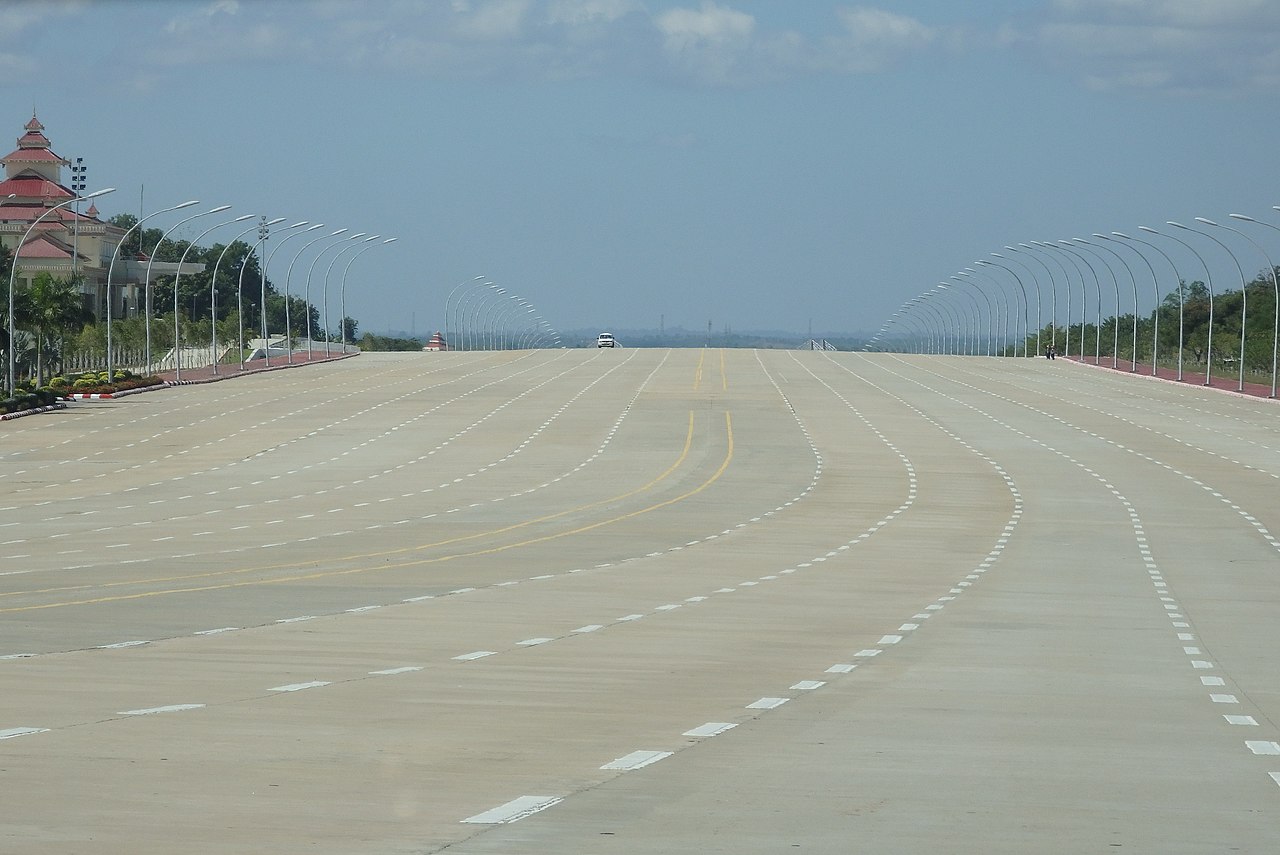
Twenty-lane highways stretch eerily empty, government buildings rise in grandeur without crowds, and large hotels wait for guests who rarely arrive. This is Naypyidaw, a capital city shaped not by centuries of history, but by a sudden decision of a military regime.
A Capital Move That Ended in Isolation
Myanmar (formerly known as Burma) has a long history of relocating its capitals. Since the era of ancient kingdoms, shifts in political centers have been common, particularly in Southeast Asia.
Cities such as Pagan (Bagan), Mrauk U, Ava, Amarapura, and Mandalay once served as seats of power, each during different periods of prominence. Pagan alone endured as a civilizational and temple-building center for 447 years.
In the modern era, however, Yangon held capital status for 143 years. The city embodied classical symbols of authority: the iconic Shwedagon Pagoda, grand colonial architecture, and a central role in the nation’s political and economic life.
There were no clear signs that this status would end, until a startling decision was made in 2005.
On Sunday morning, November 6, 2005, without any public announcement, convoys of trucks carrying ministry documents and equipment quietly departed Yangon for a remote site roughly 320 kilometers to the north.
Their destination was Naypyidaw, a new city that had been built in secrecy since 2002. The name Naypyidaw itself means “the abode of kings.”
A Giant City in Isolation
Geographically, Naypyidaw lies far from Myanmar’s main population centers. The city spans an area of roughly 7,000 square kilometers—four times the size of London and six times that of New York—yet is home to fewer than one million residents. This scale makes it one of the world’s least densely populated capital cities.
Naypyidaw’s infrastructure reflects vast ambition: highways up to 20 lanes wide, enormous roundabouts, a sprawling and heavily guarded parliamentary complex, and rigidly separated urban zones.
There are designated districts for ministries, the military, residential areas, hotels, recreation, golf courses, a zoo, and massive sports facilities built for the 2014 Southeast Asian Games. Two large stadium complexes were even constructed almost identically, despite being located 35 kilometers apart.
Yet all of this exists in near silence. The highways are often empty, so much so that they once served as the setting for a football match staged by Top Gear in 2014.
On some stretches, water buffalo can be seen resting casually in the middle of the road. There are no traffic jams, no urban clamor.
Monumental Infrastructure, Sparse Life
Officially, the relocation of the capital was framed as a solution to Yangon’s congestion and a push toward modernization. Many observers, however, argue that the primary motivations were political and strategic.
By building the capital deep inland, the military created distance from urban centers prone to political unrest. Naypyidaw was designed to be isolated, easy to secure, and difficult for mass movements to surround.
The city’s layout reinforces this impression. There is no organically developed city center. Vast blocks are separated by long distances, making daily life heavily dependent on vehicles.
In residential areas, even rooftop colors are coded according to the ministry where residents work. Access to the parliamentary zone is tightly restricted, surrounded by moats, fences, and heavy security.
The cost of construction is equally staggering. The Myanmar government is estimated to have spent between USD 4 and 5 billion on Naypyidaw, an enormous sum for a country whose annual GDP at the time was around USD 10 billion.
Naypyidaw has ultimately become a singular symbol: a capital shaped not by the needs of its citizens, but by fear and the strategies of power. As political conflict has again engulfed Myanmar since the 2021 coup, the city remains quiet—maintaining its role as a fortress of authority, far from the turbulence of the streets.


