Deep within the rainforests of Sulawesi and the limestone cliffs of Bantimurung, lives a creature that seems borrowed from another planet. It weighs less than a chocolate bar, fits neatly in the palm of a human hand, and yet possesses one of the most extreme visual systems ever produced by evolution.
This is the tarsier, often overlooked in favor of Southeast Asia’s larger icons like elephants or orangutans, the tarsier is one of the region’s most extraordinary biological treasures. Its most striking feature is not its size, but its eyes. Eyes so large, so specialized, that they redefine how mammals see in the dark.
Eyes Larger Than the Brain
The most astonishing scientific fact about tarsiers lies in their anatomy. Each eye is larger than the animal’s brain. If humans had the same proportions, our eyes would be roughly the size of billiard balls.
This is not a design flaw, but an evolutionary masterpiece. Tarsiers are strictly nocturnal hunters, relying almost entirely on vision to detect prey in near-total darkness. Their oversized eyes function like light-collecting telescopes, allowing them to spot the slightest movement of insects in the forest at night.
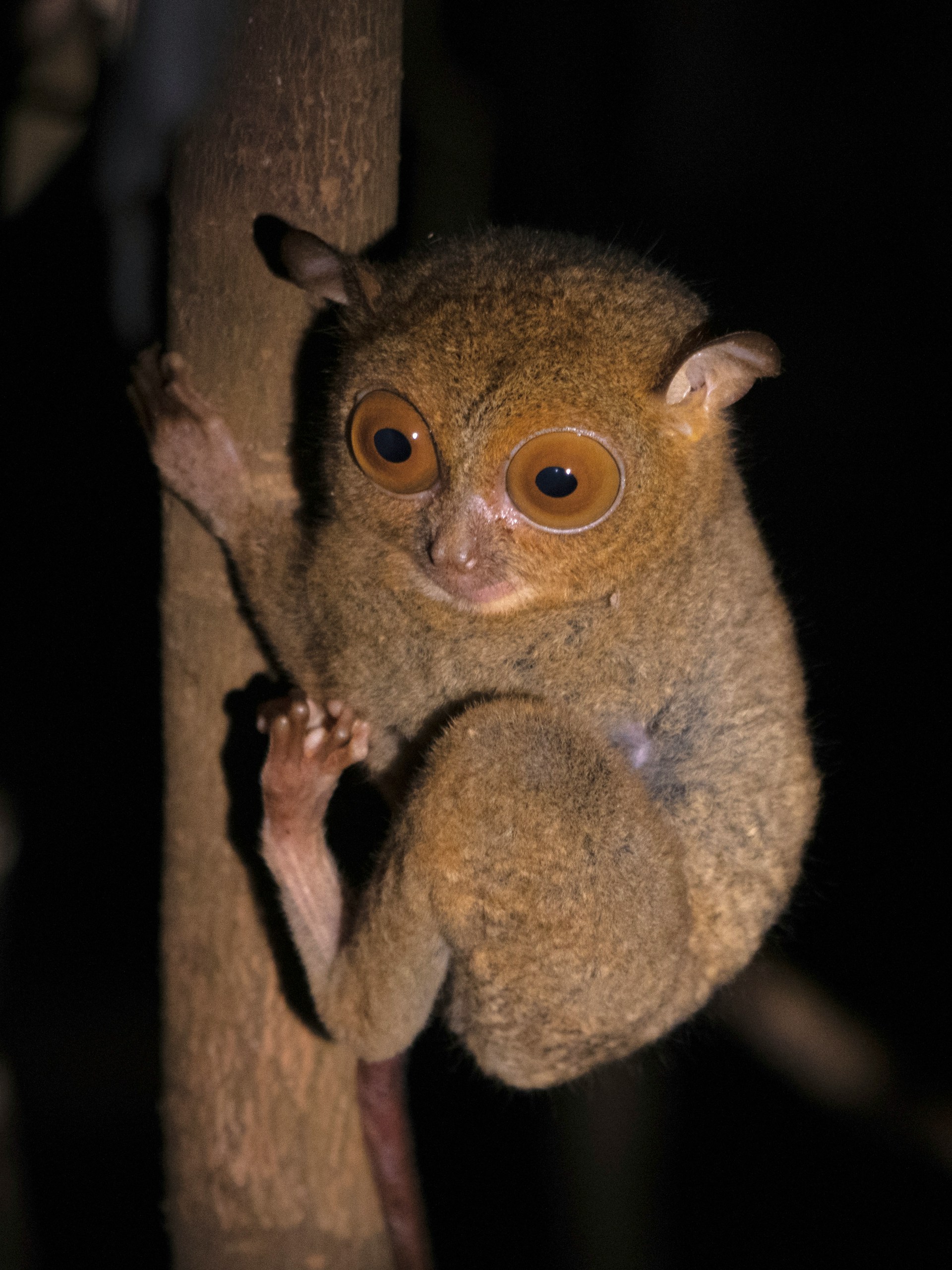
However, there is a trade-off. Because their eyes are so large, they are fixed in place. Tarsiers cannot roll their eyes or glance sideways. To compensate, evolution provided a remarkable solution: a neck that can rotate up to 180 degrees in each direction.
The result is what biologists often describe as a “living periscope”, a mammal that scans its environment not by moving its eyes, but by turning its entire head.
Why Sulawesi Became the Global Capital of Tarsiers
Indonesia is not just home to tarsiers. It is the global center of their diversity. According to researchers from IPB University, of the 15 known tarsier species worldwide, 14 are found in Indonesia. Thirteen of those species live exclusively on the island of Sulawesi. Nowhere else on Earth hosts such a concentration of tarsier diversity.
Modern DNA analysis reveals why this matters. Different regions of Sulawesi, from the northern peninsulas to southern forests and offshore islands like Buton, are home to genetically distinct tarsier populations. These differences are not cosmetic.
They represent deep evolutionary divergence, shaped by Sulawesi’s complex geology and long isolation. In other words, Sulawesi is not just a habitat. It is a natural laboratory where evolution continues to unfold.
A Predator That Hunts in Silence
Despite their delicate appearance, tarsiers are highly efficient predators. Unlike most primates, they are obligate carnivores. Their diet consists entirely of insects, small reptiles, frogs, and even birds.
Even more remarkable is how they communicate. Tarsiers use ultrasonic vocalizations, producing sounds at frequencies too high for human ears to detect. This allows them to coordinate with one another while hunting, without alerting predators or prey.
This ability places tarsiers among a very small group of mammals capable of ultrasonic communication. Combined with their visual specialization, it makes them one of Southeast Asia’s most uniquely adapted hunters.
When Evolution Meets Fragility
For all their evolutionary brilliance, tarsiers are surprisingly vulnerable. They are monogamous, highly territorial, and extremely dependent on their native habitat.
Wildlife experts, including ecologists from IPB, emphasize that tarsiers cannot survive outside their natural environment. Attempts at captive breeding or relocation consistently fail, as the animals experience severe stress and often do not survive.
The greatest threat to tarsiers is not natural predators, but human activity. Deforestation, limestone mining, and the conversion of forests into monoculture plantations continue to fragment the habitats tarsiers depend on. Once a forest patch disappears, an entire local tarsier population can vanish with it.
A Silent Guardian of Sulawesi’s Forests
Tarsiers have lived in Sulawesi’s forests for millions of years, long before humans arrived. Today, their survival depends entirely on whether those forests remain standing.
Protecting tarsiers is not about preserving a cute animal for tourism. It is about safeguarding one of Southeast Asia’s most irreplaceable evolutionary lineages. Every intact forest is a living archive of natural history, and every lost habitat is a chapter erased forever.
In the end, the tarsier is more than the world’s smallest primate. It is a reminder that some of Southeast Asia’s greatest natural wonders are not the largest, loudest, or most famous. Sometimes, they are the quiet guardians watching the forest in silence, with eyes larger than their minds.