


Across the remaining forests of South and Southeast Asia, an endangered primate with distinctive white “spectacles” around its eyes is facing an uncertain future. Phayre’s leaf monkey (Trachypithecus phayrei), now found mainly in Northeast India, Bangladesh, and western Myanmar, is increasingly forced to adapt as its forest habitat continues to disappear.
Once dependent on dense, continuous canopies, the species is now frequently observed in secondary forests, rubber plantations, and areas close to human settlements. Conservationists warn that while this flexibility may help the monkeys survive in the short term, it is also a clear sign of severe ecological stress. The International Union for Conservation of Nature (IUCN) currently lists Phayre’s leaf monkey as Endangered, with populations estimated to have declined by more than 50 percent over the past 36 years.
What Makes the “Spectacled Monkey” Unique
Phayre’s leaf monkey is easily identified by the white rings surrounding its eyes, giving rise to its common name, the “spectacled leaf monkey.” These markings contrast with its dark bluish-brown fur, which becomes darker around the head, limbs, and tail. The species was named after Arthur Purves Phayre, a British naturalist who documented it in the nineteenth century.
Like other leaf-eating langurs, this primate has a specialized, multi-chambered stomach that allows it to digest tough leaves and neutralize plant toxins. This adaptation once gave it access to food sources that many other animals could not use, making it well suited to life in mature forests.
Once Widespread, Now Confined to Pockets of Forest
Historically, Phayre’s leaf monkey occupied a wider range across South and mainland Southeast Asia. Recent genetic and taxonomic studies, however, have narrowed its officially recognized distribution. Today, confirmed populations are concentrated in parts of Northeast India, especially Tripura, Assam, and Mizoram, as well as northeastern Bangladesh and western Myanmar.
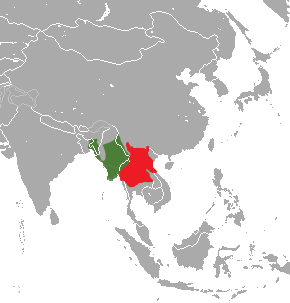
In Myanmar, populations previously thought to belong to this species have been reclassified as the Popa langur, which is now listed as Critically Endangered. This revision has further reduced the estimated population size of Phayre’s leaf monkey. Current data suggest that around 1,200 individuals remain in India and fewer than 400 survive in Bangladesh, marking a dramatic decline from historical numbers.
Adapting the Menu When the Forest Disappears
Traditionally, Phayre’s leaf monkeys fed on a diverse range of forest vegetation, including leaves, shoots, fruits, flowers, and bamboo. In areas where forests remain relatively intact, their diet still changes seasonally, reflecting natural cycles of plant growth.
In heavily altered landscapes, however, researchers have documented a major dietary shift. In parts of India’s Tripura state, rubber tree leaves now make up a large proportion of the monkeys’ annual diet. Other non-native plants, such as acacia, have also become important food sources. Scientists caution that rubber plantations are monocultures and may not provide the nutritional balance these primates need for long-term health, raising concerns about the sustainability of this adaptation.
Life in the Trees, Under Growing Pressure
Phayre’s leaf monkeys are naturally shy, diurnal, and highly arboreal, spending most of their lives high in the canopy. Under normal conditions, they tend to flee immediately upon encountering humans. As forests shrink, this behavior has begun to change.
In several regions, troops have been observed entering villages to feed on garden crops such as jackfruit and vegetables, particularly during periods when forest food is scarce. Although they still prefer tall trees for resting and sleeping, their daily movements increasingly take place across fragmented landscapes that include plantations, roads, and settlements. Researchers note that rubber plantations and tea estates have become some of the few places where long-term observation is possible, simply because natural forest cover has declined so sharply.
Rubber Plantations: Refuge or Risk?
The expansion of rubber plantations has played a significant role in habitat loss, particularly in Tripura, one of India’s largest rubber-producing states. Since the late 1960s, large areas of natural forest have been converted into plantations. According to the Forest Survey of India, Tripura lost more than 160 square kilometers of forest cover between 2015 and 2017 due to development, plantation harvesting, and shifting agriculture.
While sightings of Phayre’s leaf monkeys in plantations have become more common, conservationists emphasize that this does not indicate population recovery. Instead, it reflects increasing pressure on the remaining individuals as suitable forest habitat continues to decline.
The Numbers Tell a Worrying Story
Bangladesh has experienced some of the most severe population losses. Surveys conducted in the early 1980s recorded around 1,300 individuals in northeastern forests. By 2019, fewer than 400 remained in the same region. Conservationists point out that this decline occurred over just a few generations, highlighting how quickly habitat destruction can drive a species toward extinction.
Recent taxonomic revisions have further reduced the species’ recognized range, meaning that overall population estimates are now lower than previously believed.
Can Conservation Catch Up With Change?
Phayre’s leaf monkey is legally protected in both India and Bangladesh and is listed under CITES Appendix II, which regulates international trade. The species occurs in several protected areas across South and Southeast Asia, and conservation programs focus on preventing illegal logging, reducing forest encroachment, and limiting hunting.
Experts increasingly stress the importance of working with local communities to raise awareness and promote livelihoods that reduce pressure on forests. While the monkeys’ ability to survive in plantations shows a degree of resilience, scientists agree that long-term conservation will depend on preserving and restoring natural forest habitats rather than relying on human-modified landscapes.
Why the Spectacled Monkey Matters
Beyond its distinctive appearance, Phayre’s leaf monkey plays an important ecological role as a seed disperser and an indicator of forest health. Its decline reflects broader environmental challenges affecting forests across South and Southeast Asia.
Without stronger conservation action, this adaptable yet vulnerable primate may continue its slide toward extinction, signaling not just the loss of a species but the ongoing degradation of Asia’s remaining forest ecosystems.


