


Rising from the green plains of Central Java, Borobudur is often described as the world’s largest Buddhist temple.
Yet beyond its religious and architectural identity, Borobudur can also be understood as something astonishingly mechanical: a gigantic three-dimensional puzzle made of roughly two million interlocking stones.
Without mortar, cement, or modern machinery, ancient builders assembled this monumental structure with a level of precision that continues to amaze engineers, historians, and visitors today.
How Did They Do It?

One of the most remarkable aspects of Borobudur is the way it was built. Constructed in the 8th and 9th centuries during the Syailendra dynasty, the temple consists of volcanic andesite stones stacked and locked together without any binding material.
Instead of mortar, the builders relied on a complex system of grooves, knobs, and dovetail joints that allowed each stone to fit snugly with the others. Every block had a specific place, orientation, and function, much like a piece in an enormous puzzle.
This technique required extraordinary planning. Stones were carved individually and then assembled on site in a precise sequence. A single misplaced block could compromise the stability of an entire section.
The fact that Borobudur has stood for more than a thousand years, surviving earthquakes, volcanic eruptions, and tropical weather, speaks volumes about the effectiveness of this puzzle-like construction method.
Around Two Million Parts, One Unified Design

Estimates suggest that Borobudur is composed of around two million stone blocks, each weighing up to several hundred kilograms. Despite this immense number, the structure maintains perfect symmetry and balance.
The stones form nine stacked platforms: six square terraces topped by three circular ones, crowned by a central stupa. From above, the temple resembles a mandala, a sacred geometric diagram in Buddhist tradition.
What makes this even more puzzle-like is that the stones are not interchangeable. Each block was carved to fit a specific position within the structure.
Relief panels align seamlessly across corners, drainage spouts channel rainwater through hidden paths, and staircases rise in perfect alignment on all four cardinal directions.
This level of coordination suggests the builders worked from an advanced architectural blueprint, even though no written plans have survived.
Reliefs that Lock Both Structure and Story Together
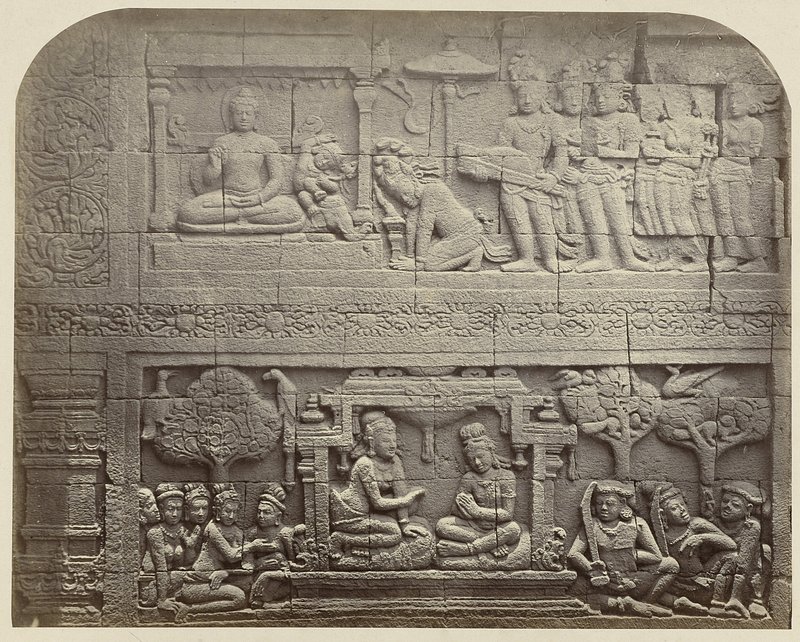
Borobudur’s walls are covered with more than 2,600 relief panels, depicting scenes from Buddhist teachings, everyday life, and royal society. These carvings are not merely decorative. They are integrated into the structural logic of the temple.
Each relief panel fits into the stone framework like an illustrated puzzle piece, contributing both to the stability of the wall and to the narrative flow of the monument.
The reliefs must be read in a specific order, as pilgrims traditionally walk clockwise around each level. This ritual movement mirrors the physical assembly of the temple itself, where every stone, path, and carving follows a deliberate sequence.
In this way, Borobudur functions as both a physical puzzle and a spiritual one, guiding visitors toward enlightenment step by step.
Engineering Genius Hidden in Plain Sight

Beyond its visible beauty, Borobudur contains hidden engineering solutions that reinforce its puzzle-like nature. The monument includes an advanced drainage system designed to handle heavy tropical rainfall.
Hundreds of spouts shaped like mythical creatures channel water away from the structure, preventing erosion and collapse. These spouts are carved from individual stones that interlock with surrounding blocks, forming a functional yet invisible network.
The builders also accounted for the natural slope of the hill on which Borobudur stands. Instead of leveling the land, they reinforced it, anchoring the puzzle of stones directly into the landscape.
This integration of architecture and environment shows an understanding of geology that rivals modern engineering.
Lost and Needed to be Reassembled Once More

Borobudur itself became a literal puzzle again centuries after its construction. Abandoned and buried under volcanic ash and jungle growth, it was rediscovered in the 19th century under the order of Sir Thomas Stamford Raffles.
Major restoration projects in the 20th century required dismantling large sections of the temple and reassembling them stone by stone.
Each block had to be numbered, studied, and placed back in its original position, much like solving an ancient jigsaw with missing pieces.
This process confirmed how precisely the stones were designed to interlock. Many blocks could only fit in one exact location, reinforcing the idea that Borobudur was conceived as a single, unified system rather than a stack of interchangeable parts.
A Massive Testament to Human Will

Seeing Borobudur as the world’s largest puzzle offers a new way to appreciate its brilliance. It is not just a religious monument or a tourist destination, but a masterwork of problem-solving, planning, and craftsmanship.
Every stone plays a role, every joint has a purpose, and every level contributes to a greater whole.
More than a thousand years after its creation, Borobudur still challenges modern understanding. Like any great puzzle, the more closely it is examined, the more its complexity reveals itself.


