


Rising gently from the interior of Bohol Island in the central Philippines, the Chocolate Hills form one of the most distinctive geomorphological landscapes in Southeast Asia.
Spread across an area of more than 50 square kilometers, this natural wonder is made up of 1,260 perfectly round mounds that appear almost artificial in their symmetry.
Their name comes from the dramatic seasonal transformation they undergo: during the dry months, the lush green grass that covers them turns brown, giving the hills the appearance of giant chocolate drops scattered across the countryside.
Geological Origins Beneath the Hills

The Chocolate Hills are primarily composed of limestone, a sedimentary rock formed from marine organisms such as corals and shellfish. Millions of years ago, this region was submerged under a shallow tropical sea.
Over time, layers of calcium carbonate accumulated on the sea floor, eventually hardening into limestone. Tectonic uplift later raised these deposits above sea level, setting the stage for the unique landforms seen today.
What makes the Chocolate Hills especially remarkable is not just their composition, but how uniformly they are shaped. Each mound is conical to dome-like, with smooth slopes and relatively consistent heights.
This uniformity hints at a long and stable geological history shaped by slow, persistent natural processes rather than sudden or violent events.
Karst Processes and Natural Sculpting

The Chocolate Hills are a classic example of karst topography, which develops when limestone is dissolved by slightly acidic water.
Rainwater absorbs carbon dioxide from the atmosphere and soil, forming a weak carbonic acid. Over thousands to millions of years, this acidic water seeps into cracks in the limestone, gradually dissolving it.
In Bohol, this dissolution occurred in a relatively even manner across the uplifted limestone plateau. Instead of forming dramatic cliffs or deep sinkholes alone, erosion worked both vertically and horizontally, leaving behind residual limestone mounds.
These mounds are what we now recognize as the Chocolate Hills, standing as remnants of a once more extensive limestone surface that was slowly worn away.
Why the Hills Are So Uniformly Round

One of the most intriguing questions surrounding the Chocolate Hills is why they are so consistently rounded. Scientists believe this shape results from a balance between erosion and rock resistance.
The limestone here has a fairly homogeneous composition, meaning it erodes at a similar rate throughout the region. Rainfall patterns, soil cover, and vegetation also contributed to smoothing the hills over time, preventing sharp edges or irregular forms from developing.
Gravity plays a role as well. As weathered material slides downslope, it naturally creates curved, symmetrical profiles. Over immense spans of time, these processes worked together to sculpt the hills into their near-perfect domes, giving the landscape its otherworldly appearance.
Climate, Vegetation, and Color Change
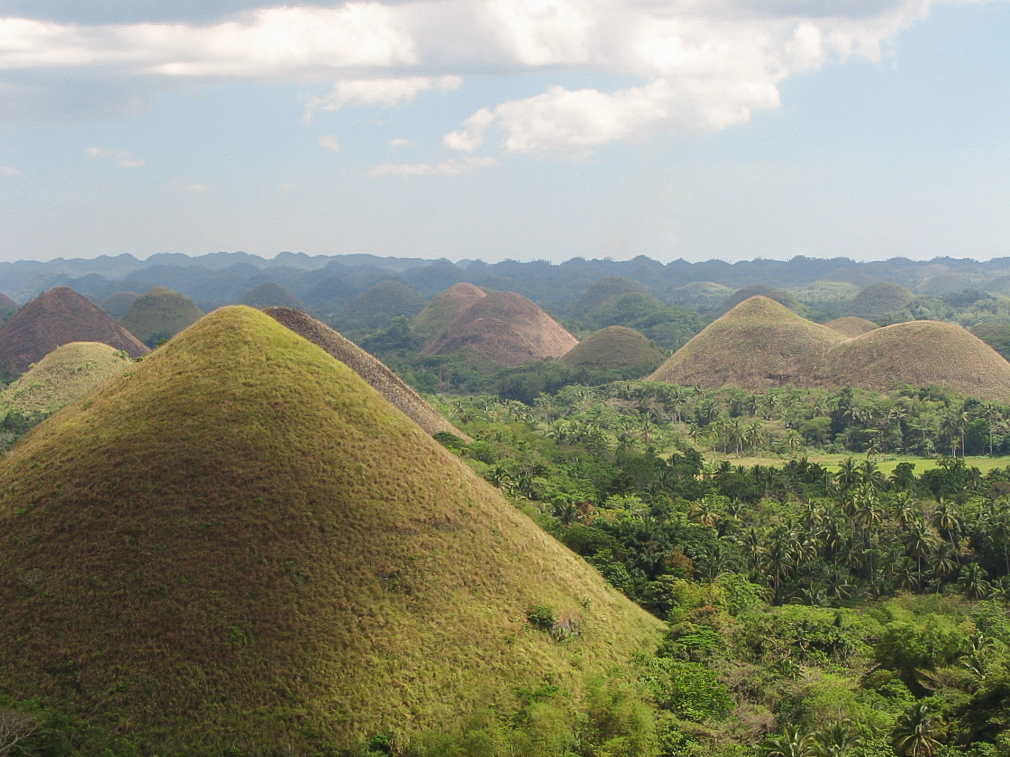
While the geomorphology of the Chocolate Hills is rooted in geology, climate adds another layer to their visual impact. The hills are covered in grasses that thrive during the wet season, turning the landscape a vibrant green.
During the dry season, these grasses dry out and turn brown, dramatically altering the hills’ color without changing their shape.
This seasonal transformation highlights the underlying landforms rather than obscuring them. When the hills turn brown, their uniform geometry becomes even more striking, emphasizing the geomorphological processes that shaped them long before humans ever saw them.
A Living Geological Heritage

Beyond their beauty, the Chocolate Hills are a valuable natural laboratory for understanding limestone landscapes and long-term erosion. They demonstrate how slow, continuous processes can produce highly organized and aesthetically powerful results.
Their preservation is important not only for tourism, but also for scientific study and environmental education.
The Chocolate Hills remind us that Earth’s surface is constantly evolving, shaped by forces that operate on timescales far beyond human lifespans.
In the quiet countryside of Bohol, the 1,260 round mounds stand as enduring evidence of the patience and precision of nature, making them one of the most extraordinary geomorphological features in the Philippines and the world.


