


Batu Caves is a complex of limestone caves and Hindu temples located in Gombak, Selangor, about 13 kilometers north of Kuala Lumpur. Within the area are several main caves, one of which is known as Cathedral Cave, also called Temple Cave. This cave houses the principal temple of the Batu Caves complex.
Despite its name, Cathedral Cave is not a Christian place of worship. The term “cathedral” refers to the vast, towering scale of the cave’s interior, while its religious function is entirely Hindu.
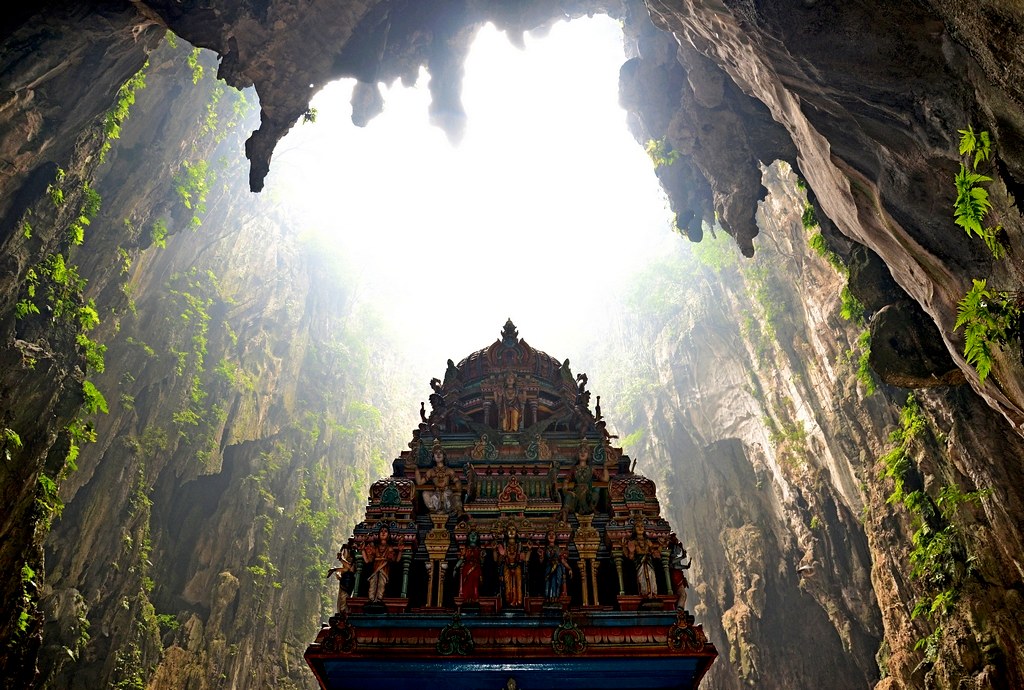
Cathedral Cave sits at an elevation of approximately 100 meters above ground level and is the largest cave in the Batu Caves complex. Its ceiling rises to nearly 100 meters, with a natural opening at the top that allows sunlight to stream directly into the cave.
Because of this natural illumination, the cave is also known as a “bright cave.” From inside, visitors can see the blue sky and the dense greenery surrounding the limestone hill.
To reach Cathedral Cave, visitors must climb 272 steps from the lower courtyard. These stairs serve as the main access route to the cave and are used daily.
At the top, visitors are greeted by the cave’s tall and wide entrance. At the far end of the cave stands the Sri Valli Devanai Murugan Temple, which serves as the main temple of Batu Caves.
From Limestone Hill to Place of Worship
Geologically, Batu Caves is a limestone hill formed around 400 million years ago. The area was originally used as a place of human settlement.
Its transformation into a Hindu place of worship is closely linked to K. Thamboosamy Pillai, a prominent Tamil leader and tin mining entrepreneur in Malaysia in the late 19th century.
He dedicated a temple inside the cave to Lord Murugan, inspired by the shape of the main cave entrance, which he believed resembled a vel, the sacred spear associated with the deity.
Standing at the front of Batu Caves is a golden statue of Lord Murugan measuring 42.7 meters in height, completed in 2006. It is the tallest Hindu deity statue in Malaysia and the second tallest in the world.
The construction process cost approximately 2.5 million Malaysian ringgit and involved 250 tons of steel, 1,550 cubic meters of concrete, and 300 liters of gold paint. Fifteen sculptors from India participated in its creation. Today, the statue has become the iconic symbol of Batu Caves.
Other Caves and Activities at Batu Caves
In addition to Cathedral Cave, the Batu Caves complex also includes the Dark Cave, which is located several meters below the main cave. This cave has no natural lighting and is not used as a place of worship.
Its main attractions are its impressive stalactite and stalagmite formations, as well as its well-preserved ecosystem, which serves as a habitat for various organisms, particularly bats.
Visitors can also explore Cave Villa, which features Hindu statues and murals, as well as the Ramayana Cave on the left side of the complex. The Ramayana Cave presents scenes from the Ramayana epic and is marked by a statue of Hanuman standing approximately 15 meters tall.
Religious activities take place daily, with Hindu devotees visiting to pray and make offerings. Batu Caves is also the primary site for the Thaipusam Festival, held annually between January and February.
Notes for Visitors
Batu Caves is open to the public and free of charge. Visitors are advised to dress modestly, arrive early to avoid crowds, and bring drinking water before climbing the stairs.
Although it is a popular tourist destination, Batu Caves remains an active religious site. Understanding its function and cultural context will allow visitors to experience Batu Caves not only as a travel destination, but also as an important part of Malaysia’s cultural and religious heritage.


