


Kuang Si Falls, located just outside Luang Prabang in northern Laos, is famous for water so intensely turquoise that many visitors assume it must be dyed, filtered, or digitally enhanced. Photos of the cascades often look exaggerated, as if saturation sliders were pushed too far.
Yet the color is entirely natural. The surreal appearance of Kuang Si Falls is the result of geology, chemistry, sunlight, and constant motion working together in a rare and visually striking balance.
A Landscape Built from Limestone

The foundation of Kuang Si Falls’ color begins underground. The region surrounding Luang Prabang is rich in limestone, a sedimentary rock composed largely of calcium carbonate.
As rainwater falls and moves through the soil and bedrock, it becomes slightly acidic and dissolves small amounts of this limestone. The water that eventually emerges at Kuang Si Falls is therefore mineral-rich long before it reaches the surface.
This dissolved limestone plays a crucial role later on, not only shaping the terraced pools that make the falls so distinctive, but also setting up the conditions that allow light to behave in unusual ways once the water is exposed to air and sunlight.
How Minerals Turn Water Turquoise

As the mineral-laden water flows over the falls, it loses carbon dioxide to the air. This causes calcium carbonate to precipitate out of the water and form tiny particles, many of them microscopic. These particles remain suspended rather than sinking immediately to the bottom.
When sunlight hits the water, these suspended minerals scatter light, especially shorter blue and green wavelengths.
The result is the striking turquoise color that appears almost neon in bright conditions. Unlike murky rivers that absorb light, Kuang Si’s water reflects and scatters it, giving the pools a glowing, opaque appearance.
This effect is similar to what happens in certain alpine lakes and Caribbean shallows, but it is far rarer in tropical waterfalls.
The Role of Sunlight and Depth

Light is just as important as chemistry in creating the surreal color. Kuang Si Falls is best known for its multi-tiered pools, many of which are shallow with pale limestone bottoms.
Shallow water allows sunlight to penetrate easily and bounce back toward the viewer. Because the bottom is light-colored rather than dark or muddy, it reflects even more light upward.
At the same time, the surrounding jungle canopy filters sunlight in a way that enhances contrast.
Bright patches of sun hit the pools while nearby areas remain shaded, making the turquoise appear even more vivid by comparison. During midday, when the sun is high, the water can look almost electric.
Constant Motion Keeps the Color Alive

Another key factor is movement. Kuang Si Falls is not a still lake but a constantly flowing system of cascades, pools, and channels. This movement keeps calcium carbonate particles suspended in the water rather than allowing them to settle completely.
The turbulence also prevents algae and sediment from accumulating in large amounts, which would otherwise dull the color.
Because the water is continuously refreshed, it stays clear and bright. In slower or stagnant water bodies with similar mineral content, the color effect would likely fade or change over time. At Kuang Si, motion preserves the illusion of glowing, artificial color.
Why the Water Looks Too Perfect to Be Real?
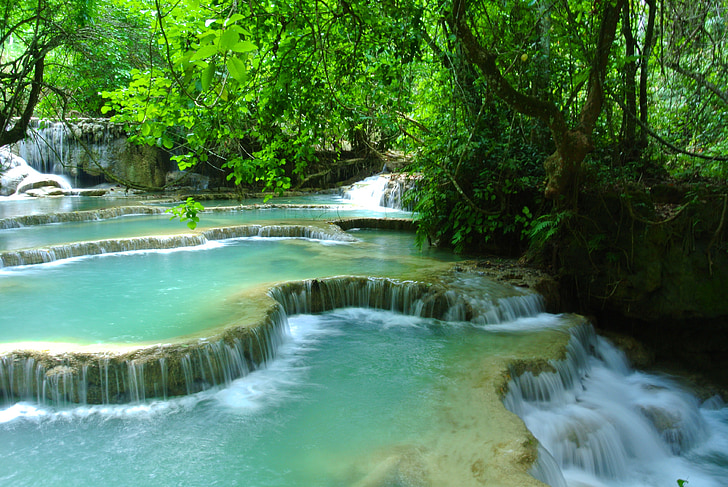
The human eye is not accustomed to seeing such intense color in natural freshwater environments. Turquoise shades are more commonly associated with tropical seas, swimming pools, or edited images.
At Kuang Si Falls, the combination of mineral scattering, shallow depth, pale rock, and tropical sunlight pushes the color into a range that feels unnatural, even though it is not.
Modern photography amplifies this perception. Digital cameras tend to capture saturated blues and greens very efficiently, often making the water look even more vivid than it appears in person. This reinforces the belief that the falls must be enhanced or altered in some way.
A Fragile Natural Phenomenon

Despite its bold appearance, the conditions that create Kuang Si Falls’ color are delicate. Changes in water flow, pollution, or upstream development could alter mineral balance or introduce sediment that dulls the water.
The surreal beauty of the falls depends on a finely tuned natural system that has developed over thousands of years.
Kuang Si Falls looks artificial because it represents a rare convergence of geology, chemistry, light, and motion.
Limestone-rich water filled with microscopic minerals, shallow reflective pools, constant flow, and tropical sunlight combine to create one of nature’s most improbable color displays.
What seems too perfect to be real is, in fact, a reminder that natural processes can still outdo human imagination.


