


The largest sauropod fossil ever officially identified in Southeast Asia has just been confirmed, and it comes from Thailand. The dinosaur, named Nagatitan chaiyaphumensis, lived around 100–120 million years ago, measured approximately 27 meters in length, and weighed about 27 tons—the equivalent of nine adult Asian elephants.
The findings were published in the journal Scientific Reports by a team of scientists from University College London, Mahasarakham University, Suranaree University of Technology, and Sirindhorn Museum.
Its name carries layered meanings: “Naga” refers to the mythical serpent figure in Southeast Asian folklore, “titan” refers to the giants of Greek mythology, and “chaiyaphumensis” means “from Chaiyaphum,” the province where the fossil was first discovered.
A 27-Ton Giant from the Cretaceous Period
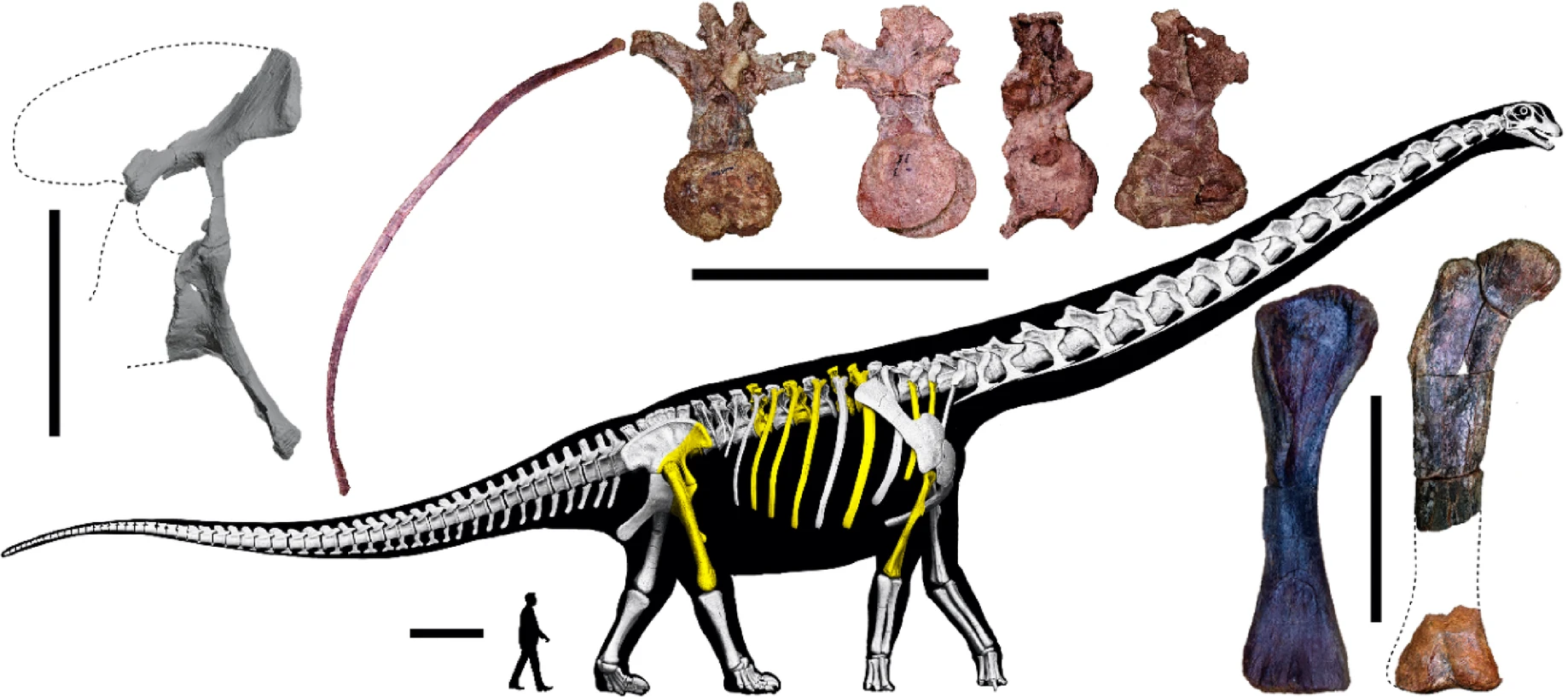
Nagatitan lived during the Early Cretaceous period, around 40 million years before Tyrannosaurus rex appeared. At 27 meters long and weighing 27 tons, it exceeded Diplodocus carnegii by more than 10 tons, although it was still far smaller than the largest sauropods such as Patagotitan, estimated at around 60 tons, or Argentinosaurus, which may have reached 90 tons.
The fossils recovered include vertebrae, ribs, parts of the pelvis, and two leg bones, one of which measured 1.78 meters long. Weight estimates were calculated based on the dimensions of the humerus and femur.
Nagatitan belonged to the sauropod family, the group of long-necked herbivorous dinosaurs that also includes Brontosaurus and Diplodocus. More specifically, it was part of the Euhelopodidae subgroup, which has so far only been found in Asia. Its closest relatives, the titanosaurs, have been discovered across multiple continents, including Antarctica.
Its habitat is believed to have been a meandering river system within a semi-arid environment inhabited by fish, freshwater sharks, and crocodiles. Nagatitan likely coexisted with other herbivorous dinosaurs such as iguanodontians and ceratopsians, as well as large predators from the carcharodontosaurian and spinosaurid groups.
The largest predators in this ecosystem were estimated to be around 8 meters long and weigh about 3.5 tons—far smaller than Nagatitan, which, at full size, likely faced very little threat from predation.
“At full size, Nagatitan likely had very little to fear in terms of predation,” said Sethapanichsakul.
The discovery has also been linked to Earth’s climate conditions at the time. One of the study’s co-authors, Paul Upchurch from UCL, noted that atmospheric carbon dioxide levels were increasing alongside high global temperatures.
“Sauropods seem to have become particularly large at this time, with gigantic forms living in South America, China, probably North Africa, and now with Nagatitan a fairly large one in Southeast Asia,” he said.
The Last Titan That May Never Be Repeated
Nagatitan chaiyaphumensis is the 14th dinosaur species to be named in Thailand and also the youngest geologically. Lead researcher Thitiwoot Sethapanichsakul described it with a distinctive term.
“We refer to Nagatitan as ‘the last titan’ of Thailand. That is because it was discovered in Thailand’s youngest dinosaur-bearing rock formation.”
He added that the discovery could represent the last giant sauropod species to be identified in Southeast Asia.
Thailand is considered the third-richest country in Asia in terms of dinosaur fossil diversity. Sethapanichsakul noted that a large collection of sauropod fossils still remains formally undescribed, and some of them may potentially represent entirely new species. A full-scale reconstruction of Nagatitan is now displayed at Thainosaur Museum.


