


On June 14, 2026, students, parents, and education enthusiasts gathered at Gandhi Memorial Intercontinental School in Central Jakarta for the Study in Kazakhstan Exhibition 2026, an event that showcased Kazakhstan's growing appeal as an international education destination and highlighted the expanding partnership between Indonesia and Kazakhstan.
More than an education exhibition, the fair reflected a broader story of two nations seeking to strengthen ties through knowledge, innovation, trade, and people-to-people exchanges. Eleven leading Kazakh universities participated, offering Indonesian students information on English-taught programmes, scholarships, affordable tuition fees, and academic opportunities in fields ranging from engineering and information technology to aviation, artificial intelligence, water management, and energy studies.
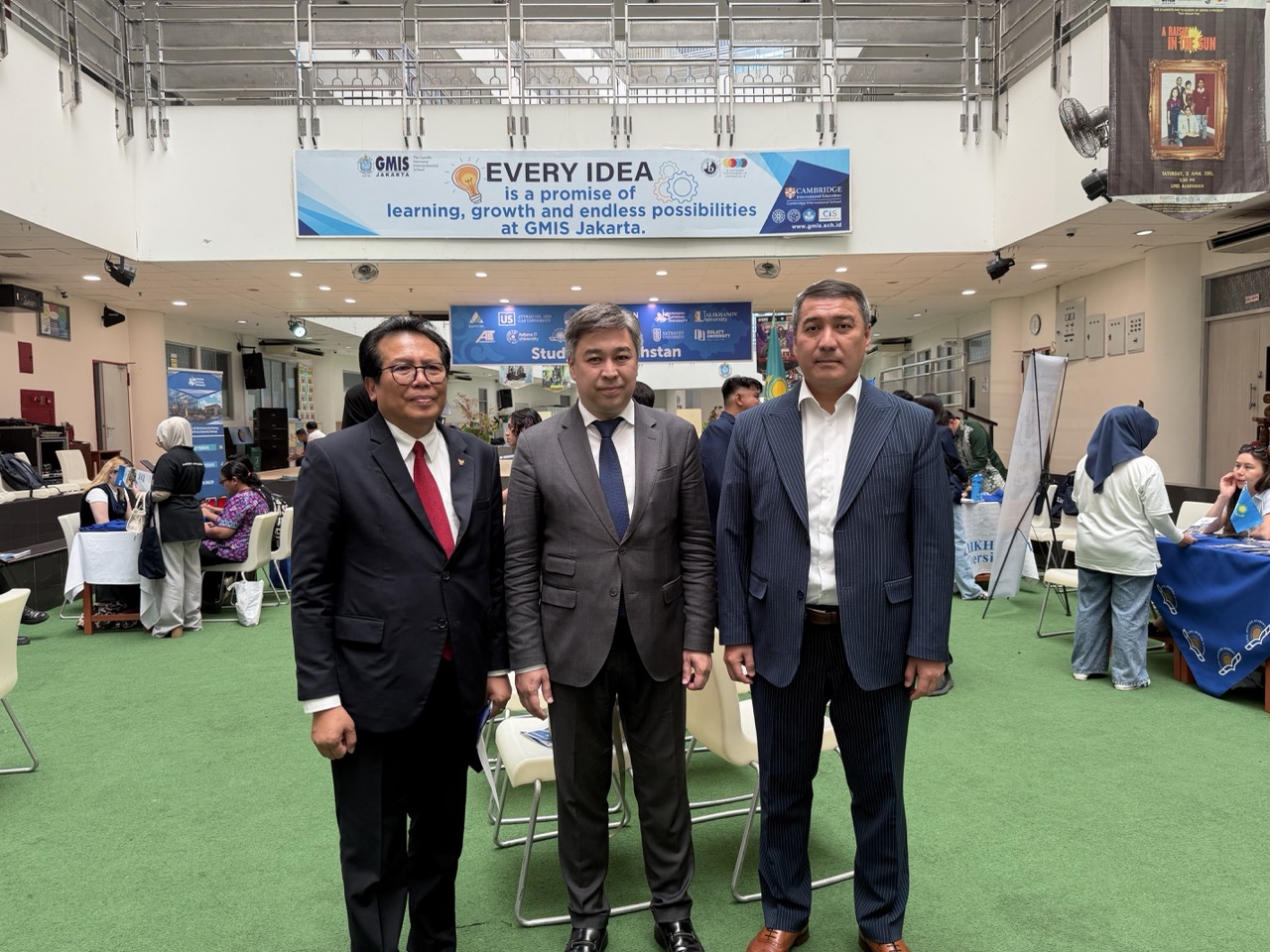
The significance of the fair was underscored by the presence of H.E. Serzhan Abdykarimov, Ambassador of the Republic of Kazakhstan to the Republic of Indonesia and to ASEAN; Serik Kalkamanov, Director of the Department of International Cooperation of Kazakhstan's Ministry of Science and Higher Education; and Dr. Mochamad Fadjroel Rachman, Indonesia's Ambassador to Kazakhstan, who traveled from Astana to attend the event.
Ambassador Abdykarimov emphasized that educational cooperation remains one of the most effective ways to deepen bilateral relations. He expressed hope that the university fair would encourage more Indonesian students to pursue higher education in Kazakhstan while expanding academic exchanges in the opposite direction. According to him, stronger educational links will ultimately strengthen people-to-people ties and mutual understanding between the two countries.
Education as a Strategic Partnership
The participating institutions included Satbayev University, Astana IT University, Eurasian National University, ALT University, Dulaty University, Margulan University, D. Serikbayev East Kazakhstan Technical University, Ualikhanov University, Atyrau Oil and Gas University, Kazakh National University of Water Management and Irrigation, and the Civil Aviation Academy.
Serik Kalkamanov explained that the primary objective of the fair was to position Kazakhstan as an emerging international education hub and attract more Indonesian students to study in the country. He noted that Indonesia's growing economy and youthful population make it a valuable partner for educational collaboration. In addition to government scholarship opportunities, he highlighted that tuition fees at many Kazakh universities remain affordable and competitive, while the government also assists international students throughout the visa application process.
Representatives from Shokan Ualikhanov Kokshetau University and ALT University further highlighted Kazakhstan's strengths in higher education. Zhailagul Sagyndykova, Vice Rector of Ualikhanov University, emphasized the institution's strong academic reputation, expanding international partnerships, and opportunities for Indonesian students. Meanwhile, Aizada Sarina, Director of International Cooperation at ALT University, showcased the university's expertise in logistics, engineering, artificial intelligence, and the digital economy, along with its smart dormitories equipped with facial-recognition access systems. She also presented visitors with university keychains designed and 3D-printed by students, reflecting the institution's emphasis on innovation and hands-on learning. Both officials encouraged Indonesian students to explore study opportunities in Kazakhstan and become part of a growing educational partnership between the two countries.
The educational engagement did not end with the university fair. On 15 June 2026, representatives from Kazakh and Indonesian universities convened at Universitas Multimedia Nusantara (UMN) in Tangerang for an Inter-University Forum aimed at strengthening academic cooperation. The forum provided a platform for higher education institutions from both countries to explore future partnerships, research collaboration, faculty exchanges, and student mobility programmes. The discussions reflected a shared commitment to expanding educational linkages and developing long-term institutional relationships that can support the growing partnership between Indonesia and Kazakhstan.
For many Indonesians, Kazakhstan remains a relatively unfamiliar study destination compared to Europe, North America, Australia, or East Asia. Yet the country has invested heavily in modernizing its higher education system and research infrastructure, positioning itself as one of Central Asia's leading centers of learning and innovation.
A Partnership Three Decades in the Making
The growing educational relationship reflects a broader diplomatic partnership that has steadily evolved over the past three decades. Indonesia and Kazakhstan established diplomatic relations on June 2, 1993, shortly after Kazakhstan gained independence.
Institutional ties strengthened with the opening of Indonesia's embassy in Astana in 2010 and Kazakhstan's embassy in Jakarta in 2012.
Today, both countries view each other as strategic partners linking Southeast Asia and Central Asia. As modern Muslim-majority nations that embrace diversity, moderation, and international cooperation, Indonesia and Kazakhstan share many common values despite being separated by thousands of kilometers.
Expanding Trade and Connectivity
The relationship received renewed momentum in May 2026 when Indonesia's Coordinating Minister for Economic Affairs, Airlangga Hartarto, led a high-level delegation to Astana as part of a broader Eurasian economic mission.
A key achievement of the visit was the revival of the Indonesia–Kazakhstan Joint Commission on Economic Cooperation, which had been inactive since 2013. Co-chaired by Minister Hartarto and Kazakhstan's Deputy Prime Minister and Minister of National Economy Serik Zhumangarin, the meeting reaffirmed both countries' commitment to strengthening trade, investment, logistics, and innovation cooperation.
The discussions followed the signing of the Indonesia–Eurasian Economic Union Free Trade Agreement (Indonesia–EAEU FTA) in late 2025. Through this framework, Indonesia sees Kazakhstan as a strategic gateway to a broader Eurasian market valued at approximately US$2.56 trillion.
During meetings with Prime Minister Olzhas Bektenov, both countries explored ways to increase bilateral trade beyond the US$244.7 million recorded in 2025. Kazakhstan offered Indonesia access to key transport corridors linking Central Asia and Europe, helping overcome logistical challenges associated with its landlocked geography. Discussions also focused on expanding Indonesian exports, strengthening Islamic finance cooperation, and exploring opportunities in renewable energy, geothermal development, and mineral processing.
Innovation and the Next Generation
One of the most promising areas of collaboration lies in technology and digital transformation. Kazakhstan has designated 2026 as the "Year of Digitalization and Artificial Intelligence," a priority that aligns closely with Indonesia's rapidly expanding digital economy.
During the Astana visit, Indonesian officials engaged with Kazakhstan's Alem.ai innovation center to explore cooperation in artificial intelligence, e-governance, digital infrastructure, and technology-driven public services. These priorities were also reflected in the university fair, where many institutions highlighted programmes in AI, information technology, engineering, aviation, and scientific research.
Dr. Mochamad Fadjroel Rachman encouraged Indonesian students to look beyond conventional academic disciplines and consider specialized fields in which Kazakhstan has developed particular strengths. He cited areas such as Central Asian studies, astronautics, glaciology, and advanced engineering as examples of disciplines where Indonesian students could acquire unique expertise and return home as pioneers in emerging sectors.
Looking Toward a New Chapter
For students attending the university fair, these developments represent more than diplomatic milestones. They signify scholarships, research opportunities, international experiences, and future careers. As Indonesia and Kazakhstan enter their fourth decade of diplomatic relations, education is emerging as one of the strongest foundations of future cooperation.
The university fair demonstrated that enduring partnerships are built not only through government agreements and trade statistics, but also through classrooms, laboratories, research collaborations, and the aspirations of young people. From Jakarta to Astana, a new generation is helping shape the future of Indonesia–Kazakhstan relations—one student, one idea, and one opportunity at a time.


